
ASIA HAS LONG been in love with property. After the early Chinese traders had made their first fortunes, they promptly made second ones buying property. From the wharves and go-downs of Hong Kong and Singapore to the shiny office towers and air-conditioned shopping malls that grace any major Asian city, local entrepreneurs have grown wealthy on the asset inflation gleaned from bricks and mortar.
If bankers and analysts are right, Asia now stands on the threshold of another property boom, this time courtesy of the capital markets. As governments, listed conglomerates and public and private property companies continue to shift assets from their balance sheets into listed investment vehicles – real estate investment trusts – investors and sellers alike stand to benefit. Investors get greater choice and diversity of investment from Reits, and companies are able to shift developed assets into vehicles that value them more highly and recycle capital into new projects that will provide a continuous pipeline for new Reits, say property bulls.
“We have huge growth markets here,” says the head of property at an investment bank. “There are some great businesses here with great execution and a lack of capital. Ten years from now, there’ll be some great real estate companies you haven’t yet heard of.”
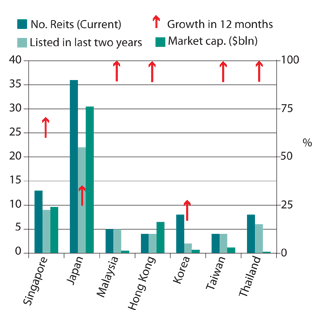
Early evidence certainly suggests continued demand from investors and plenty of asset sellers. From a standing start in 2001, Asia’s Reit market has grown from $2 billion to $49.4 billion, a compound annual growth rate of 87%, according to UBS (see table 1). There are already 77 listed Reits in Asia – there were just two in September 2001 – and the pipeline for new Reits is also strong (see table 2).
| Table 1: The start of something big . | ||||
| Asia Reit sector, as at September 2006 | ||||
 |
||||
| Table 2: Join the queue . | ||||
| Asian REIT pipeline | ||||
| Location | Issuer | Sector | Amount ($mln) | Timing |
| Singapore | Singapore Healthcare Reit | Healthcare | 150-200 | 4Q ‘06 |
| Hong Kong | Regal Hotels International | Hospitality | 600 app | 4Q ‘06 |
| Hong Kong | Chinese Estates | Real estate | 450 app | 4Q ‘06 |
| Hong Kong | Sun Millennium | Real estate | 430 app | Delayed |
| Hong Kong | Sunlight Reit | Real estate | 500 app | Delayed |
| Malaysia | Amanah Raya | Real estate | 200 app | 4Q ‘06 |
| Malaysia | Sungei Wang Reit | Real estate | 135 app | 4Q ‘06 |
| Malaysia | Permodalan Nasional | Real estate | 200 app | 4Q ‘06 |
| Indonesia | Lippo Healthcare Reit | Healthcare | 100 app | 4Q ‘06 |
| Source: UBS | ||||
Two key themes support the bullish case for Asian Reits, as Mark Ebbinghaus, executive director, joint head of real estate, lodging & leisure – Asia at UBS explains. “Asia’s [property] markets are mostly undercapitalized,” he says. “A lot of assets are still on the balance sheets of developers.” UBS calculates that just 4% of Asian property assets are held in Reits. That compares with 60% in Australia.
There is no shortage of buyers for repackaged Asian property assets. “Global investors are underweight Asian real estate and Reits are a low-risk way of getting in,” says Ebbinghaus. “[Asian Reits] are direct beneficiaries of global funds flows.”
No panacea
Those flows are heading Asia’s way for several reasons. Valuations, say analysts, are attractive when compared with more mature western markets. Equally important, in markets where investment institutions have to cope with ageing populations, Reits offer the attractions of yield, stable and visible earnings and an implicit element of capital protection. Real estate typically provides a hedge against inflation and also exhibits a low correlation with equities, offering investors potential for absolute rather than relative returns.
Yet as Asia’s Reits market develops, correlation with equities is likely to increase. After all, Reits are equity products and are priced and traded according to the laws of the capital markets. If Reits prove to be as popular as bankers expect, investors could eventually find that they have too much of a good thing.
“Reits aren’t a panacea,” says the head of a principal investment fund. “We’re at the beginning of the advent of the capital markets into real estate. It won’t evolve the same way as in the US. The nuts and bolts of the market here are different.”
Tim Grady, managing director and head of Pacific Rim global commercial real estate at Merrill Lynch, believes that while the outlook for Reits is positive, Asia’s real estate investment universe is likely to evolve on several fronts.
“Investors will still own physical buildings,” he says, “but the ownership configurations will become more diverse over time and may include such structures as CMBS, real estate funds, mezzanine debt and Reits. Some of these products have yet to become widely accepted in Asia but they eventually will.”
In the meantime, the growth of Asia’s Reits markets shows no signs of slowing. Asian real estate remains heavily concentrated in private hands: UBS estimates that 64% of total investment-grade property in Asia, including Japan, is not capitalized. And as investors continue to clamour for more products, bankers are hunting down new assets to strip, package and sell off. With a number of the larger regional property developers having proved the Reits concept, bankers expect two key sources of new Reits emerging: privatization and cross-border Reits, both likely to be pioneered from Singapore, comfortably the regional leader in Reits.
“I think you’re going to see lots of [Singapore] government assets on the block,” says Ebbinghaus. “Singapore only has so much real estate in private hands but the government owns a lot on its books. They’re starting to rationalize these to recycle capital. So you’ll see sale and leasebacks, aggressive sell-downs.”
Over the border
Cross-border Reits – essentially overseas property assets packaged and sold in another jurisdiction – are new to the region but already more are planned, say sources. Leading Singapore property and Reit group CapitaLand plans to launch a $500 million China Reit to be listed in Singapore by the end of this year. Other Singapore Reits (S-Reits) under consideration include real estate in India, the Philippines, Thailand and Indonesia. Vietnam is also mooted as an attractive potential source for S-Reits.
Properly structured, cross-border Reits can provide investors with exposure to real estate assets in developing markets despite restrictions on foreign ownership, by entering into joint ventures with local partners, using leasehold strategies or adopting structures to repatriate income to the offshore domicile. Investors also benefit from knowing that their assets are managed by professional management within a transparent vehicle listed in a well-regulated market. It is an appealing proposition, as one investor’s experience with local vehicles attests.
“We’ve looked at Reit-type vehicles in various markets,” he says. “But the legislation is not adequate. In Thailand, for example, the original owner is required to manage the property. Where’s the arm’s length in that?”
Notwithstanding growing demand from overseas investors for Asian real estate assets, legislation and regulation for local Reits in most Asian countries do not pass muster with international investors (see Missing the market, Euromoney November 2006).
The emergence of cross-border Reits provides evidence of the evolution of Reits in Asia away from the original reason for their popularity. The traditional Reit attracted investors principally as a substitute for investing in direct property. The transparency of Reits, their conservative management and capital structures and high dividend payout ratios found strong support from institutional and retail investors alike.
In contrast, cross-border Reits amount to a development in complexity, with higher gearing levels, and hedging products against income and capital, given significant currency exposures. While institutional and retail investors alike have broadly accepted these structures, they are a shift away from a direct property substitute towards a more structured financial product, and hence a closer correlation with equities.
Real estate or really complex?
Now Asia’s Reit market seems set to evolve one step further, with the emergence of several highly structured Reits that owe more to financial sleight of hand than they do to underlying property fundamentals. Dubbed financially engineered Reits, these vehicles own underlying property assets but their capital structures are intricately engineered to various ends. Very high property valuations that would ordinarily suppress yields and prohibit marketing can be achieved if the yield to investors is enhanced using such techniques as high gearing, returns of capital, debt repayment holidays and even income support from sponsors, which usually means the Reit manager forgoes all or part of its fees for an initial period.
The ill-fated Hong Kong-listed Champion Reit, launched by Citigroup and Merrill Lynch in May 2006, is a good example of such a vehicle (see Euromoney June 2006). Champion Reit had it all, effectively subsidizing its first year’s dividend payments to investors from interest rate swap proceeds, debt holidays, sponsor’s income support and even a return of capital: investors were effectively paying themselves their first year’s dividend with the IPO proceeds.
Athough there is nothing wrong per se with such structures, they are a quantum shift away from the original Reits in Asia towards a structured financial product and a higher market correlation. That explains why traditional property investors have typically avoided such deals, often leaving them to the investor of last resort, the retail punter. Champion Reit shares remain below their IPO price.
Despite the shift from pure property play to structured product of some Reits, UBS’s Ebbinghaus does not believe that closer market correlation is necessarily a bad thing, or likely to dampen enthusiasm for the Reit product.
“It’s not a big issue at present,” he says. “If there’s a perception of an issue, it’s outweighed by the benefits of being able to invest in direct real estate. For one, retail investors have no choice.”
Getting the treatment
In the capital markets continuum, the development of the Reit product will not end with financial engineering. In Australia, a well-developed Reits market, stapled securities, has emerged that effectively adds operational business assets to Reits, increasing correlation with traditional equities. Singapore already has a hotel Reit. In the US, healthcare assets, storage facilities and even prisons have undergone the Reit treatment.
So more evolution, specialization and more esoteric products are to be expected from investment banks. And just as the spectrum of Reit products in Asia will change, so the investor base will widen as different Reit structures appeal to different investors’ needs. That is to be welcomed but investors need to be clear as to what kind of Reit they are buying. Perhaps it will soon be time to find a better term for what might come to have as much to do with mathematics as with property.