Lima acts as the source of mining capital
THE EAGERNESS OF global financiers to fund Brazilian mining company Companhia Vale do Rio Doce in its $18 billion takeover of Canadian nickel producer Inco is a sign of the times. A commodity boom sparked by China’s rapid economic growth is fuelling the development of new mines and mining acquisitions in Latin America and, in turn, the bank loans and capital markets deals to finance them.
Last month, Brazilian iron ore producer CVRD issued the biggest-ever global bond by a Latin American entity. The company sold $3.75 billion worth of 10 and 30-year paper. Investor demand totalled $13 billion. The bond will help refinance part of the record-breaking $18 billion loan CVRD took on to pay for its take over of Inco. When CVRD announced that loan it was flooded with short-term funding offers totalling $34 billion for its deal, far more than it needs, as international banks try to get in on a surge of mergers and acquisitions in mining this year. “As we say in the mining industry, banks always want to loan you money when you don’t need it, and when you do need it, they’re not interested in lending,” says Carlos Galvez, chief financial officer of New York-listed Peruvian metals company Buenaventura, which jointly owns Latin America’s biggest gold mine, Yanacocha, with Newmont Mining of the US.
The two-year bridge loan to back CVRD’s $18 billion all-cash bid for Inco is the biggest ever in Latin America, dwarfing the next largest $6.1 billion deal in 1996 to Argentina, as well as the region’s largest corporate loan, a $5.5 billion deal to Mexico’s state-owned energy company Pemex earlier this year. Credit Suisse, ABN Amro, UBS and Santander are arranging and underwriting the loan, which is described by one banker as “an amazing benchmark deal”. The total pool of banks vying to back the CVRD transaction reached 34, with institutions from Asia, the US and Europe crying out to take part. It’s a world away from the late 1990s, when depressed mineral prices and regional political and economic instability meant mining companies in Latin America struggled to get financing for new projects.
Now investors can’t enough of these companies. Just a week before CVRD issued its global bond, Hochschild, a Peruvian gold and silver miner, became the first Latin American company to debut its shares on the main market of the London Stock Exchange for more than a century. The company listed 25% of its shares, raising £270 million in the process. Its market capitalisation of £100 billion-plus means it is one of the 200 biggest companies listed on the LSE. The IPO was three times oversubscribed.
The CVRD and Hochschild deals are more than a sign of Latin America’s growing business confidence after years of crises and unprofitably run state-owned companies.
They illustrate that in certain industries, such as mining, Latin American companies are as competitive as any of their global peers. And that means that when it comes to financing their growth, they are in a strong position to dictate the terms of any deal. Moreover, they can turn to a number of sources to raise cash, and not just the capital markets. CVRD could have also asked Brazil’s development bank, Banco do Desenvolvimento Economico e Social (BNDES) to help refinance its bridge loan, although it is arguably cheaper for the company to go to the international capital markets instead. For the November transaction, for example, it was able to price the 10-year tranche just 1bp wider than the sovereign’s 2017 bond. “A CVRD issue is seen almost as a quasi-sovereign issue – in fact enjoying better rates and lending terms than the Brazilian government,” says a fixed-income manager in São Paolo close to the CVRD refinancing plans. “CVRD can tap the markets whenever it needs to, and we’ll see any offer oversubscribed.”
CVRD sold a 10-year, $1 billion bond in January with a yield to maturity of 6.25% managed by JPMorgan, a better bet than the average 8% interest rate for a BNDES loan. That is also comparable to a recently reopened, dollar-denominated Brazilian global 2037 bond that pays an annual yield of 6.83%. A 2022 real-denominated $300 million bond reopened in October pays a 12.46% yield. Furthermore, CVRD’s finances and the mining sector boom in Latin America appear to be so well regarded by investors that the increase in company debt to $22 billion from $6 billion that comes with the Inco transaction will not affect CVRD’s investment-grade rating.
Debt reduction strategy
“CVRD benefits from significant flexibility to reduce debt at a strong pace in 2007 and 2008, restoring credit measures to adequate levels even under conservative cash generation assumptions,” says Reginaldo Takara, credit analyst at Standard & Poor’s. Merrill Lynch has reiterated its buy recommendation on CVRD stock, as iron ore prices are expected to rise 5% next year and maintain steady progress in 2008 on strong Chinese demand. Last month, CVRD also issued the biggest ever reais-denominated debenture by a Brazilian corporate to help refinance the Inco transaction, raising R$5 billion.
Still, the stiff competition to be part of the CVRD/Inco deal underscores the difficulties for many banks of winning business involving the region’s biggest miners and projects, often developed by US and Canadian mine companies and investors, putting pressure on fees and margins. Many banks that did not previously focus on mine finance are moving into commodities because analysts at financial houses such as Miami-based Bulltick Capital Markets forecast another five years of booming metal prices. China and India need copper, zinc, nickel, tin and other metals to fire construction and infrastructure growth. Local capital markets are also proving an alternative source of funds for mine development, and high profits from record mineral prices also enable companies to help finance their expansion internally.
Luckily for bankers, however, a huge number of smaller mine projects in Argentina, Bolivia, Brazil, Chile, Mexico, and Peru need financing, making up for some of the lost business. At least 30% of global mineral exploration investment is directed at Latin America, with a proliferation of small, one-project developers concentrating on getting to the production stage. Chile, Brazil and Peru are leading in capturing those inflows, with Mexico and Argentina catching up fast. “We used to arrange the financing for the big names and we don’t do that any more. In the meantime, though, we’re doing the financing for smaller mines and projects, so one compensates the other,” says Florence Pourchet, part of BNP Paribas’ commodity structured finance team in the Americas.
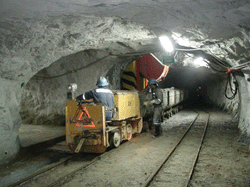 |
| Tunnel vision: Peru’s domestic capital markets have been taking an active part in funding mining projects such as the Antapite mine |
That change in business has not stopped BNP doing landmark deals. BNP Paribas and Barclays last December signed a highly structured $225 million loan to finance the development of Bolivia’s $680 million San Cristobal silver-lead-zinc project, the first major international mine finance transaction in the Andean nation with majority book running, underwriting and participation of commercial banks. The deal was also achieved despite the political instability surrounding Bolivia’s leftist government, which in May nationalized its energy fields. In June BNP Paribas was a lead arranger and bookrunner for a $1.2 billion facility for Brazilian mining and commodities producer Votorantim to refinance existing debt, the largest deal ever arranged for a Brazilian group at the time and secured in part by metals exports. The syndication was well received by the bank market and syndication attracted 10 banks, joining lead arrangers BNP, ABN Amro, BBVA, Citibank and Santander. This meant BNP was able to reduce its $240 million underwriting to $150 million. Interest rates for banks can also be attractively high on smaller, so-called junior, projects because of the lack of a big name and greater perceived risk.
Making the most of relationships
That kind of success usually comes after banks build up a strong relationship over many years with a country and its mining companies, setting up a dedicated team that comprises not only bankers but also mining engineers and geologists. “Securing a mandate over a competitor is always difficult and now that the market is hot, you see a lot of banks flocking into the sector. But margins and fees are not everything because a mining company wants good advice and bankers who really understand the business,” says Philipp Reimnitz, head of resources at the markets and investment banking arm of Germany’s HVB bank, one of the world’s top mine financing houses. As a result, even beyond the landmark deals, small mines are generating business.
Australia’s Macquarie Bank in August agreed to lend Peruvian-Canadian company Minera Santa Cruz $55 million for its Argentine San Jose gold and silver project. Brazilian iron ore miner Samarco, joint-owned by the world’s biggest diversified miner, BHP Billiton, and CVRD, has raised $800 million in seven-year loans with 18 banks to finance a $1.2 billion expansion project. HVB, part of Italy’s UniCredit group, has been active in Brazil as well as in Peru, with loans for Yanacocha and the huge copper-zinc mine Antamina, and also in Chile. Yamana has signed a commitment letter with HVB and ABN Amro for a revolving $200 million credit line at an interest rate of Libor plus 1.1% to 1.5% a year depending on the company’s debt to ebitda ratio.
One of the most significant deals has been the $893 million project by US-based Phelps Dodge to double production at its Cerro Verde copper mine in southern Peru. With total project debt of $450 million and $443 million in equity, the project has driven the financing, rather than vice-versa, and enables Cerro Verde to buy down debt if it misses any repayment targets, rather than being tied to output levels. Such freedom in project management was unheard of just three years ago and reflects a trend toward less tightly structured financing. As well as issuing bonds in Peru’s local debt market (see box), Phelps Dodge, one of the world’s biggest copper producers, raised a $450 million facility in tranches from Japanese development bank JBIC, the Royal Bank of Scotland, German development bank KfW, Calyon, Mizuho Corporate Bank and Scotia Capital Markets. The 10-year deal has a 2.5-year grace period.
 |
| “A mining company wants good advice and bankers who really understand the business” Philipp Reimnitz, HVB |
Ultimately, no matter how big the deal, banks are looking for performing loans, something that is in general supported by an environment of high metals prices. “If it’s a good asset, the best situation is that it performs and continues to stay on your books. In this boom market you could get repaid after two years, but then you’d have to find a new project, so that’s not always the most desirable position to be in,” says Reimnitz. “Still, if the project performs very well for the junior or emerging mid-tier sponsor, as a bank we should have the possibility of being repaid earlier, ie, sharing in the upside of a project. This mechanism is structured by means of a cash sweep. But the cash sweep should not claim more than 50%; typically you try to negotiate for 25% to 50% maximum. It’s a very delicate balance.” For bankers and miners alike, the huge financing possibilities are only set to continue over the next five years, with a host of projects looking for financing and pushing to begin metal production. India’s Jindal Group aims to invest $2.3 billion in Bolivia over the next 10 years to develop an iron ore mine and steel plant at the El Mutun site near the Brazilian border, one of the world’s biggest deposits of the ore. Jindal says it will need $1.5 billion over the next five years and says it will rely heavily on bank financing. Venezuela is dotted with gold projects, and Mexico and Colombia are eager to develop their coal resources. Peru has untapped mineral deposits ranging from silver to uranium. Its Rio Blanco copper project, owned by the UK’s Monterrico Metals, is expected to need $250 million in equity financing and more than double that in bank financing. Chile, the world’s top copper producer, aims to dramatically increase its production over the next few years.
Alternative funding strategies
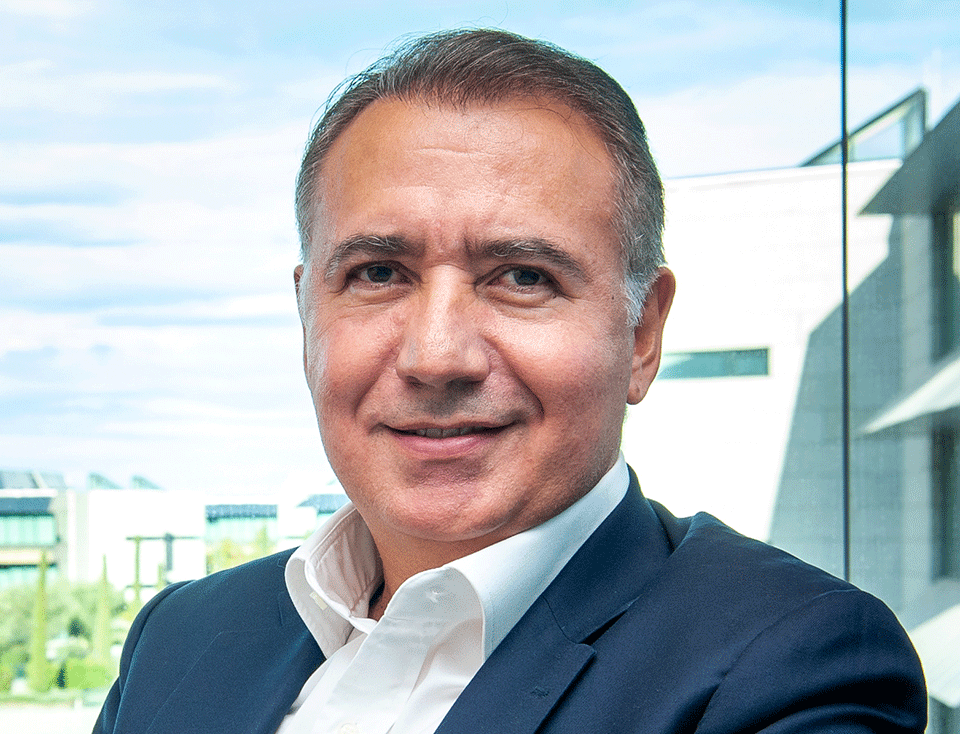
That huge potential means that banks are unlikely to provide all the financing that mining projects will require, prompting the need for alternative funds involving debt and equity. Latin America’s local capital markets are developing just in time, while some home-grown mining companies aim to list in the world’s mine finance capitals, namely New York, London and Toronto. Lima-based Hochschild Mining, which specialises in silver production in Argentina, Mexico and Peru, plans to list on the London Stock Exchange in November “to finance our Latin American growth strategy,” according to the company’s executive chairman, Eduardo Hochschild. “We have a strong project pipeline and also plan to maximize the potential of our existing operations.” JPMorgan Cazenove and Goldman Sachs are the joint sponsors, coordinators and bookrunners for that deal.
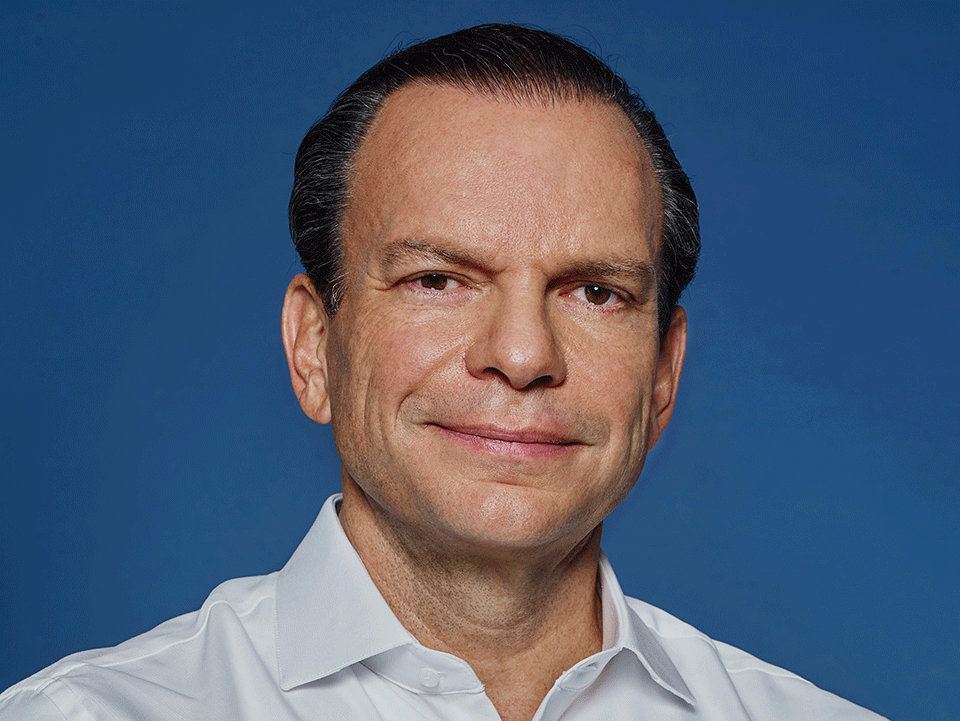
Brazilian iron ore miner MMX aims to list on the Toronto Stock Exchange in November, following its initial public offering in Brazil in July. The company only started mining last December and hopes to be the world’s fifth-largest iron ore producer by 2011. “The advantage of Toronto is that there are more investors there and it will give us greater liquidity,” says MMX’s chairman Eike Batista.
Meanwhile, Chile’s state-run mining company, Codelco, the world’s biggest copper producer, plans to issue $300 million in 30-year bonds in the next few months to expand its operations and follow on from its landmark quasi-sovereign bond issue of $201.7 million in April last year. Chilean mining and steel company CAP issued $200 million in 30-year bonds in September, led by HSBC, the company’s debut in international markets, as the company sought longer maturities than the local market can provide. Peruvian capital markets have proved to be surprisingly deep in financing mining projects.
| THE GROWING PACE OF FUNDING | ||||||||
| Latin American mining sector deals, January 1 2005 to May 10 2006 | ||||||||
| Priced | Issuer | Nationality | Value $mln | Currency (Tranche) | Value $mln | Coupon | Years to maturity | Bookrunner |
| 26 Jul ‘06 | Minera Yanacocha | Peru | 158.0 | $ | 58 | 7 | 10.0 | Banco de Crédito del Peru |
| 26 Jul ‘06 | Minera Yanacocha | Peru | 158.0 | $ | 42 | 3-mth Libor+143.75bp | 10.0 | Banco de Crédito del Peru |
| 26 Jul ‘06 | Minera Yanacocha | Peru | 158.0 | $ | 58 | 7 | 10.0 | Banco de Crédito del Peru |
| 26 Apr ‘06 | Sociedad Minera Cerro Verde | Peru | 90.0 | $ | 90 | 6-mth Libor+160bp | 9.4 | Citigroup |
| 25 Apr ‘06 | Minera Barrick Misquichilca | Peru | 50.0 | $ | 50 | 6-mth Libor+150bp | 6.0 | Banco de Crédito del Peru; Citigroup |
| 6 Jan ‘06 | Vale Overseas | Brazil | 1,000.0 | $ | 1,000 | 6.25 | 10.0 | JPMorgan |
| 26 Oct ‘05 | Vale Overseas | Brazil | 300.0 | $ | 300 | 8.25 | 28.2 | ABN Amro; HSBC |
| 16 Sep ‘05 | Corporación Nacional del Cobre de Chile – Codelco | Chile | 500.0 | $ | 500 | 5.625 | 30.0 | JPMorgan; Deutsche Bank |
| 13 Apr ‘05 | Minera Barrick Misquichilca | Peru | 50.0 | $ | 50 | 6-mth Libor+172bp | 8.0 | Citigroup |
| 1 Apr ‘05 | Corporación Naciona del Cobre de Chile – Codelco | Chile | 201.7 | CLF | 201.7 | 3.68 | 20.0 | Celfin Capital SA |
| Source: Dealogic | ||||||||