 |
| “It was a very dilapidated area but the golden rule of property development is location, location, location. Taipingqiao was such a prime location that I was very confident” Vincent HS Lo, Shui On |
METRO MANILA’S URBAN sprawl is at its neatest and most orderly in Makati City – and for good reason. Almost single-handedly, Ayala Land, a local property developer established after World War II, has planned, designed and built the city from the ground up, without a cent of government money. There is concrete evidence of this achievement on Makati Avenue, one of the two key city thoroughfares along with Ayala Avenue. Squeezed between the glass-fronted skyscrapers and office towers sits a modest two-storey block. Formerly a control tower and now a protected building, it is the only visible evidence that Makati was once an airport and Makati and Ayala Avenues its runways.
“The vision of the company was to move the centre of commerce from old Manila, which was ravaged by war,” says Jaime E Ysmael, senior vice-president and chief finance officer of Ayala Land. “We master planned everything, built all the roads and utilities, even water works and sewage treatment. We continue to own the roads in Makati and maintain them to this day.”
Ayala Land’s key assets in Makati are now Ayala Center, a 36-hectare residential, retail and commercial district, and Ayala Triangle, seven hectares of office development. All in all, the group still owns a third of Manila’s central business district.
The firm has done more than just throw up office towers. Perhaps its most iconic and successful development is the Greenbelt retail and commercial centre that sits in the heart of Makati. Constructed around an existing park, chapel and museum, Greenbelt, now in its fifth phase of development, has been hugely successful.
“It’s not your typical mall,” says Rowena Manhit-Tomeldan, vice-president and deputy group head of Ayala Malls Group. “The idea is to blend indoors and outdoors seamlessly. We did a lot of research and sought inspiration from abroad. We came up with a mall that embraces the park.”
Greenbelt belies its location in the heart of one of Asia’s poorer cities. Luxury-brand stores and trendy up-market restaurants with alfresco dining areas are more reminiscent of downtown Sydney or Singapore than the crumbling streets of Manila. Yet the development was not without its doubters.
“A lot of people challenged us: ‘Why build this in a country where it rains half the year?’” says Myrna Fernandez, senior division manager of Ayala Malls Group. “But we believed Filipinos would like the concept and embrace it.”
That has proved to be the case. According to Ayala Malls Group, Greenbelt receives up to 90,000 visitors a day. In total, all of the Ayala malls in Makati attract 400,000 visitors daily. That makes for very profitable retail business.
“Our malls business generates more than 1 billion pesos [$20 million] of cashflow annually,” says Ysmael. “Typically for our larger malls, the payback period is between five and seven years and we get IRRs in the mid to upper teens at our current cost of capital.”
That capital was provided solely through internally generated funds at the corporate level, says Ysmael.
Shopping heaven on earth
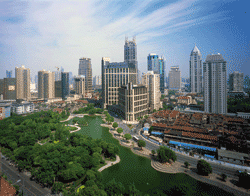
Ayala Land’s success with Greenbelt, although unusual in a region used to vast box-like mega malls, is not unique. Equally iconic in design and influence is the Xin Tian Di retail and entertainment development in the Taipingqiao area of Shanghai.
Designed and developed by Hong Kong and China property developer Shui On Land, Xin Tian Di, which means new heaven and earth, is the brainchild of Shui On founder, chairman and CEO Vincent HS Lo. The Shanghai city government approached Lo following a local property slump in 1996, asking for help in regenerating the central yet run-down area of Taipingqiao.
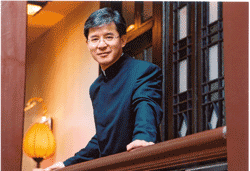
“I think they saw me as someone interested in contributing to the place rather than simply making a lot of money and running away,” says Lo. “It was a very dilapidated area but the golden rule of property development is location, location, location. Taipingqiao was such a prime location that I was very confident.”
Although Shui On did not face Ayala Land’s problem – a complete absence of government infrastructure support – it was still a big challenge to sell the concept to the local authorities.
Employing American architect Benjamin Wood of Wood & Zapata, Lo designed a retail and entertainment that used the traditional stone gate housing, known as shikumen, that was unique to early 20th century Shanghai.
“It has been a phenomenal success,” says Lo, “but it was an uphill struggle trying to convince the government and the local Shanghainese to visit initially. They used to say: ‘We don’t like to eat and drink outside’, but the outdoor tables are always the first to go.”
 |
| “The banks never lent us a dollar. They came back to us after we’d spent most of the money and offered us a $45 million loan” Vincent HS Lo, Shui On |
Shui On invested $175 million in the three-hectare development, all of which was self-funded. “The banks never lent us a dollar,” says Lo. “They came back to us after we’d spent most of the money and offered us a $45 million loan.” The group’s investment has paid off handsomely. The success of the Xin Tian Di development has increased land prices around Taipingqiao, where Shui On holds a total of 52 hectares for development. In addition to Xin Tian Di, Shui On is developing Corporate Avenue, a grade A office, entertainment and commercial complex, a luxury residential zone and Taipingqiao Lake and Park.
“I was very confident that if Xin Tian Di was successful, it would enhance the value of the area,” says Lo. “This will be the 11th year of double-digit growth in Shanghai. That’s generating demand for property internally and from outside.”
Ivory towers to cutting edge
That kind of economic growth generates a momentum of its own and is the envy of most cities in Asia. Although Jakarta lacks the growth rates of Shanghai, it shares many of China’s urban regeneration issues. However, like Manila it suffers from chronic under-investment by government in infrastructure. So acute has the problem become that developers are beginning to seek their own solutions.
“Jakarta is typical of many Asian cities,” says M Ridwan Kamil, principal of Urbane Indonesia, an architect and urban design firm. “We suffered from a colonial and a post-colonial period. A lot of the initial planning was done by the colonialists. The Dutch left hastily and after that there was a vacuum. Planning was more about politics than design. We ended up with [president] Sukarno building ivory towers.”
That historical legacy has left Jakarta with a Los Angeles-type urban sprawl, says Ridwan – horizontally rather than vertically developed, but with none of the requisite infrastructure.
“It’s still very difficult for poor people to find decent-standard homes here,” he says, “so they have to move to the perimeter, but that costs them in transport. Some developers saw this as an opportunity and started to build along the toll roads.”
The pioneer of such real estate developments in Indonesia is Lippo Karawaci, whose eponymous development in west Jakarta created the first so-called edge city.
“The idea was to create a self-contained city that provides work to keep residents there instead of migrating in large numbers over crumbling road systems into the inner city,” says Gordon Benton, senior executive and urban planner at Lippo Karawaci. “We also decided to attract investment for social facilities: hotels, hospitals, schools, offices and shopping. That made us a complete town.”
Enter Lippo Karawaci from Jakarta’s crumbling highway and the contrast is indeed remarkable. The firm built all the infrastructure throughout the town, which feels more like Silicon Valley than southeast Asia.
As Benton points out, such an undertaking in a developed market would be hugely expensive and take perhaps 30 years to complete, given government planning regulations. Lippo Karawaci faced no such obstacles and completed the development within 10 years.
“We had a team of international and local consultants with expertise in every aspect of urban planning,” says Benton. “We got Gleneagles from Singapore to develop the hospital, GSIC [Government of Singapore Investment Corporation] and Rodemco to build the mall.”
Demand for housing was generated by building an international school, funded by the pre-sale of certificates offering places for the children of wealthy Indonesians, mainly of Chinese descent.
“We built the school first,’ says Benton, “that’s usually the last thing to be built in a town. But we guaranteed English education with native English speakers. It was the first such school in Indonesia.”
Total protection
The development sold quickly, with 700 homes snapped up in the first 10 days of sale. Also critical to its success was the offer of what Benton describes as total protected zones. With mainly wealthy Indonesian Chinese buying homes in a city surrounded by rural villages populated by poor, mainly ethnic Indonesians, the challenge was to ensure that the two communities could live safely side by side.
“We had to set up a linkage between these people,” says Benton, “to keep the villagers happy.” That entailed ensuring that jobs in the city were made available to local villagers first.
The success of the strategy is evident in the city’s statistics. With 40,000 residents after 12 years of development, 9,000 homes and 47,000 jobs, the community offers important lessons for further development of Jakarta and Indonesia, claims Benton.
“We’re urbanizing globally and that’s going to create big problems for this country,” he says. “Jakarta will grow by 200,000 people per annum, 300 new cars on the road every day. It’s a serious problem.”
 |
“Typically for our larger malls, the payback period is between five and seven years and we get IRRs in the mid to upper teens at our current cost of capital” Jaime Ysmael, Ayala Land |
Lippo Karawaci’s success has spurred similar developments around the Jakarta fringes. Yet successful though they are, edge cities are not the only solution to Jakarta’s chronic congestion, says Ridwan of Urbane Indonesia. “There are still problems in the downtown areas of Jakarta,” he says. “There’s too much uncoordinated development. We need to find a smarter way to deal with these problems.” His solution is to develop central Jakarta along what he terms super blocks – large parcels of land that are designed according to a strict master plan and with the specific aim of creating communities in line with a “live, work and play” concept. This encourages populations to remain within these communities, reducing commuting and congestion.
Ridwan is currently working with Bakrie Land to develop Rasuna Epicentrum, a super block site covering 12 hectares in central Jakarta consisting of office, residential, retail and entertainment buildings that relies on strong design and branding for its success.
“It’s now under construction,” says Ridwan. “I’m campaigning with key developers here that good design means good business. Not everyone gets that, most just worry about their cashflow.”
Rasuna Epicentrum has a total investment cost of $350 million, which will be funded through an initial capital outlay with the bulk funded from the pre-sale of residential apartments, a favoured funding method of large developers. Ridwan estimates that the project will earn an internal rate of return of about 25%.
“With this kind of project, the developer works on a phasing plan,” he says. “They never build everything in one go, but manage the cashflow from the project very carefully.”
Rival CBD
Such developments are not unique to Jakarta. In Manila, in addition to Ayala Land’s super block developments in Makati and Fort Bonifacio Global City, rival developer SM Investments Corporation has ambitious plans to establish a completely new central business district on a 60-hectare site on reclaimed land in Manila Bay, known as SM Bay City. Famous for its mega malls, the new central business district plan is part of a strategy shift says Jess Lucas, executive vice-president of real property at SM Investments.
“We’re getting our act together, looking at our land bank,” he says, “to see if we can do more integrated developments.”
SM Bay City already houses the firm’s headquarters as well as the Mall of Asia shopping centre. A purpose-built business process outsourcing and call centre complex, OneE-comCenter, is under construction and a 45,000 square metre SMX Convention Center is slated for completion in 2007. The project will also develop a 1.5 km waterfront development called the Esplanade, housing retail and entertainment facilities. Like other major community developers, SM Investments will foot the entire bill for the project, mainly from internal reserves.
“You’d expect the government to make some investment in infrastructure for this scale of development,” says Lucas, “but in this part of the world it doesn’t work that way.”
It is not just hard infrastructure that lacks government investment, according to Vincent Lo of Shui On. A key project under way in inner-city Shanghai is the Knowledge and Innovation Community, an 84-hectare site in the Yangpu district of the city.
Described enthusiastically by Lo as a cross between Silicon Valley and Paris’s Left Bank, the project is an attempt to assist the local government in developing the city’s education and services infrastructure. With 14 universities in the area, Shui On has built an entire street, University Avenue, as well as KIC Plaza, a work, business and cultural centre; KIC Village, a mixed-use housing office and retail area; and KIC Tech Park. The project is designed specifically to appeal to a young student community.
Lo says: “We’re creating atmosphere – facilities to attract young people to go and hang out there. If you have a place to meet, if you attract the right kind of people, I believe you can create activities and establish communities.”
Cities of dreams
One of the most ambitious projects to develop new communities in Asia is another project of SM Investments in the Philippines. As part of a strategic shift into the tourism sector, the company is planning to develop an eco-tourist project called Hamilo Coast, a 34-kilometre stretch of coastline comprising 13 separate coves. The land sits in a 5,900-hectare virgin property of outstanding natural beauty, owned by SM Investments, just two and a half hours’ drive from Manila.
The master plan for the development envisages an integrated set of coastal resort communities built to international real estate development standards and will include low-rise condominiums, residential lofts and townhouses, as well as hotels, beach and country club facilities and retail and entertainment areas.
Building a development of that scale on a virgin site requires more than just the erection of buildings. SM Investments plans to build access roads to the main highway, power and telecommunications, water and waste disposal systems, all privately funded.
“We’ll be building everything,” says Jess Lucas of SM Investments, “all the macro infrastructure. We’re trying to work with the local utilities companies.”
SM Investments will develop the project in distinct phases, says Lucas. Funding will come from pre-sales of residential units as well as internal funds.
“You have to ride the wave,” he says, “slow down, speed up, do what you can according to market conditions. It’s a long-term commitment of course, but in 30 years’ time, you’ll have a string of coastal communities connected by a privately built road system. It’s a big project, but you have to dream a little here!”
With little or nothing in the way of assistance from governments to turn these dreams into reality, enterprising developers with vision, know-how and capital are single-handedly turning virgin land into new communities and transforming dilapidated urban landscapes into first-world, cutting-edge cities. What makes these achievements all the more remarkable is that they are also highly profitable.