Argentina has rebounded strongly from the 2002 crisis, but some analysts are getting worried about inflation and the low level of investment. How would you reassure the international financial community?
Concerning your second point about investment: the level in the final quarter of 2004 was at a peak of 21% of GDP. In the first quarter of this year there was a fall to about 19.5% but this is quite usual in the first quarter owing to seasonal issues. The provisional figures we have for the second quarter are extremely positive and probably we will recover to 21%.
 |
|
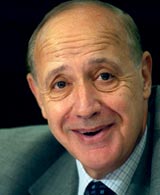
Roberto Lavagna, Economy minister |
In fact we need another two or two-and-a-half points – an extra $3.8 billion of investment – which historically would give us [a level] that is very high by Argentine standards. If we want to continue a rate of growth of no less than 5% we will need this additional level of investment. We think about 1% of this two-and-a-half additional points will come from public utilities. The remainder will come from the tradeable sector of the economy, basically industry and agriculture. We are trying to create conditions for that to happen.
Inflation is a different problem. In an economy that has been increasing its output by 8% every year for the past three years, it’s always possible you will face some pressures in different sectors, especially sectors that are [running] at near [full] capacity. What are we doing?
First, we are adjusting fiscal policy. [We had planned] to increase pensions by 10% but that idea has been postponed. On income policy we are working with the business community and the unions in trying to stop a spiral in prices and wages. Both sides accept that they have to reduce their demands.
We are also [adjusting] monetary policy [by halting the sales of inflation-linked bonds]. Therefore, we are using income policy, fiscal policy and monetary policy simultaneously [to combat inflation] without reducing the level of activity in the economy.
What is the realistic pace of growth next year given these problems?
The realistic pace, for the fourth year in a row, is at about 6.5% to 7%. For the next year it will be about 5% but that requires an increase in investment.
Will that rate of growth be enough to sustain the fiscal surplus levels that you’ve generated in recent years?
Certainly. The fiscal surplus is related to how we manage expenses, the growth of the economy and [our success] in reducing tax evasion.
Is the percentage of tax collection increasing?
The percentage is increasing but, as important, the quality of the taxation has changed. In Argentina it was common for income tax collection to equal about one-third of the VAT collection. Last year, and this, the collections of both taxes have been practically the same. That means we’ve increased the collection of income tax.
The IMF has said that it would like to see a higher fiscal surplus than you have stated in your budget. How do you respond?
That is a problem for the IMF; it’s not our problem. It’s our economic policy, we [control] our economic policy. For the past three years, for over 70% of the time, we have not had an agreement with the IMF and the result hasn’t been too bad. That means we hear what the IMF says but we have ownership over economic policy. For more than a decade-and-a-half we didn’t own our economic policy. That’s why at this point we will try to get the surplus as high as possible but we will not accept putting 4.5% to 5% [of GDP] in an agreement with [the IMF] – absolutely not.
Is it insisting on that in terms of a new agreement?
It’s very difficult to say. It is discussing [a potential new agreement] in a quite reasonable way. You never know. In any case the IMF knows we will not establish [a policy that targets] more than we need in order to make our debt payments.
The Fund is also recommending fiscal tightening. It’s an election year. Do you think that the IMF has problems understanding the politics of running a country?
In the case of Argentina, the fact that for 70% of the time over the past few years we were without an agreement with the IMF is a clear indication it was recommending policies that were different to what we thought were best for Argentina and the result is not so bad. That’s why if it insists on that [fiscal tightening] it would certainly be an obstacle to an agreement.
So you will not cut expenditure over the next six months?
We will not freeze the economy. In a country that still has 40% of its people below the poverty line [defined by the government as per capita income of Ps800 ($280) or less] and 12.5% unemployed, any move that decreases the rate of growth would be a big social and political mistake.
Do you think that the ideological divisions between Argentina and the IMF are still very apparent?
I don’t know. We will see. The meetings [at the end of July] were very reasonable.
What about general structural reform? What’s happening with the negotiations with the private utilities, for example, and when can we expect results?
Today 50% of the contracts have been pre-negotiated. The decisions are now in the hands of congress. Congress will probably take some additional time, probably after the elections, at least for some subjects.
Some companies have decided to take [their complaints] to the International Centre for Settlement of Investment Disputes [Icsid – an arm of the World Bank that enforces bilateral investment treaties] but most important companies have stopped their demands.
The corporations that decided to stay in Argentina are basically agreeing with the government. The companies that have decided to leave the country are obviously more aggressive and may continue [to take legal action].
Argentina is appealing against one decision made against it by the Icsid in favour of CMS Gas Transmission Co. I understand, however, that Argentina has stated it will not pay even if it loses its appeal. Is that correct?
We have never said that. Certainly the appeal will probably take two or so years but we will accept the result. We think we are on solid ground for this appeal. The [original] decision was quite positive in the sense that the tribunal decided there was no discrimination between companies; there was no expropriation [of assets]. Both things are extremely positive.
The negative aspect was that in the mind of this tribunal the crisis in Argentina was not sufficiently important to justify [our actions]. [Yet] the World Bank supports people living below the poverty line and this crisis was the worst in Argentina for 150 years. Even the courts in Italy understood the seriousness of the crisis. That means that this tribunal was quite particular in not taking into account the position of the World Bank itself.
Let’s move on to other structural issues. Will taxes on financial transactions and exports be phased out?
On financial transactions our intention is to continue what we started. We took two steps. One was to decrease the percentage [of the tax levied]; the other was to exclude some financial operations [from the tax]. Our intention is to continue that.
Exports are a different issue. It is an income tax in a sector in which evasion is very high. Until we can counter this evasion, especially in the agriculture sector, this export tax [will remain as] an income tax.
What about the banks? One of the problems before the crisis was that a lot of banks were forced to buy government securities. There are some concerns that you might have a funding gap coming due and one of the means around that could be to force banks to buy government securities. Would you consider that?
Certainly not. The position of the government is to decrease the net debt of the country. That means nobody, not only the banks but also pension funds, for example, will be forced to buy bonds from the government. In fact, if you read the most recent report on the banking system in Argentina, you will see that exposure to the government, both central and provincial, has decreased over the past year. Our intention is to continue decreasing [public debt] in order to stop the traditional process of crowding out [the private sector].
On the exchange rate, the central bank is intervening frequently to keep the peso competitive. Do you think that’s an appropriate policy or do you think the peso should be allowed to freely float in the market?
The first point concerns hypocrisy. No country in the world has a free-floating currency. Everyone has some kind of dirty flotation, some kind of intervention. That’s the reality. You will not get out of Argentina something you are not asking of other countries.
On the other side, people think – and this applies to the IMF, for example – only about the supply of money and not the demand. Over the past two years, even if we supplied a certain amount of money, the demand has been extremely high. We have to take into account the equilibrium between money demand and supply and not just about how many pesos are issued by the central bank.
So you don’t think the FX intervention policy will lead to a quasi-fiscal deficit, as some people have suggested?
No. We have enough room to accommodate this policy.
Now that the restructuring has been completed, how do you think the mood of the country has changed over the past 12 months or so?
When you look at things from abroad, you think that the main problem facing Argentina was the [government] restructuring. But that’s not the case. Internally, other structural reforms were much more important.
One was monetary reunification. Remember that in Argentina the provinces issued debt in 14 different currencies. In order to construct macroeconomic policy you need control over your currency.
We lifted all the [restrictions on the withdrawal of] deposits – the corralito and the corralón – that were introduced by the previous government. This was essential to [returning to a] normal financial system.
We restructured all the provinces’ debt [with the central government]. This was essential in bringing control over the provinces’ budgets. All the provinces now have a primary surplus. The restructuring was equivalent to $8 billion. The provinces have now started to repay the debt.
The other issue was to recapitalize the financial system; to compensate both public and private banks for their losses.
Has that process been finished yet?
Yes, just. There are still some technical discussions taking place. We can compensate once the auditors can tell us what the impact [of the crisis] was on the banks. In some cases, the banks are still in discussion with their auditors trying to establish a final figure. Except for these particular cases, we have compensated all the banks.
When will these cases be resolved?
I suppose they will be completed in the next six months.
What are the issues that you need to tackle now?
To ensure the rate of investment will reach 23% to 23.5% [of GDP]. That’s the most important thing. That is a question, on the one hand, of the business climate, including specific measures to reduce the cost of investment. On the other, it depends on political and social stability.
What’s the biggest lesson you have learnt from this process?
There are two or three. One is that you need ownership of policy. You cannot just take what the IMF or what the financial system wants.
The IMF has stressed the importance of policy ownership.
That is just lip service. [If the IMF] tried to impose a revaluation of the peso and a 4.5% to 5% fiscal surplus, which is not the case at the moment but if it did become so, we would not accept these conditions. That would change our policy completely.
Ownership is important, the exchange rate is extremely important. People speak all the time about the southeast Asian countries. They have to recognize that probably the most important tool used over 20 years by these countries was an undervalued national currency.
Avoidance of any currency mismatches [is another important lesson]. Remember people in Argentina were making deposits in pesos and [borrowing in dollars].
Another lesson is the importance of a fiscal surplus. Argentina’s debt in 1975 was less than $8 billion. In 2001 it was $190 billion. The difference between these two figures is the fiscal deficit. That is why it is essential to decrease the country’s debt. The debt is now $125 billion after the restructuring.
Would you have done anything differently over the past three years?
It’s difficult to say. The country was in such huge crisis when we took office. [He takes out a print of a painting by an Argentine artist showing people setting the streets on fire and looting]. That reflects the situation in April 2002. The situation was extremely dangerous, not just in an economic sense but also in terms of social and political disruption.
Maybe we made some mistakes but the outcome so far has been very positive.
Do you think you get insufficient credit? That people still stress the negatives?
That is very clear. That’s the case with the IMF, for example. They are unable to accept that, in some cases, by doing exactly the opposite of what they recommended, the outcome has been very positive. The IMF is a bureaucracy and for a bureaucracy that is very difficult to accept.
In May 2002, in the middle of the crisis, they recommended, and I will repeat exactly, “a short and controlled period of hyperinflation”. I don’t know what that means – short and controlled. But that’s exactly what they said in order to decrease the banks’ liabilities. Had we done something like that then the outcome probably would have been the end of the government within one or two months.
I understand that it was a difficult situation. But, for example, the opinion was that monetary reunification would be impossible to achieve. But we did it.
The other [complaint] was that export taxes would [hinder] export growth. Our level of exports is at a historical peak of $35 billion.
Has Argentina turned the corner?
It depends how we continue to manage the situation. The future is not guaranteed. The future depends on how we react each day to internal and external challenges. For example, the fact that the Brazilian economy is experiencing some difficulties is, for us, an extremely important problem. We will have to manage that.


