
THE OFFICES OF RPDEV Foundation, an organization founded by former Philippines president Fidel V Ramos (FVR), feel like a campaign office in waiting. Filing cabinets are full of research reports, tables groan under the weight of magazines, newspapers and periodicals and there is barely a square inch of wall space that does not sport a photograph of FVR with a president or celebrity. His schedule is full of appointments with politicians, business leaders and the media.
Describing itself as non-partisan, non-profit and a non-stock organization, RPDEV Foundation is FVR’s vehicle to promote his vision for the future of the Philippines. The initials stand for Ramos Peace and Development. They might just as easily read Republic of The Philippines Development, for the two are rapidly becoming synonymous as FVR increasingly captures the political high ground.
At the heart of Ramos’s manifesto, if indeed that is what it is, lies the urge for reform of the political system in the Philippines in favour of a parliamentary democracy.
Chomping enthusiastically on his trademark Havana cigar, which curiously always remains unlit, Ramos expounds the goals of RPDEV as though he were barking orders on a parade ground: “This is a foundation that is devoted to four major concerns of the people and the republic. First, [Asia Pacific] security, peace and stability, especially in the Philippines. Second, sustainable development – environment, health, water, fighting poverty. Third, democratic governance, including fighting graft and corruption. Fourth, social and economic diplomacy, creating the right image for the Philippines.”
Those are lofty goals for an organization that claims to be apolitical. It is a measure of the respect with which FVR is regarded in his country that his campaign for constitutional change is not only being taken seriously but has been hijacked by the government of president Gloria Macapagal Arroyo (GMA), which is now earnestly promoting it – principally, critics charge, to deflect criticism from GMA’s presidency.
In the midst of the political crisis engulfing the incumbent administration, Ramos is clearly happy to make political capital to further his agenda: “If she follows my formula, GMA will survive,” he says confidently. “The parliamentary system will place more importance on political parties. She’s supported by [the president’s party] Lakas, which I founded.”
In fact, say some observers, the only reason that GMA has survived this far is that Ramos has publicly supported her.
“FVR is not known to be a big fan of the president,” says Guillermo Luz, executive director of the Makati Business Club, which called volubly for the resignation of GMA, “but he sided with her. If he’d come through on that Friday [July 8] with what we were asking for, she’d be history now.”
Alfred Dy, head of research at CLSA Philippines in Manila, agrees. “FVR was the key,” he says. “He has the support of the military. If he hadn’t stepped in [to support GMA], you’d have had chaos on the streets.”
Despite backing GMA, Ramos is far from fulsome in his support. “She is the best option right now,” he says. “In a multiple choice, you might want to tick ‘none of the above’, but what’s the alternative? I’m not supporting her per se. I’m supporting the dispossessed and the poor. I’m really concerned about the increasing gap between rich and poor.”
No coup attempts in my time Ramos has earned the respect of his countrymen. First, as the chief of staff to former president Corazon Aquino in quelling the coup attempts faced by her administration; secondly, as a fair and capable president who presided over one of the strongest and most successful periods of economic growth in the Philippines, as he is keen to point out. “During my time, for four years, we had a budget surplus, the economy grew by around 5.4% – a high of 6.8% – and we paid off our 22 programmes in the IMF,” he says. “There were nine coup attempts under Cory Aquino. Were there any under my time? No, of course not!”
He laughs as though the very idea is preposterous.
“In the lower house, I had [the support of] 38 out of 205 members and in the senate, I had just two from 24. But I reached out to the opposition during my time. We debated freely as Filipinos. We’re all on the same ship: we need unity, solidarity, teamwork.” With each word, he thumps the table for emphasis.
According to Ramos, it is this inclusiveness that is missing in the political system, which he believes instead breeds corruption and cronyism. “The system lends itself to corruption,” he says. “The high cost of elections, the turncoats and dynasties.” To illustrate how he believes a parliamentary system would reduce the effect of the bought votes that blight elections in the Philippines, Ramos recalls a round of golf with Singapore prime minister Goh Tok Chong.
“Along the way, he [Goh] pointed to a few housing blocks,” says Ramos. “‘That’s my constituency,’ he said. I asked him how many voters? There were just 26,000. I told him: ‘In my own home town we have 30,000 voters alone and yet you’re PM!’ ‘Ah yes,’ said Goh, ‘but I had to be elected party leader. That took place among 200 people!’ So that’s one thing that can be changed.”
So deep have the political problems become under the Philippines’ presidential system that constitutional change is rapidly assuming a talisman-like status among politicians and many in the business community.
Yet Ramos himself is not relying on a change of political system alone to address the country’s problems. “Political reform is not going to automatically solve the problem,” he says. “We need leadership. I’m a little disappointed by all this because I turned over this country to my successor in pretty good condition.”
He might be right, but it is difficult to see where that leadership is going to come from. Ramos is keen to dissociate himself from any notion that he might run for the office of prime minister in the event that the country does embrace a parliamentary system.
“I’m not interested in being prime minister,” he says. “That’d be a demotion. I’m Tony Blair and the Queen in one!”
He frowns. “Seriously, if people are worried about me running again, I challenge congress to pass a law banning Cory [former president Corazon Aquino], me and Estrada [former president Joseph Estrada] from running again. If I violate it, put me in jail!”
Ramos is equally dismissive of the possibility of a military solution to the political crisis, although he admits that the threat is never far away.
“People come to my office all the time, supporting a military junta,” he says. “When they ask me for my views, I give them. They say: ‘You lead the junta, you’re like De Gaulle’. I say: ‘Bullshit, have you ever read French history?’ The military is pledging to be constitutional and I believe them. This is different to Edsa I and Edsa II [the two people-power movements that removed presidents Ferdinand Marcos and Estrada in 1986 and 2001 respectively].”
No expense to the government
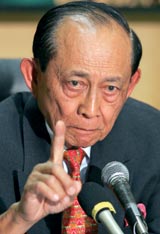 |
When he is not entertaining the media, politicians and business leaders, Ramos is travelling, promoting his vision and version of his country. He maintains an impressive schedule. He pulls open a filing cabinet and removes a sheaf of papers. “I’m not idle here, ” he says. “I created this foundation because of my concern for the people.” He flicks through reams of RPDEV research and surveys: “Look at these reports, look at my travel schedule. I have done all this at no expense to the government.”
Aside from the political future of the country, and as part of his activities with RPDEV, Ramos believes that the Philippines needs to find its niche in the world using its resources to best advantage: “We have seven thousand islands,” he says, “that’s a great advantage in logistics management, in supply-chain management. Global commerce has shifted to the South China Sea and the Pacific and we’re the nearest of the southeast Asian nations to China. We have plenty of niches – IT call centres, telecom, media, entertainment, graphics. We have all of these things God-given, so why are we still so backward?”
“I challenge congress to pass a law banning Cory, me and Estrada from running again. If I violate it, put me in jail!”The answer to that question, of course, comes full circle to the political problems. If the Philippines is ever to realize its potential, its political future must be secured first. If Ramos really is out of the running and with the GMA administration looking increasingly tarnished, the country badly needs a new viable leader to emerge who can unite the country, politicians and business leaders.
Luz, of the Makati Business Club, is looking to the younger generation for political leadership. “We respect the guy,” he says of FVR, “but it’s time to move on. We need someone younger; leave ex-statesmen where they are. We’d love to have someone from the business community, but we don’t see it.”
CLSA’s Dy remains optimistic and sees a role for Ramos. “I’m positive that things will work out,” he says. “Things here tend to work out at the last minute. By nature we’re not combative, there’ll be a compromise. The first prime minister, if it ever happens, will happen with the blessing of Ramos. He can be the king-maker.”
Aurelio Montinola III, president of Bank of the Philippine Islands, is also optimistic and looks to history for an answer. “I’m either optimistic or naïve,” he says, “but people are so fed up they’re going to come up with a Filipino solution. It’ll be a solution that works. In 1986, whoever thought there was something such as People Power?”
Fidel Ramos played a crucial role in the People Power movement that toppled the dictatorship of Ferdinand Marcos in 1986. Although the events that lead to the next leadership succession might prove to be less dramatic, their resolution is no less important to the future of the country, and Fidel Ramos is likely to play an equally important role.


