In your latest quarterly inflation report you suggested that you’d overshoot the target. Is that correct?
 |
|
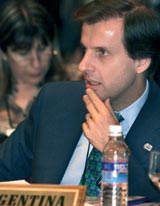
Martin Redrado, President Banco Central de la República |
We didn’t exactly say that. What we said was that the deceleration in inflation that we had in the second quarter was not going to continue. We had 2% inflation in the second quarter and the reasons behind this will not continue.
Some people interpreted that as saying that inflation was going to increase. What we said is that in the first quarter inflation was 4% and there was a strong deceleration in the second quarter, but this has made it difficult for us [to hit] the 8% target we have for this year.
So what rate do you envisage this year?
I don’t want to make a projection in the middle of the year. What we have to analyse is: what are the factors that lie behind the new environment that we face? Core inflation, that is, taking out seasonal products and regulated products, is projected to be 5.7% this year.
[Elsewhere] the price of natural gas is going up, as is the price of electricity. A one-time adjustment in relative prices is logical because these were prices that lagged the currency [devaluation of 2002].
That is why we emphasized [the need to freeze the planned] salary increases – in order to send a warning. If we have salary increases, that would be very harmful for the economy. The executive was thinking of increasing retirement benefits and public-sector benefits for employees. At the moment, they have frozen that policy.
What we have done since the beginning of the year is change the bias of monetary policy. For the first time since getting out of the recession we have started increasing interest rates. We raised rates by between 250 and 300 basis points in the first semester and that has allowed a fall in the monetary base in real terms by 3.9%. We are in a contractive rather than expansionary mood.
You say the inflation target is 8% this year. The market thinks a level of 10% is more probable. At what level would you start getting worried, given the psychological impact of inflation in Argentina?
It is a concern, but we have a programme that is based around monetary aggregates. You may ask why [does your policy revolve around] monetary aggregates, as few central banks use it as a policy tool? I would answer by saying that when you get out of a crisis you have very few instruments.
Even though we have shrunk the monetary base, our capacity to affect the real economy is limited because the credit market [in Argentina] is only 10% of GDP.
Would you tolerate an inflation rate of more than 10%?
No, I wouldn’t tolerate more than 8% but what I’m saying is that [we] don’t have the tools given our small credit market and the fact that we’re emerging from a crisis.
What we need to look at next year is how fiscal policy will behave and, in particular, how contractive it will be. We will do whatever we can to keep inflation in single digits, knowing that we are achieving our targets in terms of monetary growth. The monetary base has decreased for [the past] eight months.
Unfortunately there have been some exogenous factors, such as an adjustment in relative prices and a decrease in the primary surplus.
Are you implicitly blaming the government then?
I wouldn’t say so. Clearly there hasn’t been the fiscal restraint needed to keep inflation at that level. Also there’s been some delay in the adjustment in relative prices. The government has taken note and that’s why it has frozen planned pensions increases.
Your strategy has been geared towards controlling price rises in specific sectors as opposed to a general tightening of monetary policy. Will that continue?
There has been an important tightening in the first six months and our policy is to sterilize the excess that we have on our trade balance. We have been buying dollars and increasing our reserves. Our reserves are at an all-time high of $24.5 billion. That is a prudent way of reducing Argentina’s external vulnerabilities.
The IMF has criticized your policy of intervening in the markets and says you should be more focused on price stability than FX intervention. How do you respond?
I am always concerned about double standards, because why is what is good for Mexico or Russia not good for Argentina? The question is: how much do you sterilize? Argentina is sterilizing almost all that is excess in the trade surplus.
What you need to look at is the transmission mechanism of monetary policy. There is no technical argument to suggest that the purchase of dollars [represents] a lax monetary policy. When we buy dollars we buy them from banks. This is not a case of printing money to finance the public sector.
You’re not worried your intervention policy could lead to a quasi-fiscal deficit?
Not really. The central bank’s balance sheet is at its strongest for 20 years. We have a quasi-fiscal surplus of about Ps2 billion [$697 million]. We have room to continue sterilizing because we have that added muscle that the central bank didn’t have previously.
Moving to the banks: there are still many problems, but do you think they have begun to turn the corner?
I think they are really turning the corner. If you look at the first semester they are showing for the first time [since the crisis] a positive return on assets of close to 1%. In the past six months, we
have created a new business environment. The banks have been unfortunately blamed for part of the crisis. Part of my mandate was to turn over the page and to help improve the business environment.
In terms of capitalization, six foreign banks have recapitalized by $600 million in the past six months. That is still a small amount, but what you have seen is that, for the first time, shareholders are beginning to take a different view [on Argentina since the crisis]. Credit is growing by 32% on average, liquidity is at an all-time high, and solvency too is at an all-time high.
What is behind their making profits?
A sharp increase in consumer lending [and] short-term corporate lending – that is, up to a year. The key challenge is to [start encouraging] institutional investors in Argentina, such as pension funds, to become end-buyers of financial products.
But these pension funds are also laden with government debt, aren’t they?
Yes, but they have about Ps350 million that they are eager to invest in longer-term securities. Unfortunately, there is a problem with the stock but the flow is becoming a healthy one and people need instruments to invest in. There are some asset-backed securitization deals denominated in pesos that are taking place and being bought by pension funds and insurance companies.
What are the big challenges facing the banks?
The big challenge is the mismatch between assets and liabilities. We don’t have a futures or swap market that will allow them to hedge their exposure in FX or fixed versus floating exchange rates. Also banks need to lengthen the duration of their portfolio and for that we need longer-term funding.
One of my key challenges is [to encourage] greater interaction between the banks and the capital markets. When you look at the bottlenecks in different sectors of the economy there is a clear need for more investment and more long-term financing in local currency.
We have recovered the transactional value of pesos but we haven’t recovered the longer-term capacity to save and to invest and to have a credit market in pesos. We need to expand the credit market to encourage longer-term credit in pesos and have a stronger monetary policy that can anchor inflationary expectations.
Does the regulatory environment need to improve?
No, it’s more of a case of creating more capital markets instruments. Some of them will need the backing of the central bank. Obviously we will not take the risk that the market should take but we are evaluating how we can give a push to the derivatives market and other capital markets instruments that will lengthen the duration of the portfolio that banks have.
Have you made the push yet?
We have started work on the futures market. We are a market-maker, for example, in the futures market for dollars. We are looking at swaps that will allow [investors] to swap fixed-rate instruments into floating rate. We envisage that to be fully [operational] in the second half of this year.