Land Securities
The company developed a structure that provided unparalleled flexibility
|
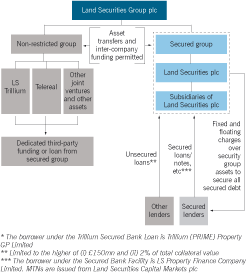
Land Securities’ capital structure The three-tier approach |
|
Land Securities dramatically broke out of a corporate finance straitjacket last October. The UK commercial property company created a new capital structure that bridges the gap between unsecured borrowing and commercial mortgage-backed securitizations/whole business securitizations. Furthermore, it executed a complicated liability management exercise, efficiently refinancing its large debt pile and yet treating its existing bondholders as long-term strategic partners. Alongside arranger Citigroup, Land Securities developed a unique, efficient and flexible funding structure that was carved into secured and unsecured parts. The former is a highly innovative arrangement that included some £6.2 billion of assets that account for about 70% of the investment portfolio.
The key reason for implementing such a debt formula was to enable the company to grow in the short and medium term without undue restrictions.
“It came about from a frustration with the existing debt strategy, which was a cocktail of secured and unsecured debt,” says Martin Wood, group tax and treasury director at Land Securities. This debt sat uncomfortably on the balance sheet, Wood explains, because the secured debt has priority over the unsecured debt.
The innovative, tiered structure offers Land Securities the ability to use its real estate assets in a more efficient manner, providing greater leverage. It has no requirement to sell assets into new special purpose vehicles but rather can simply utilize the existing programme when fresh assets are acquired. It now enjoys, at the lower leverage levels, the freedom to buy and sell property assets with minimal restrictions. Only when the company moves from one tier to another – from moderate to higher loan-to-value ratios and differing interest coverage ratios – will tougher covenant language be implemented, incrementally introducing bondholder-friendly regulations that the borrower must adhere to.
This bespoke, three-tier package offers hitherto unparalleled flexibility for a secured real estate borrower from a corporate finance perspective. The structure is even REIT-friendly should the company wish to pursue that strategy. At the same time, Land Securities enjoyed a rating upgrade from single A to double A while increasing leverage to twice the previous figure.
Land Securities’ deal is the largest real estate financing to date and broke down into a £4 billion ($7.3 billion) Eurobond programme and a £1.5 billion syndicated bank facility. In addition, £1.8 billion of existing debt was refinanced into £2.4 billion of new securities without incurring punitive penalty payments in the form of what is known as a Spens clause (where, if there is premature redemption, the issuer has to pay the investors the price equivalent to the yield on the underlying benchmark) in return for a range of covenant improvements.
The result of all this is a substantial increase in Land Securities’ financial headroom. This outcome was a function of Land’s acceptance of explicit covenants in return for a capital structure that can take a number of different forms and provides enhanced operational flexibility vis-à-vis other options.
The migration of £1.8 billion of debt into a new security group – comprising £1.8 billion of unsecured bonds and £800 million of debentures – was not a forced restructuring, so investors had to be persuaded of the real benefits of getting involved.
In the event, the 800 debenture and bondholders found ample justification. Lower borrowing costs were a direct consequence of the new combined debt and loan package. The previous weighted average cost on the bonds was 8.51%, and the weighted average cost of debt for the group was 7.64%. This was to tumble to 5.44% for the bonds and 5.63% for the group as a whole.