Pedro Pablo Kuczynski: Peru
 |
|
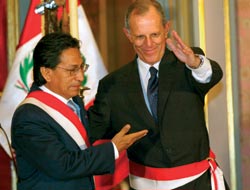
Kuczynski (right) has taken Peru back to the international markets |
NOT ALL PERUVIANS love Pedro Pablo Kuczynski, who was, until August, their finance minister and is now prime minister. From the time he took on the job of managing Peru’s $68 billion economy in 2001, the Oxford and Princeton-educated economist was harassed from all sides to loosen the purse strings and lavish money on teachers’ pay rises, angry bus drivers, overworked doctors and populist government subsidies for the poor. To his credit, Kuczynski mostly said no and in fact brought Peru’s fiscal deficit to a five-year low of 1.1% of GDP last year. But some unions and left-wing politicians sought revenge, claiming that a foreigner cannot hold office – Kuczysnki is also a US citizen. They succeeded in blocking him in 2002, albeit temporarily, when he was forced to step down as Peruvians violently rejected his plans to privatize two electricity utilities and president Alejandro Toledo’s unpopular government came close to collapse.
But ever since Kuczynski was reappointed in late 2003, his star has risen. With a seemingly permanent half-smile on his face, the 66-year-old took Peru back to the bond markets, restructured its external debt, brought stability to Toledo’s crisis-hit government and has overseen some of Peru’s best economic growth in its 184 years of independence. “I do it for the good of the country. I’m a modest person, I’m not looking for fame,” says Kuczynski, the son of a Polish musician and himself a talented flute player, in an interview with Euromoney.
One of his most impressive achievements is his pre-payment of Peru’s Paris Club debt. Following similar agreements made with Poland and Russia by the grouping of 19 creditor nations in late July, Peru wrapped up $1.55 billion in financing to prepay the club, which includes the UK, France and Japan, on August 15. With his fine-tuned knowledge of capital markets, the former fund manager helped Peru avoid a looming build-up of payments this year.
Peru owes the Paris Club $1.08 billion this year, a jump from $370 million in 2004, out of a total outstanding debt with the club of $8.5 billion. The accord should save Peru $350 million a year between 2006 and 2009, and slightly less this year. The deal came after Peru’s first bond issue in euros earlier this year and after Kuczysnki had taken Peru back to the international markets in 2002 after a gap of more than seven decades.
He has had some luck on his side. Record international metals prices have enabled Peru to notch up four years of consecutive economic growth, as its key mining sector helped exports soar to a record $12.5 billion last year. Between 2001 and 2006, the economy will have grown almost a quarter and this year’s growth, at 6%, is set to be the best yet, Kuczynski says.
Growth next year could fall to between 4.5% and 5% because of the uncertainty that traditionally surrounds Peru’s elections, due in April, but the fundamentals are still strong. “Peru’s economic figures are likely underestimated. It is probable that our growth might be a percentage point higher than the statistics say,” says Kuczynski.
Although the man often known as PPK says he is much more at home on his farm in Wisconsin than on the grinding streets of Lima, he is not ready to retire with the change of government next July. His recent successes have seen him appointed to the post of prime minister, a position he might keep in any new administration. “I’d do it for a five-year period, not a day more,” he says.
Although no longer directly in charge of the economy, he still has plenty of influence and will be key to helping meet Toledo’s fiscal deficit target of 1% of GDP this year. This target has been partly undermined by recently announced plans to create two new ministries and a fund for the poor. Kuczynski confesses that he is concerned about these moves. “As one of Toledo’s ministers, I should support his proposals, but I haven’t hidden from him that I’m nervous about the idea of new ministries,” he says.
Even without the new portfolios, says Alejandro Indacochea, an economist at Peru’s Catholic University, Peru could be on course for a deficit of 2% of GDP after the government increased this year’s budget by $400 million to pay for salary rises and subsidies for the poor. That is a worry for bondholders, as a deficit of more than 2 % of GDP prompts fears of more government borrowing and less money for debt servicing.