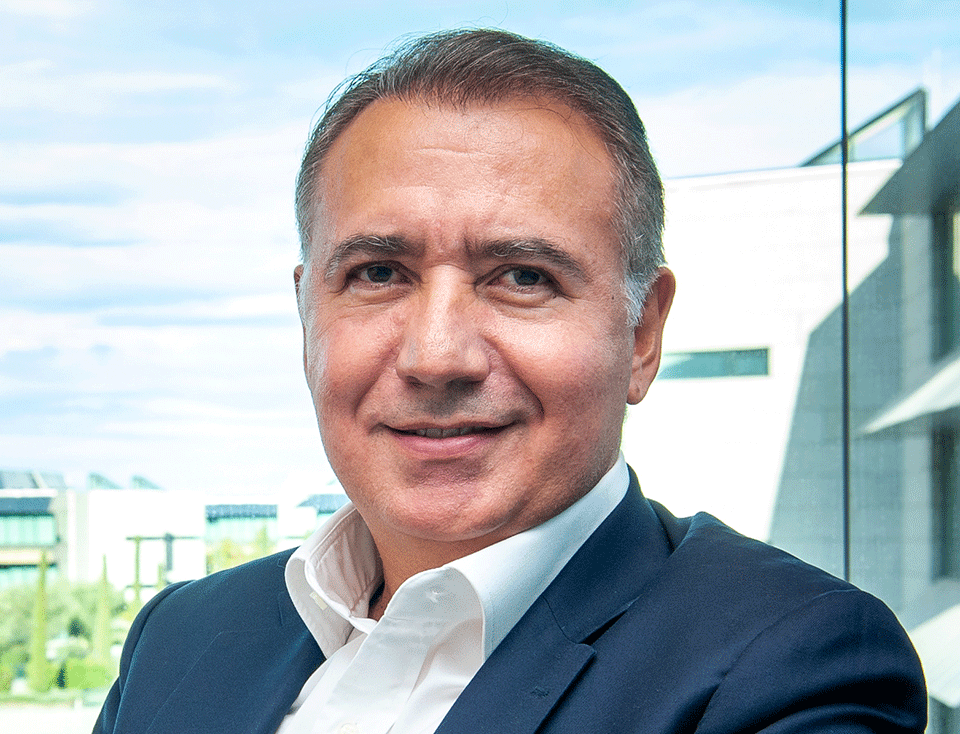
THE NEW PRESIDENT and CEO of Malaysia’s electricity generating and supply monopoly Tenaga Nasional Berhad (TNB) has a lot on his plate.
“It’s very exciting,” says Dato’ Che Khalib Mohamad Noh enthusiastically. “I wouldn’t want to go to a company that’s easy and boring. TNB has a lot of challenges. It keeps me going!”
He is not exaggerating. Appointed in May 2004 as part of a shake-up of the sleepy power company by government holding company Khazanah, Che has as his first task an effort to get to grips with the high level of borrowings inherited from his predecessor. These stood at almost 220% of shareholders’ funds at the end of 2004, although they were reduced to 186% in the second quarter of 2005.
“We don’t have enough revenues to cover the capital expenditure, so the company has had to borrow to sustain its capex,” says Che. “We’ve been telling the government that we need a tariff increase because this is not sustainable. We have to address this fundamental problem the company has.”
Discussions with the government on increasing power rates are under way. So far, says Che, his entreaties are receiving a sympathetic ear.
“In principle, they understand,” says Che. “We’ve told them if they don’t address the problem directly, the company will suffer and so will the power.”
Che is blunt about the prospects for Malaysia and the economy if this issue remains unresolved. “A lot of people told me that the TNB business is simple,” he says. “Yes, TNB has a level of monopoly, but we’re a regulated monopoly. Everybody expects an uninterrupted power supply – it’s not like a mobile phone if a call drops. I always say that TNB will be very visible when other people are in darkness!”
Despite the continuing arguments with the government about tariff increases, Che claims TNB has a good relationship with Khazanah itself and welcomes the recent changes. “It’s a better arrangement now, having Khazanah look after the GLCs [government-linked corporations] on behalf of the government,” he says. “Now they’ve professionalized Khazanah, [the government] knows it has the skills and knowledge to monitor the performance of the GLCs.”
Monitoring is one thing, but interfering is another. Some analysts point to the M$1 billion ($266 million) acquisition in July by TNB of three bust domestic power companies, including Northern Resources Utilities, as evidence that Khazanah still exerts strong influence over the GLCs. “What’s really changed at the GLCs?” asks one analyst in Kuala Lumpur. “You’re still seeing the things you used to see before. Look at the acquisition of Northern Resources by TNB. Everyone knew there was only one buyer: it was already bust. They [TNB] should’ve bought it for a song, but they paid over book value. The rumour is that they did it to bail out the banks, most of which are owned or controlled by Khazanah.”
Khazanah is also accused of playing nursemaid to the GLCs, with some pointing to the government’s transformational manual handed recently to GLC leaders as evidence of an overly prescriptive, hands-on approach. Perhaps predictably, it is a charge that Che rebuts. “This is a radical change,” he says of the government’s new strategy towards its GLCs, “and they have to elaborate it so that people understand fully. The manual is a blueprint for us to prepare our own procedures. At least with this book we know what the government wants to be done.”
Staying at home With so much housekeeping of his own still to accomplish, Che is keen to play down TNB’s acquisition activities, especially overseas. The firm has invested in a Saudi Arabian power project alongside Khazanah and Malakoff (a private Malaysian company), however, and, as Che points out, it is already exporting some of its electricity to neighbouring countries, an activity that is of growing importance. “Asean is a region for us that works well,” he says. “We’re already selling electricity to Thailand – 10 times the amount we sold last year. In the years ahead we’re looking at the linkage with Indonesia. There are also opportunities to supply to Singapore – we already have the connection. Ten years from now they’re probably going to need it.”
Despite the opportunities abroad, for the foreseeable future Che’s feet remain firmly planted in Malaysia. “We’re very selective about any overseas investment,” he says, “because at the moment we have a lot of issues to resolve here. There’s a lot of housekeeping to be done and our plan is to make sure our house is in order in the first five years.” In fact, Che believes it will take a decade before TNB is ready to make meaningful forays abroad, at which point his immediate destination, as with many GLCs, is likely to be Indonesia.
“In about 10 years from now, TNB should be in a more confident position to consider seriously spreading its wings overseas,” he says. “We have a lot of capital building to do in terms of human resource skills and establishing a better financial standing.” Che clearly understands the task before him and is adopting a realistic approach to tackling Tenaga’s issues. While TNB wrestles with its problems at home, however, the land grab for dominance of the region will continue and TNB will fall further behind.
Already, private Malaysian power companies such as YTL and Genting are moving abroad and other regional players, such as Singapore Power and Hong Kong’s CLP Holdings, are not waiting for TNB to get its house in order. Perhaps Khazanah will step in to play a protecting role, warehousing regional investments that can be injected into TNB at a later date. Whatever the solution, TNB already faces an uphill task at home. Without the protection of a monopoly and an increasingly competitive environment, the slope abroad will be steeper still.