 |
NINE MONTHS HAVE passed since the Orange Revolution swept Viktor Yushchenko and his prime minister Yulia Tymoshenko to power in Ukraine, and both must be feeling that their honeymoon period in office is over.
Ukrainian citizens and foreign investors alike are demanding results. The heady and wide-ranging promises that the two politicians made as they took charge earlier this year must now be put into effect if they hope to consolidate their position in the run-up to parliamentary elections in March 2006.
Some cracks are also beginning to show in their relationship, notably over the extent to which so-called “illegal” privatizations conducted under the previous president should be examined and rerun.
“Ukraine’s political system is evolving positively, but not rapidly so,” noted a Merrill Lynch research report published at the end of August. “The country has made steps forward toward a more pluralistic and democratic society, thereby enhancing its chances of long-run integration with the EU. However, political power struggles are still eclipsing economic reform, a noticeable difference to more advanced convergence countries.”
The government has to confront several issues concerning the economy. GDP growth is down from more than 12% last year to below 4% for the year to date. The country’s trade surplus has been eroded and is likely to drop from 10.5% of GDP in 2004 to between 5% and 6% this year. Annual inflation reached 14.8% year on year in July, up from 12.3% at the end of 2004, 8.2% at the end of 2003 and price stability in late 2002.
Tymoshenko’s government has also followed a policy of increasing social spending, in a bid to secure popular support in the run-up to next year’s elections.
 |
|
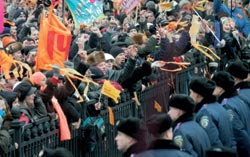
People brought Yushchenko to power in the Orange Revolution. Now can the president give the people the economy they want? |
But despite this somewhat gloomy prognosis, there are signs that progress is being made. Last month, for instance, the government announced that the resale of Krivorozhstal, the country’s most contentious privatization under the last administration, would take place in October. Furthermore it set an opening price of $2 billion for the sale, $1.2 billion higher than the figure originally paid by the consortium led by former president Leonid Kuchma’s son-in-law last year. And investors clearly see value in Ukraine – whether through the stockmarket, which posted new highs in August, or in the potential consumer market that Ukraine’s population of 48 million provides. Last month, for example, RZB International wrapped up a deal to buy Aval Bank, Ukraine’s second-largest financial institution.
Concorde Capital, one of Ukraine’s leading equity brokerages, also announced in August that it had joined forces with Colliers International to launch a $100 million real estate fund — one of the country’s first.
After months of procrastination about its international financing plans, the finance ministry has announced plans for a A600 million 10-year Eurobond, which is probable either in October or November. This will be the first opportunity for international investors to get their hands on new sovereign debt since Yushchenko became president. The appetite they show for Ukraine’s paper should give a good indication of how they judge his progress.
The presidential election demonstrated splits within Ukraine. How do you intend to unify the country?
During the election period, two-thirds of my compatriots wanted radical changes in the way Ukraine was governed after 10 years of rule by my predecessor. They wanted an end to government corruption, which was evident in all aspects of their daily lives, from the tax and traffic police to high-level government stealing. All this was done as the population drifted further into poverty. Ukrainians are united when it comes to wanting more economic opportunities and freedom of choice to improve their lives and become less dependent on the state and government bodies. A majority of them see their future and that of their country anchored firmly in Europe, not only geographically, historically and culturally, but more importantly, politically and economically. This is our long-term historic goal. Therefore, to understand Ukraine fully one should not confuse a snapshot of election politics with Ukraine’s long-term geopolitical aspirations.
What are your specific economic goals?
After forming the government in February, our first priority in budget policy was increasing living standards for the most needy in society. This included raising pensions and wages for state workers. Measures were taken to level the playing field with regard to tax and other privileges, close budget loopholes and end shady budget schemes, which were siphoning off government revenues. Line by line we went through the budget examining whether or not economic measures could be taken to increase revenues to pay for essential social expenditures. We found a workable solution to an unbalanced budget inherited from my predecessor. More modification and changes are planned as budget priorities and related policies for 2006 are identified.
The task of my government at the macro level for the next two or three years is to ensure 6% to 7% GDP growth a year and 7% to 8% inflation rate; to increase the rate of GDP redistribution through the budget to nearly 40%; and to create annually at least one million jobs.
The total volume of accumulated foreign investments in Ukraine – $8.8 billion – is still insignificant. We are planning to increase foreign investment flows from $1.6 billion in 2004 to $5 billion in 2005 and to uphold this process.
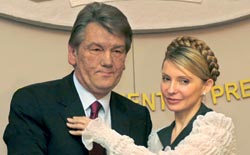 |
| Yushchenko and Tymoshenko: still united? |
With regard to Ukraine’s international economic relations, the following goals are being pursued this year: recognition of our market economy status by the European Union and the US; World Trade Organization membership; and repeal of US Jackson-Vanik trade restrictions. Eventually, we are striving to create free-trade zones with the EU, Russia, Belarus and Kazakhstan. These measures will integrate Ukraine further into the global economy, make our goods and services more competitive and be a source for numerous investment opportunities and projects. Over the long term we will transition shadow business activities into the legal economy. Two components of this include improving tax policies and collections, which decrease tax rates and in turn broaden the legal tax base. Another component is deregulation policies that remove unnecessary government interference from day-to-day business activities. Both measures will decrease opportunities for government corruption throughout all levels of the bureaucracy.
Independent analysts have raised concerns about your plans to cut the fiscal deficit and have stated that your assumptions are optimistic. How do you respond and can you outline how you plan to bring the deficit down?
Analysts believe assumptions are optimistic because they cannot imagine the vast amount of budget revenues siphoned off by shady deals in industry sectors where the dominant player was a state monopoly. This includes sectors such as transportation, energy, telecommunications and the post, to name a few. Here alone we’ve been able to close the budget deficit by several percentage points. Another important element is reducing excessive budget expenditures and introducing truly independent and transparent tenders for the state’s purchase of goods and services. We will do away with tender coefficients previously given to privileged businessmen with close ties to the government. State infrastructure projects will come under intense review and scrutiny to avoid corruption and theft. By increasing revenues and reducing waste, we are confident budget deficit margins will be reduced and managed effectively.
You have promised commitment on childcare and pensions. How can you succeed in following through on these promises without making the fiscal position worse?
There are two sides to the balance sheet. And during the past half-decade of Ukraine’s remarkable economic growth, my political allies and I continued to ask why budget revenues are not increasing accordingly to pay for basic government services. After three months in office, we’ve uncovered budget revenues being stolen by those in political office abusing their authority. As a result, a number of criminal cases have been launched.
Therefore, the increase in pensions, minimum wages and salaries for state workers will stimulate private consumption and so will have a net positive impact on the local economy by increasing demand for basic goods.
There have been mixed signals over your reprivatization plans. Can you clarify what privatizations you will look at again, what the procedures will be, when these reprivatizations are likely to be done and how much extra money they might bring in?
We are not talking about reprivatization. We are conducting an administrative review of those privatizations of state property conducted with procedural violations, which resulted in state property being transferred to private hands without competitive tenders, objective valuations and using other types of machination. If there are such privatizations, court actions and arbitrations will be filed to resolve discrepancies in privatization procedures.
What new privatizations are you planning and, again, what will be the procedure, when are they likely and how much money will they generate?
Presently the government is elaborating a programme defining public policy in this sphere and subjects for privatization. It should be mentioned that the priorities have already been assessed. First of all, unprofitable state-owned enterprises and those demanding investments for their functioning are to be closed down.
As to the amount of funds raised through privatization, it is due to fill the state budget by Hrn6 billion [$1.2 billion] this year. However, one of the government’s main tasks is to receive revenues not only from selling enterprises but also through the encouragement and improvement of state corporate rights management.
What assurances can you provide foreign investors and how are you planning to encourage them?
The best encouragement of foreign investment is a legal guarantee that a level playing field will exist for all investors, regardless of their nationality. Independent courts will guarantee and protect investments. In addition, anti-monopoly legislation and rules are being applied more strictly to ensure a level playing field is not being influenced by collusion and other practices of unfair competition.
We are planning to re-establish a foreign investment advisory council in Ukraine to stimulate investments, enhance dialogue with foreign investors and remove the impediments to their activity.
The government is also setting up a foreign investment agency that will assist investors to launch businesses in Ukraine.
Will you encourage Russian investment? If so, in what areas and how will this affect Ukrainian business interests?
We encourage all investment. However, there are no special privileges given to investors based on their nationality.
Last year there was capital flight from Ukraine. How concerned are you that more money will leave the country?
In the near future we expect a completely different situation: we will stop the outflow of capital and increase the volume of foreign investments significantly, having improved the country’s investment environment. As has already been mentioned, in 2004 the investment growth rate was $1.6 billion and we are planning to raise it in a short time.
Creating economic conditions that encourage businesses to operate legally and transparently is one of the greatest means of fighting against capital flight.
How do you respond to criticism that your ministers lack the necessary experience?
I’m satisfied that the prime minister and her team are highly qualified professionals with sufficient previous government service and with ample legislative affairs experience. I’m confident they will guide the country, as a whole, to sustained economic growth, and in particular will bring order to various industry sectors, making them more transparent, competitive and efficient.
How would you characterize your relations with prime minister Tymoshenko?
I appointed Yulia Tymoshenko prime minister because we are political partners who share the same values and mission for our nation. Our common vision about the way government should function, the basic services it should deliver to all citizens and the strategies to implement reforms and changes for the betterment of Ukraine align us. Together with our political allies we will improve the lives of Ukraine’s 48 million citizens.
You say you want Ukraine to be a member of the EU within 10 years. Are you drawing up specific goals that need to be met by certain dates over the next 10 years to achieve this ambition?
One of my first visits as president of Ukraine was to Brussels, where I signed a new joint EU-Ukraine action plan, which has an implementation term of three years – beginning in 2005 and ending in 2007. During this autumn’s Ukraine-EU summit, a progress report on implementing the new plan will be made. In early 2006 we will again analyze progress and take the appropriate next steps. The action plan is far reaching and outlines a wide range of issues under the neighbourhood rubric, the successful implementation of which will bring Ukraine closer to the EU. The action plan calls for deepening trade and economic relations between the sides, cooperation in the areas of energy, transportation, protection of the environment, modifying legislation in line with EU standards and closer cooperation in the area of international relations and security. The action plan also calls for the creation of a free-trade zone between the sides, which will become possible after Ukraine’s membership of the WTO is complete. When the plan is realized fully in 2007, it will coincide with 10 years of cooperation and partnership between Ukraine and the EU. Thereafter, we can foresee a new, more intensive plan being signed between Ukraine and the EU in 2008, the cornerstone of which would be Ukraine’s associate membership in the EU. The major benchmark in our relations will be the progress made on realizing these action plans, which will serve as the roadmap to EU integration.




