
AUSTRALIA HAS LONG entertained an on-off relationship with Asia. Wander around the neat streets of downtown Sydney and it is easy to assume that you must be somewhere near the region: Asians already account for a significant proportion of laid-back Sydneysiders and evidence of their growing influence is everywhere.
Despite this apparent connection to Asia, Australia’s track record in capturing opportunities thrown up by the world’s fastest-growing economic region has been patchy. In its debt capital markets, success has been almost non-existent. Australian dollar issues from foreign borrowers, termed kangaroos, feature few Asian names. In the past five years there have been just six by genuine Asian issuers, raising US$1.2 billion equivalent. And four of those came from the Asian Development Bank.
Compare that with the US$85 billion raised from nearly 850 kangaroo issues by US and European issuers over the same period and the scale of the discrepancy is clear. It is an issue that National Australia Bank is keen to address. Speaking at its Asian Issuer conference in February, an attempt to get Australian investors and large Asian corporations to talk bonds, NAB CEO Australia, Ahmed Fahour, made the point clearly enough. “There’s going to be money to be made out of Asian companies, and if Australian investors are not interested, there’ll be many more others who’ll take up the opportunity,” he said. “It’s up to us as Australians to take the gift that’s been put in our hand.”
There is not much evidence that Fahour’s warning is being heeded. Indeed, it appears to be other, mainly US and European investors that have chosen to grasp Asia’s gift. Last year there was record bond issuance by Asian sovereigns, quasi-sovereigns and investment-grade companies, with more than 90% of foreign-denominated debt issued in US dollars and the balance in euros. Allocations to investors vary according to the nature of the credit and specific demand dynamics at the time of launch, but books for Asian credits are always split between US, European and, increasingly, Asian investors.
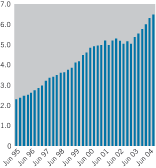
So where are the Australians? It is not as if they do not have the money. “Demand [for bonds] is consistently increasing,” says Philip Bayley, head of fixed-interest credit research at NAB in Melbourne. “The reason is the demand-supply imbalance, especially due to the superannuation contributions. At the end of September 2004, there was already A$650 billion [US$514 billion] in [superannuation] funds under management. It’s a compulsory system. Fund managers are desperately looking for assets – property, shares and bonds.”
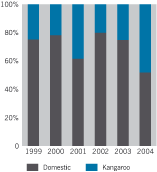
That demand has increased foreign issuance in Australian dollars – cumulative kangaroo issuance reached A$20 trillion in 2004 to reach almost 50% of all bond issues according to NAB Markets (see chart) but so far the only meaningful Asian contribution, says Bayley, has been on the buy side.
“Most of the Aussie dollar issues come from North America and Europe,” he says. We’re getting the Asian participation in the deals, but not the Asian issuers yet.”
There are a number of reasons for this discrepancy say the apologists. First, despite the sophistication of most aspects of Australia’s financial markets, the debt markets lag badly. “It’s really a very young market,” says Bayley. “You can really only trace it back as far as 1996. The movement away from government [bonds] to corporate [bonds] has only happened since the government started to run surpluses.”
According to Brian Cahill, managing director corporate finance Asia Pacific at Moody’s Investor Services in Sydney, that transition from government to corporate has barely begun. “The true corporate sector is absolutely tiny here,” he says. “Plus a lot of it is monoline guaranteed by AAA institutions. The only sector that has successfully tapped the [debt] markets is Reits [real estate investment trusts].”
The immaturity of the debt markets has been exacerbated by the lack of quality credit research at fund managers, which in turn has led to a strict adherence to the investment-grade sector, a fact reflected in the mandates of most fund managers.
Discomfort
|
Total debt issuance Kangaroo versus domestic (%) |
|
“All the Australian investors are sitting there with a lot of money to invest,” says Cahill. “A lot of the credit skills are still evolving so they’re naturally conservative. So you’re seeing a lot of demand but also hesitation around anything below an AA. They know that they need to invest in lower-rated paper, but there’s a discomfort with the credits.” Greg Stock, fund manager at Perpetual Investment Management in Sydney, reflects this conservative approach and offers an explanation as to why most Asian credits are off his radar screen. “The big factors here in terms of corporates are liquidity and mandates requiring investment grade ratings,” he says. “In Asia, there aren’t too many companies that can issue here for those reasons which is why it’s been mainly sovereigns and policy banks that have issued in Australian dollars so far.”
That may be so, but as NAB’s Bayley points out, the growing liquidity problem coupled with restrictive investment mandates will start to push investors, however reluctantly, towards Asian credits issuing in the local market. “Most people want liquidity but very few can participate in the international markets due to their mandates and it’s not easy to change them,” he says. “So they have to start to invest in Asian issues and Australia has become an attractive market to issue into.”
Perhaps, but everyone agrees that before wholesale Asian kangaroo issuance takes off, Australian investors have got to lay to rest the ghost of Asia’s financial crisis. Unlike US and European investors, who have clearly moved on after the crisis and have been investing aggressively in Asia for several years already, Australian investors still stumble over the crisis hurdle.
“The Australian corporate debt market is relatively new and is still evolving,” says John Sorrell, director structured products and credit, cash and fixed income at Merrill Lynch Investment Managers in Sydney. “It’s partly blindness on our part for not having more Asian issuers, we’re still revisiting our views after the Asian financial crisis. It’s probably Australian fund managers’ natural conservatism.”
It does indeed seem overly conservative to be mulling over an event that occurred almost eight years ago, but as Sorrell points out, Australian fund managers got caught out badly. “If you were in the financial markets at that time, it was a big issue. KDB [Korea Development Bank, a state-controlled policy lender] had issued [here]: it went sub-investment grade and a lot of investors got hurt. It was a substantial psychological event so Australian investors have been a bit resistant since.”
Frustration
It is an attitude that clearly frustrates Craig Marran, head of fixed income and originations, Asia, for NAB in Hong Kong, who was instrumental in organizing NAB’s Asian issuer conference and has been ploughing a lonely Asian furrow. “We suggested this conference about three years ago. The word then was: ‘ it won’t work’. When I asked why not, people cited the Asian financial crisis – that was six years ago back then: they’ve got long memories.”
The first real sign that perhaps memories were fading came in 2003 when NAB brought KDB back to the Australian dollar market, a deal that was well received and, Marran hopes, is a harbinger of better times ahead. “We tested the water 18 months ago with KDB but there hasn’t been another pure Asian issue since,” he says. “Investors are being forced to look at Asia. A lot of domestic companies are cashed up and are many have been issuing overseas. Where are investors going to put their money?”
If Australian investors are finally coming to terms with their Asian losses and are being forced to consider deals from the region once more, what of the potential Australian dollar issuers themselves? Most potential issuers remain open-minded as to the opportunity, driven principally as they are by pricing and terms.
“For 2005, KT’s parent needs to raise about W1.5 trillion (US$1.2 billion) in bonds,” says Dong-il Shin, managing director, finance, at Korean telecommunications company KT Corporation. “We are looking at both the Korean and international capital markets, so depending on market conditions, we’ll try to mix. Our policy is to expand and diversify our investor base so if we have attractive opportunities from Australian investors, we’d go ahead.”
He is not alone. Most Asian investors are interested in the opportunity, although hardly in a hurry to tap the market, so wide are their current funding options. In fact, some potential borrowers are clearly attracted as much by the diversification benefits as the specific need for capital. “Most investors in our bonds come from the US and Asia,” says Yang Wen Pu, deputy general manager, treasury department, at government policy lender China Export & Import Bank. “We do want to diversify our investor base and bond distribution.”
Dialogue
|
Superannuation stockpile Australian savings funds assets (A$bn) |
|
|
It is not just greater bond distribution that some are eyeing. “This is the first time that we’ve been to Australia,” says Sung Won Shin, manager investor relations at Korean steel maker Posco. “We’re trying to introduce our company to Australian investors. About 70% of our equity holders are foreign and we already have some Australian investors. But more than 50% [of our holders] are US investors, so I’m looking for other Australian investors.” Although Asian companies might have opened a dialogue with Australian investors, few believe that the Asian kangaroo market is likely to take off immediately. In fact, say some in the market, Australian investors and banks still have some way to go up the credibility curve before Asian issuers are likely to listen attentively. “One Asian issuer that enquired [about Australian dollar bond terms] was told there might be appetite for five-year money up to A$200 million,” says Moody’s Cahill. “The company was too polite to say it, but why would they bother? They can do that in a heartbeat in the US dollar market or with their banks back home.”
So if the Australian dollar bond market is going to open up for Asian issuers, local investors and banks will need to get a lot more aggressive in their outlook. Is that happening? The evidence is mixed.
“The global search for yield is driving a lot of the interest [among investors],” says Merrill’s Sorrell. “But the Asian market is harder. There are currency controls, the political regimes. No-one expects the US government to ban overseas payments but that has happened in Asia. Then there are corporate governance issues, differences in the way companies interact.”
“What do Australian investors look at?” says NAB’s Marran. “Their mandates don’t seem overly adventurous in terms of currency and structured product and they aren’t willing to go down the credit curve too much.”
That may be about to change, albeit slowly. One event cited as a catalyst for Australian investors to open up again to Asia is the change last year in the local benchmark bond index operated by UBS Warburg. After it was amended to include BBB credits, local investors rushed to buy bonds in Tabcorp, a local gaming company that issued BBB+ rated seven-year bonds and raised A$450 million. With so many Asian credits still below investment grade, might Australian investors’ newfound appetite for lower-rated paper be just the spark needed to ignite the Asian kangaroo market? Sadly not yet, it seems, with most local investors cautious about the chances of participation in Asian sub-investment-grade credits, despite evident interest.
“I think it may be changing,” says Sorrell. “I’ve noticed more income-intensive demand. There’s demand here for hybrid and sub-investment grade. But it’s an area that needs a lot of work. We’d prefer to buy Euro and US high yields still.”
That work includes getting comfortable with both issuer and issue, as well as ensuring enough of the deal is available to justify the investment in time. “The first thing is, can I understand the deal?” says Sorrell. “We’ve seen too many people burnt where people thought the deal was great but didn’t really understand it. Size is important: it’s got to be worth the effort to work on them. I don’t want to work for three to five weeks just for A$1 million of stock.”
Strong demand
While Australian investors wake slowly to the opportunities afforded by Asia’s improving credit story, the risk is that the good deals simply continue to pass them by. Recent bond issues from the region have demonstrated a strong demand from Asian credits for raising high-yield paper and there has been no shortage of US and European investors willing to move down the credit curve. That is not something that Australian fund managers are ready for.
“We’re seeing a lot of demand for high yield out of Asia and the US,” says NAB’s Marran. “But you’re not going to find Australian investors buying those kinds of credits, not just yet.”
This suggests that local fund managers will continue to invest principally in local credits. “The volatility of the region,” says Stock of Perpetual, “combined with their lower ratings and our need for higher ratings is why local managers have largely been content to invest domestically and not in Asian markets. That’s one of the reasons why there hasn’t been a natural fit between Asian corporate issuers and Australian financial markets to date.”
Moody’s Cahill sums up the problem neatly. “It’s a market sophisticated enough to know there are risks there but not sophisticated enough to know how to manage them,” he says.
Until Australian fund managers figure out that problem there is little chance of them joining US and European investors in Asia’s rapidly growing debt markets. With no shortage of fresh capital from investors elsewhere, unless local managers awake soon to the opportunities, the region’s best companies are likely to pass Australia by. With a growing need for higher-yielding assets, that is not the result Australia needs.