Telecom Italia
The company has successfully diversified its sources of funding in the past 12 months
|
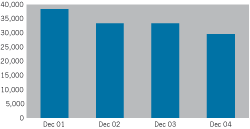
Reducing the debt burden Net debt of Telecom Italia, €mn |
|
Telecom Italia (TI) courted controversy when it became the first corporate to issue a 50-year bond in the euro-denominated market in March this year, but whatever the view on that issue, its benchmark offerings in sterling, dollars and euros, as well as its jumbo loan in the past year, have set important precedents for the company and the market. One of TI’s treasury officials says its recent deals reflect the company’s credit evolution since it merged with Olivetti and integrated Telecom Italia Mobile. “Before the merger with Olivetti, all our debt was in the euro market, but our strategy has been to diversify our funding. With our debut sterling and two dollar transactions, we have achieved this,” he says. “In the same way, we have consistently made sure our bank loan transactions are syndicated to the biggest available group of quality international banks.”
TI’s €12 billion loan this January to fund its €20 billion purchase of the remaining minority stake of its mobile arm TIM, was a highlight of the loan market over the past 12 months. Despite its size, the deal was syndicated extremely quickly and closed heavily oversubscribed. The company’s treasury spokesman says this was because Telecom Italia already majority-owned and operated TIM, and so knew exactly what it was buying and what it was worth: “The clarity of the rationale behind the acquisition meant we could attract a strong amount of bank liquidity very rapidly with very broad syndication.”
In the bond market, the company’s debut sterling bond last June, raising £850 million ($1.56 billion) of 15-year debt, was also extremely popular. The company raised this amount in just a day and a half, with over £1.1 billion in orders. Stuart Bell, head of European corporate syndicate at ABN Amro, one of the issue’s four bookrunners, says it worked so well because TI’s management had preceded it with a discreet UK roadshow. “They achieved a good size and profile by launching an £850 million bond, which at the time of launch was the second largest single-tranche sterling corporate bond ever.” He says the pricing of 130 basis points over gilts was about 15bp less than where the company’s comparable euro-denominated debt trades. “They achieved outstanding pricing in Euribor terms.”
In September, TI’s fixed-rate $3.5 billion 144A bond with five-, 10- and 30-year tranches, again offered competitive pricing. “Access to the US markets allowed Telecom Italia to diversify its predominantly European investor base and raise funding at a material cost arbitrage versus direct euro issuance,” says Jim Esposito, head of investment-grade syndicate at Goldman Sachs, one of the bookrunners on the deal.
The company targeted the sterling and dollar markets not just for one-off cheap funding, but so that it could be a consistent issuer in these markets. “Obviously it would be silly to ignore cost advantages offered sometimes in different currencies, but what we are really looking at is reliability of the market, the quality of the product and the investor base,” says the treasury official.
Whether TI will be able to go back soon to investors that bought into its 50-year, €850 million bond issued this March is rather more doubtful, given its poor secondary market performance. Bankers criticize the fact that Deutsche Bank was the sole bookrunner and that the deal was upsized from €500 million to €850 million, given that long-dated issues are always more volatile in the secondary market. This, in any case, was already selling off because of a spike in oil prices and a profit warning by General Motors in early March.
However, the critics also accept this was a terrific deal for Telecom Italia, giving the credit 50-year financing at just 20bp more than where its 30-year in euros was trading. One investor says that buyers will demand a much higher risk premium next time an issuer tries to do a 50-year deal, but that didn’t stop investors queuing up to buy at the time. “Telecom Italia were very shrewd to take advantage of low rates before they might rise and get a very low coupon,” he says.
“When you’re sole lead manager, you always have some criticism, some of it fair, some unfair,” says Francois Bleines, head of corporate bond syndicate at Deutsche Bank in London. “But we had a market which moved from very, very tight credit spreads with investors chasing any type of security and, within a few days or even hours, the market changed tone from tight to soft. Many deals done at that time were severely impacted in terms of spreads. This deal also opens up new opportunities going forward in the euro market, showing it can be competitive in 50-years with dollar, sterling, or with any other market.”