Republic of the Philippines
|
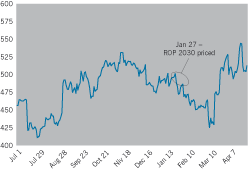
Philippines 2030 bond Spread over US Treasuries |
|
The Philippines has become accustomed to being Asia’s odd man out: sidelined from a rampant economic recovery and saddled with economic challenges and a fiscal straitjacket that are a distant memory for its regional neighbours. Indeed, borrowing in the debt capital markets has been straightforward for other Asian sovereigns over the past 12 months, with vast liquidity driving a strong appetite for Asian risk. But while other Asian sovereign issuers tapped the markets very successfully during the period, most notably perhaps, China, with a €1 billion deal in October 2004, the Philippines just muddled through. In 2004, while investors fretted about the prospects of a downgrade for the Philippines in light of the worsening economic outlook, the government raided the market as best it could, tapping existing issues and raising small amounts of debt whenever possible, to the irritation of the market. “All they did was to tap existing deals and ended up bidding down their curve,” says one banker.
So it seems perversely apt that the ignominy of Asia’s only sovereign downgrade since the financial crisis helped provide something of a turning point in the country’s fortunes when it did in fact arrive in January 2005.
“Sentiment for emerging-market debt was good,” says one fund manager, “and the Philippines was seen as one of the cheapest out there. The downgrade was well flagged and the market was already negative. So when the downgrade came, the market realized that it had been too bearish.”
This partly explains why attitudes towards the Philippines since the downgrade could not offer a more stark contrast to those in 2004. In January 2005, the government launched a $1.5 billion 25-year bond, the largest ever from the Philippines, a deal that has transformed the country’s funding profile as well as its image in the eyes of investors.
Described as bold and opportunistic by some, the deal also completed almost half of its annual borrowing requirement in a single go.
According to Aamir Rahim, managing director and co-head of Asia debt markets at Citigroup, one of the co-lead managers of the bond alongside Deutsche Bank and UBS, it was not just the downgrade that helped the deal but also the fact that the borrower started to listen to the market’s concerns. “They took investor feedback before structuring and launching their deal,” he says. “So it worked from both an issuer and an investor perspective.”
As a result of that feedback, the government also pledged to raise most of its funding from two single deals of benchmark size, which added to the potential scarcity value of the bond and helped underpin its likely success.
“They’re very market savvy,” says Michael Luk, managing director and head of cross-border debt capital markets for Asia at Deutsche Bank. “They’d been watching what some of the other emerging-market sovereigns had been doing: going to the long end [of the yield curve] and fairly cheaply. They saw that was a good opportunity.”
The success of the bond offering is evident from the deal statistics. The book grew to $7.5 billion of demand during the roadshow and pricing guidance tightened to finish at a respectable 503 basis points over 30-year US Treasuries, and barely any premium to the Philippines’ existing 2025 bonds. The bonds also traded strongly in the aftermarket.
In all, some 400 investors purchased the bonds, with allocation even across the US, Europe and Asia, representing the widest distribution ever for a Philippine bond. A large part of the allocations was to longer-term holders, rather than the hedge funds that were chasing Asian credits throughout much of the past 12 months as part of a carry trade.
“There were a lot of real-money investors interested in this deal,” says Rahim, “instead of a lot of the hot money that they got last year.”
Amid all the euphoria, it is easy to forget that the Philippines remains in a fiscal and economic tight spot.
Recent wobbles on the tax reforms and the spectre of inflation could easily shatter a lot of the recent confidence that seems to have returned among investors. Despite this, the government appears to be headed on the right track and if it can continue the pace of much-needed reforms, perhaps the Philippines can finally lose its reputation as the poor man of Asia.
The government’s handling of its $1.5 billion 25-year bond is an impressive start to what will be a long process. For that performance alone, the Philippines deserves the accolade of best sovereign borrower in Asia.