Aviva
Innovations in equity release MBS and tier 1 offerings have reaped rewards for the UK’s largest insurer
|
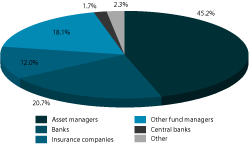
Aviva’s e700m perpetual NC 2014 DCI tier 1 Demand by investor type |
|
Aviva (and subsidiary Norwich Union) stands out in the insurance sector as the most innovative issuer active in public capital markets over the past 12 months. It has approached the capital markets in a strategic manner, for instance using structured finance not simply as a financing tool but also as a way to boost regulatory capital. Aviva has a high profile in its sector: it is the number one insurer in the UK, the fifth-largest insurer in the world and one of the leaders in Europe’s life business. These circumstances have supported Aviva’s status as one of the benchmark issuers of capital securities.
In July and September 2004, this borrower – via Norwich Union – printed two ground-breaking asset-backed securitizations that, in addition to a £1 billion equivalent classic tier 1 offering in Aviva’s name, launched in November 2004, impressed the markets.
The first securitization was £418 million ($769 million) in size, and, being a mortgage-backed issue, might be considered uninteresting flow business. But despite being the fourth in a series, Equity Release Funding No 4 – arranged by Morgan Stanley – marked a significant break from the past.
The very first equity release deal from the originator was also highly noteworthy. Equity release mortgages are fundamentally different to the usual assets used in typical mortgage-backed issues, lacking the usual form of cashflows. And the structures previous to ER4 were not without their drawbacks.
The borrower had not sold paper all the way down the capital structure, in fact none of the previous Equity Release deals had sold securities below the double-A level. However, ERF4 issued debt rated as low as BBB–, a considerable advance for the originator. Furthermore, the borrower previously paid insurance against the risk of negative equity on the assets securitized. ERF4 was the first where all that risk was transferred to the capital markets. There was also a more straightforward advance, related purely to marketing – the borrower moved away from the sterling fixed-rate sector.
“ERF4 was wholly floating-rate note. It gave us the opportunity to talk to a different investor base,” says Russell Hughes, head of finance and strategy at Norwich Union. Hughes also points to the new liquidity structure. Because of the nature of equity release mortgages, cashflows in the early years of the transaction are relatively low. ERF4 was structured with a liquidity facility provided by Royal Bank of Scotland.
The search for efficient embedded value securitizations for insurance companies is the equivalent of the hunt for the Holy Grail. Insurance companies have been under pressure to enhance returns, and extracting the value embedded in their portfolios is an extremely attractive option. Previous attempts to obtain value in this manner had been focused on non-strategic business. But Norwich Union Life and Pensions really opened up this market with its ABS of future new business surplus. The key factor is that this created a new funding route for the financing of new business, offering diversification away from traditional financial reinsurance markets or using its own capital.
The £200 million deal called Anglia Funding was funded via a Royal Bank of Scotland sponsored asset-backed commercial paper vehicle called Thames Asset Global Securitization.
Norwich Union receives a £200 million loan from Anglia that is financed by the RBS-structured ABCP. The backing is in turn provided by premiums and commission clawbacks from new business.
Last but by no means least was the £1 billion equivalent (€1.4 billion), two-tranche (€700 million/£500 million) Direct Capital Instruments offering. This was the largest tier 1 issue from a UK insurance company to date.
The rationale was to pay down senior debt with a security structured to meet the Financial Service Authority’s newly defined regulations for innovative tier 1 issuance by insurers. The perpetual proved extremely popular, with an order book of €3.2 billion for the euro note and over £2 billion of orders coming in for the sterling-denominated tranche – without the issuer paying an overly large new-issue premium, estimated at around 10 basis points over its upper tier 2 debt.