 |
|
“If a foreigner makes ‘too much’ money from a deal the government gets accused of selling off the national jewels” |
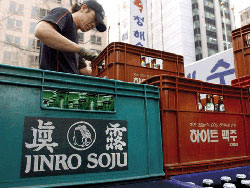
ANYONE WHO HAS visited South Korea knows that the Koreans are partial to a drink or two. The poison of choice is soju, a strong liquor distilled from rice, tapioca or sweet potatoes. Koreans drink a lot of soju, which is why dominant distillery Jinro Ltd enjoys revenues of some $200 million. It is also why there was an outcry against a national “treasure” being brought to its knees by a foreign “vulture fund” when the company was forced into receivership by chief creditor Goldman Sachs in 2003. Jinro was recently put on the block as part of the restructuring for creditors. The asset attracted enormous interest from domestic and international buyers. This time, however, a Korean party was the winner, with Merrill Lynch announcing in March that a consortium led by brewery Hite had won the right to proceed to due diligence with a bid rumoured to be W3.2 trillion ($3.1 billion).
Ominously for some, the two other preferred bidders were also all-Korean consortia, raising the cry from certain foreign parties that this was all a Korean nationalistic plot to see off foreign participation in a prized Korean asset.
Improbable line-up
“The Jinro-Hite deal is another example of Koreans being favoured over foreigners,” says an international fund manager who invests in Korea. “Why could they afford to pay the highest price? Because the government supported them.”
Behind that comment is the fact that Hite’s consortium contained an unlikely collection of investors, including the Korean Teachers Credit Unit, the Military Aid Association, the Korean Federation of Community Credit Cooperatives and the private-equity arm of Korea Development Bank, perhaps an improbable line-up of investors in an alcoholic drinks company.
Other observers, although they concede that there was probably government involvement, take a more pragmatic view: “No-one else could come up with the Hite valuation,” says a senior M&A banker familiar with the deal. “Everyone was at the W2.7 trillion to W2.9 trillion level. Is the government behind the scenes? Absolutely. But is it a good investment for these funds? Absolutely – it’s a national brand.”
James Paterson, research analyst at CLSA in Seoul, agrees that the government was probably pulling strings, but he also points to the price Hite is paying for such a valuable asset.
“It’s suspicious that all three of the short-listed bids were Koreans,” he says. “And I don’t deny that I never thought it was going to go to a foreigner. But the evidence is there – the buyer certainly paid a top price: it’s 14 times EV/ebitda [enterprise value over earnings before interest, taxation, depreciation and amortization].”
That such suspicions are prompted by what appears to be a straightforward asset disposal conducted through a normal bidding procedure says a lot about attitudes of foreign investors towards the Korean market. The feeling appears to be mutual.
“There is some intense nationalist sentiment,” says Sung Min Hon, CEO of Joongy International, a Korean business consultancy based in Seoul. “[The government is] intensely aware of foreigners coming in and buying everything out. The good thing for the government to do is to stop some of the hedge funds coming in and breaking up these businesses and selling them off.”
How much is too much?
That sentiment does not sit well with Jamie Allen, secretary general of the Asian Corporate Governance Association, an independent regional watchdog.
“There’s a sense in Korea that when the economy is in crisis and banks are on the verge of insolvency, the government and business community are happy for foreign white knights to step in,” he says. “But if those foreign investors make ‘too much money’ from the transaction it is seen as harmful to Korea and creates a political problem. The government is accused of selling off national jewels too easily and anti-foreign sentiment intensifies.”
The Jinro-Hite deal is not the only incident of its kind. It is arguably a regular market transaction caught in the crossfire coming from other more ominous events that are causing tensions to rise.
The most recent Korean move to raise the hackles of the international investment community was the legislation hastily passed in Korea’s National Assembly right at the end of last year. Two issues have raised particular concern. The first was a change to the Securities and Exchange Act that permits companies facing a hostile takeover to issue new equity as a defence mechanism, so-called poison pill provisions. “This clearly seems to be designed to protect the chaebol [conglomerates] against takeovers,” says Allen. “The fact that the parliament is passing major legislation on December 31 is suspicious in itself.”
The second change, which has stirred up an even bigger row, concerns intricate amendments to existing disclosure rules by Korea’s financial regulator, the Financial Supervisory Service (FSS). Shareholders are still obliged to disclose share ownership, when their stake reaches 5%, and every 1% thereafter, but the amendments demand additional information as a result of making a shareholding disclosure.
Previously, disclosing holders merely had to specify what their investment intentions towards the company were – for “investment purposes” or for “exercising influence on management”. The new rules require shareholders that specify the second category to re-file. For all such filings, the rules then impose a five-day “cooling-off period” during which the holder is barred from acquiring any more shares in the company and is disenfranchised from any voting rights already held.
A further new provision has riled foreign fund managers. Whereas previously, any change in investment purpose had to be reported if there was a change in the share ownership level, all investors that trigger the 5% level must now make a new disclosure if they change their investment purpose, regardless of whether the size of their shareholding has changed or not. The same standstill and non-voting restrictions apply to any such filings.
The new regulations also impose additional disclosure obligations on business entities (that is, fund managers), requiring statements as to the officers, largest shareholder and in the case of those stipulating “exercise of management control” as their investment purpose, further disclosure of the investment purposes and the source of the capital behind the fund.
The FSS certainly employed an aggressive turn of phrase when explaining the reasons for the new regulations. In a press release in October 2004, the FSS cited “increasing cases of unfair stock trading through false disclosure…and frequent and abusive disclosures by shareholders who exploit unlimited corrected filings”.
It all seems a trifle dull to warrant so much attention, so why the furore? Confusing and detailed though the new rules are, they have caused outrage among many fund managers, who see them as an attempt to restrict genuine market activity and force unwarranted disclosure on legitimate private funds. Moreover, given the stringent penalties for breaching the regulations, which include imprisonment, fund managers claim that the rules are deliberately confusing and cunningly drafted so as to herd managers into a fail-safe disclosure of “exerting management influence” lest they be caught out even by such mundane restrictions as meeting with management.
No sense in the rule
Some market participants argue that the rules enable the FSS to obtain information they might otherwise not get and to exert control over investors. “The new rule does not make sense,” says the ACGA’s Allen. “It’s the kind of thing that undermines Korea’s reputation for improved corporate governance. And it is hard to see how it will improve transparency.”
One foreign institutional investor in Korea believes foreign investors are being targeted deliberately. “The authorities over the last few years and in recent months have been after external fund managers,” he says. “They don’t treat local and foreign fund managers with an equal hand. Everyone knows what the local abuses are. They just do nothing about them.”
Not everyone goes along with the conspiracy theory. CLSA’s Paterson believes that investors have missed the real point behind the legislation, but does think that the Koreans have a habit of bringing some of this calumny upon themselves. “There’s a lack of perspective in the arguments,” he says. “Everyone likes to take a pot shot at Korea: it’s easy and they do shoot themselves in the foot from time to time. But I think part of the agenda [behind the rule changes] is that they’re after the chaebol, bringing cash back onshore through SPVs and taking stakes in affiliates illegally. I think that’s as much a part of the rule as going after foreigners.”
Sung Min Hon agrees with Paterson. “It’s not 5% for foreigners only, ” he says. “It’s for everyone. What has been neglected [by the authorities] is the heirs to the conglomerates buying more than 5% in companies and not reporting it. They [the government] want to protect the takeover of companies from within Korea.”
Regional ambitions
What makes the recent spat all the more alarming, at least for Korea, is that the government harbours larger ambitions for the country’s financial markets. “We are trying… to transform Korea into a leading financial hub for northeast Asia,” said Yoon Jeung-Hyun, governor of the FSS in a speech in February. “To this end, we will focus our efforts on creating an investment climate that continues to attract new capital, new investors, new skills and new talents throughout our country.”
Mention the government’s regional pretensions to overseas fund managers and the reaction is predictable. “Sure, Korea wants to become a regional hub,” says one, laughing. “My grandmother wants to become an astronaut, that’s how likely it is. Why would you? How would you?”
It is just one more reason, say critics, for the fabled ‘Korea discount’ – the theory that because of Korea’s poor record towards foreign investors, patchy corporate governance record and failure to stamp out corruption, its shares trade at an inherent discount to other similar markets. It might be impossible to prove the connection arithmetically but for the world’s eleventh-largest economy, the discount does seem something of an anomaly.
For all the current investor discontent, by some measures Korea certainly has embraced foreign investment. Korean domestic banks are largely owned by foreign investors: private-equity house Newbridge Capital acquired control of Korea First Bank in 2000, sold this year to Standard Chartered Bank; distressed asset expert Lonestar bought control of Korea Exchange Bank in 2003 and Citigroup acquired Koram in 2004. Even these deals did not clear without controversy. When Newbridge earned a $1.2 billion profit from the sale of Korea First Bank there was such outrage in Korea that in an effort at appeasement, Newbridge announced it would set aside $20 million of the proceeds to help small Korean companies.
The few high-profile bank deals have been held up by some observers as evidence of Koreans’ willingness to welcome foreign capital; others, though, regard them as exceptions to the Korea-only rule and believe that now the financial crisis is over, the authorities feel they are justified in making life a bit harder for foreigners.
“In the past half year,” says Takihara Ogawa, Korea country analyst for Standard & Poor’s, “there has been a tendency in Korea to have tighter regulations on foreigners and easier regulations on the chaebol. There is a feeling in the nation that the government has sold off assets to foreigners too quickly and too cheaply and, at the same time, restricting the chaebol. And in Korea, other than the chaebol, there is virtually no-one else who can afford to buy these financial institutions.”
The head of M&A in north Asia for an international investment bank believes Korea has in fact opened up to foreigners more than most realize. “There’s a huge amount of Korean businesses changing hands, year in and year out,” he says. “Who owns Daewoo? General Motors. Who owns Ssangyong? Shanghai Automotive. Who owns the bank sector? Foreigners. Name me another Asian market that has the same level of foreign ownership.”
Foreign equity investment
And it’s not just outright acquisition. Foreign investment is most evident in the stock market – international investors already own more Korean shares than Koreans do. “Foreigners own 43% of this equity market,” says CLSA’s Paterson. “So there’s bound to be heightened paranoia, especially with Sovereign Asset Management trying to take control of SK Corp. In that environment, some mis-steps will be made. But from the equity market perspective, on balance we’re seeing better companies, better management and better returns.”
The bitter tussle between Sovereign and SK Corp, Korea’s largest oil refiner, is often cited as an example of all that is wrong with the Korean chaebol. Despite a conviction in 2003 for an accounting fraud perpetrated at an affiliated company, a son of the SK Group founder, Chey Tae Won, returned as chairman of SK Corp after a brief spell in prison. Sovereign, the largest single shareholder in SK Corp, with a stake of 14.99%, has spent the last two years and millions of dollars in an attempt to oust him that has so far proved fruitless.
Although Paterson admits that the SK Corp affair does not show corporate Korea in its best light, he warns foreign investors not to judge Korea by just one company.
“There are obviously many battles to be fought within Korea,” says ACGA’s Allen. “But there’s also enough that is positive to give me confidence that the reform process will continue.”