IN THE MID-1990s, the eyes of the world turned to central Asia, to countries most people could barely spell let alone place on a map – Kazakhstan, Turkmenistan, Azerbaijan. These countries, newly liberated from the Soviet Union, were said to be home to fabulous energy reserves.
A report from the US State Department claimed that offshore the Caspian Sea there were reserves of as much as 200 billion barrels of oil – enough to rival reserves in the Persian Gulf.
Suddenly, the future of the Caspian littoral states, and of their oil, became a matter of great importance to the west and, in particular, the US. In 1998, the CEO of Halliburton, Dick Cheney, said: “I cannot think of a time when we have had a region emerge as suddenly to become as strategically significant as the Caspian.”
Commentators quickly dubbed the jostling between nations and oil companies for position in the region a new Great Game, rivalling the competition between Russia and the UK for influence in the region in the late 19th century.
At the centre of this Great Game, supposedly, was the Baku-Tblisi-Ceyhan (BTC) pipeline, which would take Azerbaijan’s great oil wealth via Georgia to Turkey’s Mediterranean coast.
The pipeline was heavily promoted by the US State Department, which was keen that oil from Azerbaijan should not pass through Russia – so that Azerbaijan would not be dependent on Russian pipelines – or Iran, so that country would be kept in economic purgatory. The US was also keen to make its ally Turkey a new energy hub for the region.
The pipeline was eventually approved and financed in late 2003, via a $1.4 billion syndicated loan that was heavily supported by export credit agencies. The first oil from Baku is due in Ceyhan this year.
But the picture for Caspian energy is now very different to when the first contract for Azerbaijani oil was signed, in 1994. Several exploration projects in the Caspian have discovered no oil and made losses running into hundreds of millions of dollars. It is clear that Caspian reserves are nowhere near the 200 billion barrels suggested by the State Department.
The former head of the Azerbaijan International Operating Company (AIOC), Terry Adams, has even accused the CIA of knowingly circulating false reserves figures to encourage private companies into the region, in order to fulfil the US government’s political aims.
Andrew McAuslan, commercial director of the BTC pipeline in Baku, says: “The US was clearly trying to promote investment in the region. It was trying to promote the development in a western direction of countries in the former Soviet Union.”
Some have even suggested that there is insufficient Azerbaijani oil to utilize the BTC pipeline’s capacity.
The attention of the world has now turned away from the Caspian, to the Middle East and Iraq. Russia is also an increasingly significant source of crude supply, as well as of billion-dollar energy financing deals.
The days when central Asian presidents were given the red carpet treatment at the White House seem to be over. As Robert Ebel, director, energy and national security, at the Centre for Strategic and International Studies in Washington, DC, says: “US rhetoric and attention has died down, in part because we have accomplished what we wanted to. We’ve helped get these countries on their feet politically.”
So is the Great Game in the Caspian nearing full time, and will the BTC deal be the last big financing deal in the region? Not quite.
The International Energy Agency predicts that global energy demand will rise by 59% by 2030, with two-thirds of that new demand coming from developing countries, particularly China and India. US demand for oil is also rising, while US domestic production is set to fall by 12% over the next decade.
Opec production is not set to grow significantly over the next five years, meaning that any non-Opec sources of supply growth are of great importance for the global economy.
Against that backdrop, Euromoney takes a look at the two key countries in the Caspian, Azerbaijan and Kazakhstan, to assess their energy reserves and the extent to which projects there are attracting external financing from the capital markets.
Two different pictures emerge – disappointment and difficulties in Azerbaijan, and an abundance of debt deals in Kazakhstan overshadowed by concerns about the country’s aggressively nationalist energy policy.
Azerbaijan: early promise not fulfilled
In September 1994, foreign super-majors including BP, Unocal and LUKoil signed a contract with the new president of Azerbaijan, Heydar Aliyev. The oil companies agreed to invest over $7 billion in return for the right to develop three former Soviet offshore fields: Azeri, Chirag and Guneshli (the ACG fields).
The Soviets did not have the technology to drill very deep offshore, leading the super-majors to hope for significant reserves not just in these already discovered fields but in other as yet unexplored areas off Azerbaijan’s Caspian coastline.
The optimism of that time, when the deal was termed the ‘contract of the century’ by the government of Azerbaijan, is in marked contrast to the present mood in the oil sector. CSIS’s Ebel says: “Azerbaijan has a problem. It hasn’t found any new oil.”
In November, Exxon-Mobil decided to pull out of the $3 billion Zafar-Marshal offshore field, in which it is the main partner, after deep drilling, thought to have cost about $150 million, failed to find oil. It was the third Exxon project in Azerbaijan to hit a dry hole.
Socar, Azerbaijan’s state oil company, is depressed at the failure of yet another drilling. One oil and gas consultant says: “Socar seems to think the foreign oil companies aren’t trying hard enough.”
Socar head Natik Aliyev says: “If Exxon decides after all not to continue these projects, then it has to pay Socar compensation equal to the budget of each well.”
That means Exxon could be paying as much as $100 million to withdraw. Chevron-Texaco, which is also a partner in the project, could well follow suit.
One energy banker says: “It’s unheard of for Exxon or Chevron to pay in order to leave a project.” But the decision underlines the disappointment many oil companies feel at the lack of new finds in Azerbaijan. BTC’s McAuslan says: “Azerbaijan has not drilled as well as expected.”
Slower progress in capital markets
With the lack of new finds, attention has turned to the ACG fields, which provide oil for the BTC pipeline. The pipeline is due to start delivering oil to tankers in the Mediterranean this year.
The $1.6 billion deal for the pipeline, closed at the beginning of 2004, involved two multilaterals, eight export credit agencies and risk insurers, 15 commercial banks, and 18 months of “solid work” according to McAuslan.
He says: “A lot of the work was helping lenders understand the country risk [of Georgia and Azerbaijan]. It was easily the biggest deal ever in those countries, and perhaps it helped the countries establish something of a track record.”
Azerbaijan has failed to maintain that track record with further private sector deals, although the European Bank for Reconstruction and Development recently approved a $170 million loan to Socar to develop the Shah Deniz gas field and the South Caucasus pipeline for the gas, which will take it along the BTC route to Turkey, freeing Georgia of its dependence on Russia’s Gazprom along the way.
However, both Azerbaijan and Socar are slowly making progress towards entering the private capital markets. Socar is undergoing a restructuring process involving the EBRD, and could possibly come to the markets in early 2006. McAuslan thinks the sovereign could follow at about the same time. Other private companies, such as Azpetrol, are also looking to raise private finance.
But if the BTC loan was by the far biggest deal to have emerged from central Asia, it was also perhaps the most controversial finance deal of recent years.
On the one hand, market sceptics claimed that the oil companies had been deceived by both Socar and the US government, and that there wasn’t enough oil in ACG to fill the pipeline, which has a capacity of 1 million barrels a day.
The pipeline, so the sceptics insist, was a political project, designed to cut out Russia and Iran, and doesn’t make commercial sense. Sergei Grigoriev, the admittedly biased vice-president of Russian pipeline monopoly Transneft, says: “Baku fed everyone the legend that they had as much oil as Kuwait. But they don’t have anything near that.”
But McAuslan of BTC is adamant. “There will be enough oil in the ACG to fill the pipeline,” he says. “The fact that we managed to get private-sector financing for the deal is evidence.”
One of the major private lenders to the project agrees: “BTC was done on very solid grounds as to what is there,” he says.
McAuslan says the proven reserves of the field are 5.6 billion barrels and that while the project is being developed, the pipeline will probably take oil from both Russia and Kazakhstan, particularly from the oil-rich Kashagan field.
He admits that the US were heavily promoting the project for their own political ends – to make countries of the former Soviet Union more independent of Russia in terms of finance and infrastructure – but says: “Oil companies go where they think oil will be. They take a scientific, not a political, view of it. We don’t just get involved because the US says there’s a lot of oil there.”
NGOs pile on the pressure
NGOs have taken a different view of the pipeline and its financing by banks and multilaterals. New NGOs were set up purely to attack the BTC project. Established names such as Friends of the Earth devoted considerable resources to criticizing the project. Some NGO workers even penetrated the EBRD office in the City of London one afternoon, took the lift up to a boardroom, and demanded a meeting with the head of energy financing. They got one.
The NGOs criticized every aspect of the project. It wasn’t economic, it should have taken the shorter route through Iran, it didn’t pay enough compensation to the farmers whose land it went through, it went too close to the Borjomi springs in Georgia, and it would lead to Dutch disease and government corruption in the Azerbaijani economy.
Rob Shepherd, vice-president of project finance at ABN Amro, one of the lead managers on the deal, says: “Some NGOs believe Third World countries’ energy reserves shouldn’t be developed, full stop.” Some environmental NGOs, it should also be added, are against the oil industry full stop. They believe it causes global warming, and that societies should switch to using non-carbon energy sources.
Nonetheless, banks were surprised to find themselves on the front line of a battle with NGOs. Some banks, such as Barclays Capital, responded to the pressure and declined to be involved. Those who did tried to fend off NGO attacks by signing up to the Equator Principles, whereby any project finance team financing a project that carries potential environmental risk promises to carry out an environmental assessment.
The NGOs that relentlessly attacked the project ignored what some advocates argue are positive aspects of the pipeline. Charlotte Phillips, senior banker on the project at the EBRD, says: “The core reason we really liked the pipeline is that it alleviates traffic through the Bosphorus.” Tanker traffic has been increasing through the strait of Istanbul for a number of years, and Turkey is very concerned about the threat of an oil disaster in the middle of its capital.
The other obvious developmental benefit of the project is the revenues it brings to Azerbaijan and Georgia, two very poor countries. Both Azerbaijan and the oil companies have also committed themselves to managing the revenues from the project transparently, so that Azerbaijanis can see exactly where the billions of dollars from the oil go. This is introducing an unprecedented degree of transparency into a country ranked as one of the most corrupt in the world by Transparency International.
Azerbaijan has set up a state oil fund to manage and invest in the project. The fund has been working closely with the IMF to make its investment decisions, and has so far used capital to build houses for refugees from the Nagorno-Karabakh war with Armenia. That’s a wise move – there is real pressure from Azerbaijanis to use the oil wealth to build up the army in order to take revenge on its historical foe, Armenia.
Time bomb?
Yet despite the degree of cooperation by BP and the EBRD with NGOs, the attacks have gone on. Now NGOs believe they have found the smoking gun that will bring a stop to the hated pipeline – the pipe sealant. BP had selected a new type of sealant to cover the pipeline. Because it was new and relatively untested, some people inside the company had doubts about its merits. One of these is said to have hired an independent consultant to check the sealant, a former BP consultant called Derek Mortimore.
Mortimore came to a very different conclusion to BP’s official study. He said the sealant was “utterly inappropriate” for the pipeline, that it was “chosen through a seriously flawed selection programme”, and that the BTC consortium was effectively burying an “environmental time bomb”.
BP chose not to heed Mortimore’s advice. Several months later, the sealant cracked on 25% of the joints in Georgia. At this point, lenders became aware of the problem, and BP organized a meeting to explain the issue and what it was doing about it.
The EBRD’s Phillips says: “The problem was that, when the sealant was applied in winter, the appliers didn’t observe the correct curing temperature. The sealant had to be heated to dissolve and congeal properly, and it wasn’t heated enough, so that’s why the cracking occurred.” The sealant has since been reapplied at the proper temperature.
A spokesperson from BP says: “BTC is aware that certain allegations have been made about its practices and these allegations have been thoroughly investigated to its full satisfaction; full discussions on this have been held with the financial institutions and other interested parties, where appropriate.”
When Banca Intesa, one of the original lenders to the project, announced in late 2004 that it was selling its stake in the loan, at a loss, NGOs claimed that the Italian bank was withdrawing because of concerns about the sealant. The EBRD’s Phillips says: “[They] offloaded the stake … because they decided to get out of the oil and gas project finance business altogether.”
Banca Intesa has declined to give its reasons for selling the stake, though it might simply have become exasperated with a project that is already about 10% over budget, partly because of the continued environmental protests against its construction.
One analyst says he thinks Banca Intesa is particularly sensitive to any controversy after its role in the Parmalat scandal. If so, the fact that a bank has decided to leave extraction project finance business altogether is evidence of what a hot potato the business has become.
Indeed, in 2004, the World Bank appointed a former Indonesian environment minister, Emil Salim, to review the Bank’s role in extractive industries financing. Salim surprised the Bank by stating in his extractive industries review that it should stop lending to any mining or oil and gas projects. The banks that had signed up to the Equator Principles demanded that the Bank stay involved. The Bank responded in August 2004 by ignoring Salim’s recommendations.
The NGOs’ campaign has now shifted to the multi-billion dollar oil and gas project in Sakhalin, off Russia’s far east coast. Again, the involvement of the EBRD has led to prolonged protests against the use of taxpayers’ money for extraction processes.
The NGOs can claim a victory of sorts – Shell has had to delay the already over-budget project in order to consider at greater length its effect on grey whales, which feed and breed in the Sakhalin
environs during the summer. It appears the tactic of engaging with NGOs, taking them seriously, is making them louder and more assertive, not less so. To industry observers, the NGOs’ campaigns can seem crude, accountable to nobody, and to serve at least in part the egos of middle-class campaigners rather than developing countries’ interests.
NGOs are certainly pushing up the price of oil and gas projects. They are making them more difficult to finance, discouraging some banks from getting involved, and forcing those that do to be cautious about the environmental security of projects they back.
And yet, no less an expert than the executive director of the International Energy Agency, Claude Mandil, said in the 2004 World Energy Outlook that dependence on oil and gas, and the amount of carbon dioxide being emitted as a result, were “deeply troubling”.
Perhaps the extra hassle of dealing with NGOs will be one minor factor that helps encourage governments and the market towards investing in alternative energy. If it did, it would be no bad thing.
Kazakhstan: new deals amid growing nationalism
 |
|
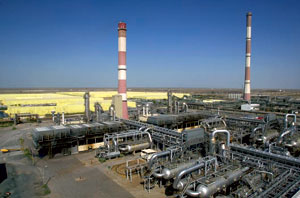
Big before the offshore finds: the massive Tengiz onshore field put Kazakhstan in the sights of international oil companies |
Although Azerbaijan has been a disappointment in terms of new oil finds, Kazakhstan’s huge discoveries have taken everyone by surprise. In 2002, offshore drilling in Kashagan hit on the largest oil find in the world in the past 30 years – estimates for the total recoverable reserves in Kashagan range from 20 billion to 30 billion barrels.
Before this discovery, Kazakhstan already boasted some of the largest onshore oil fields in the world, such as the Tengiz field, being developed by Chevron, Exxon and Kazakh state oil company KazMunaiGaz.
Oil speculators and geologists are confident that other fields as big as Kashagan are yet to be found. Fred Hodder, CFO of Nelson Resources, one of the leading independent oil companies working in Kazakhstan, says: “Kazakhstan has 220 offshore blocks in the north Caspian, of which only 18 have so far been leased. The country will sell off those blocks over the next decade, and we think there are huge reserves out there to be discovered.”
The market seems to agree – Kazakh energy deals have had no difficulty in finding private sector financing for their projects. In November, for example, Tengizchevroil, the company developing the Tengiz field, issued a 10-year $1.1 billion bond issue.
The deal was lead managed by ABN Amro and Lehman Brothers. “The whole deal was extremely well supported,” says ABN Amro’s Shepherd. The bond has a coupon of 6.125% and was priced 225 basis points over seven-year treasuries. It traded down in the secondary market even while other CIS issues suffered from Ukraine-related volatility.
Lehman, which had not previously done much business in Kazakhstan, was responsible for selling about 60% of the deal to US investors, including some high-grade investors. The deal was the first Kazakh bond, and only the second CIS deal, to be double investment grade.
Jim Merli, Lehman’s global head of fixed income syndicate, says: “For many of the US investors, it was the first Kazakh deal they had invested in. They were impressed with the political stability of the regime there. And they liked the fact that there’s a who’s who of western oil companies which have invested in the country.”
Other recent Kazakh energy deals have done equally well. Intergas Central Asia, another subsidiary of KazMunaiGaz, issued a $250 million bond in October 2004, lead managed by JPMorgan.
Stefan Weiler, an associate in the CEEMEA project finance team at JPMorgan, says: “The deal was four times oversubscribed, and upsized from $200 million.”
On the equity side, Nelson Resources, which was already listed on the Toronto Stock Exchange, managed to raise an additional $119 million from a listing on London junior market AIM. The success of the secondary offering, says Hodder of Nelson, shows that “there’s a lot of excitement and interest among investors about Kazakhstan”.
Weiler says: “There’s a tremendous amount of activity in the Kazakh energy sector. A number of different projects are currently under construction or under consideration.”
Bond investors seem increasingly comfortable with Kazakh debt issues, thanks in part to the country’s investment grade, its well-developed financial sector, large oil reserves, and stable, not to say immoveable, political regime.
Rafael Morechal, emerging market portfolio manager at Fortis Investments, says: “We like Kazakh debt more than Russian debt. In Kazakhstan you don’t have the same battle between the government and oligarchs as you do in Russia. Business is more transparent and predictable in Kazakhstan, but yields are more attractive because many investors still don’t know the country that well.”
Tightening the screws on the foreigners
However, there are similarities between the politics of Kazakhstan’s energy sector and those in Russia. Just as the Russian state feels it was swindled by privatizations in the 1990s, so the Kazakh government increasingly feels it was short-changed by the oil contracts of the previous decade.
Like Russia, it has decided to counter this with a two-pronged strategy. It has raised taxes on all new oil projects and has also created a national champion, KazMunaiGaz, which as of two months ago had the right of first refusal for a 50% stake in all new energy projects.
Both strategies raise potential problems. The steep new tax rate could put a dampener on new investments. Bill Page, head of the CIS tax department at Deloitte & Touche, says: “There’s a tension between Kazakhstan’s plan to triple production by 2010 and their aggressive tax policy on energy projects.”
Page says the new tax code will reduce the potential upside for new projects to about 9% or 10%, which given the possibility of $100 million-plus losses, as in the Zafar-Marshal field in Azerbaijan, is not much of an incentive for super-majors to get involved.
Page says the tax has “already had a negative effect on investment. There were some discussions about several offshore developments, but no new contracts have been signed.”
Meanwhile, KazMunaiGaz has announced ambitious plans for its expansion, including the acquisition of British Gas’s 16% stake in the Kashagan project next year for as much as $4.5 billion. The question is how KMG will raise enough to participate on equal terms with super-majors in future projects.
ABN Amro’s Shepherd says: “KMG will have to consider carefully how to support its investment obligations across all these opportunities.” He adds: “The state could of course easily provide the necessary support, but that goes against the principles they and KMG are trying to adhere to, with the latter operating as a separate company, as opposed to an extension of the state.”
KMG failed to respond to messages left by Euromoney but Weiler of JPMorgan says: “The company has asked banks recently for ideas to come up with a way to finance $1.3 billion for the acquisition [with the rest financed by equity]. The size of such a financing implies that a combination of debt products may be used.” Weiler mentions a possible bond and ABS deal, as well as a syndicated loan.
The China factor
Other state energy companies are also looking to finance ambitious projects. KazTransOil, a subsidiary of KMG, is about to raise a $600 million loan to finance a new oil pipeline to China, conditionally guaranteed by its partner in the project, CNPC. The deal, also lead managed by JPMorgan, is likely to be targeted to Asian investors. Weiler says KazTransGaz is also considering a gas pipeline to China, which could be financed in 2006.
The new deals underline the extent to which China is a new force in central Asian energy politics. But they also indicate that Kazakhstan is emerging not as a pawn in a Great Game played between larger countries but as a master of its own destiny, with economic ties to Russia, China, the US and, increasingly, Iran.
If there is one unifying trend throughout the former Soviet Union, it is the ability of young countries such as Kazakhstan, Ukraine and Georgia to strengthen their own nationhood without fully aligning themselves with any one great power.
Through its increasingly assertive energy policy, Kazakhstan also hopes to build a national company that can stand side by side with super-majors. With the oil price so high and market sentiment on Kazakh debt so favourable, KMG’s huge funding requirements look feasible.
However, the company should take a cautious look west, to Russia, where an aggressive national energy policy has in some instances scared away foreign investors and could put too heavy a burden on company balance sheets.
Russia’s national energy company, Gazprom, was prepared to raise a $10 billion one-year loan in order to gobble up Yukos’s core asset, Yuganskneftegaz. Such a loan, says Renaissance Capital’s oil and gas analyst, Adam Landes, would damage Gazprom’s balance sheet and lead to significant refinancing risk.
Meanwhile, Gazprom’s increasingly bullying behaviour, whereby it is muscling in on private-sector projects, slowing reform in energy utility UES and preventing TotalFinaElf’s acquisition of rival Novatek, has exasperated one head of corporate finance at a Russian bank. “At the moment,” he says, “the company is basically out of control.”
The effect of the state and Gazprom’s bellicosity on foreign investment is obvious from a remark in December 2004 by Lee Raymond, chief executive of Exxon-Mobil.
Raymond says that in 2003 he considered Russia a safe place to invest but that “the latest data may say that my judgement was premature”.
The challenge for Kazakhstan is to tread the middle line that Russia seems incapable of following – to take what it believes is its due from its oil reserves, without scaring away the foreign super-majors that can provide the capital and technology to help it develop its sizeable resources.