Thailand’s model broker

Since Asia's 1997 financial crisis, most Thai financial businesses have been forced to focus on recovery and restructuring. But Asset Plus Securities came through unscathed. Now called Asia Plus Securities, the firm shows what might lie ahead for other Thai financial firms if they can get their houses in order.

Kongkiat Opaswongkarn, chairman and CEO of Asset
Plus Securities has just put the finishing touches to a
transformational deal that will take the local
investment banking and securities business to number
two in turnover on Thailand’s lively bourse.

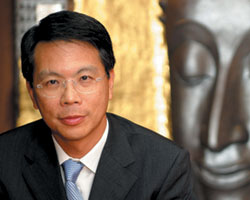
THERE IS A discreet smile on the face of Kongkiat Opaswongkarn (pictured right) when he walks into his office in downtown Bangkok. The chairman and chief executive officer of Asset Plus Securities has just put the finishing touches to a transformational deal that will take the local investment banking and securities business to number two in turnover on Thailand’s lively bourse. In May, Asset Plus Securities merged with ABN Amro Securities, another locally listed Thai broker, to form Asia Plus Securities. The deal was structured as an acquisition of Asset Plus, but was effectively a reverse takeover of ABN Amro Securities. Kongkiat is already pondering the next deal.

“We still have a couple of things we want to do,” Kongkiat says. “We’ll consider selling the Asset Plus company, the shell: it has a licence and a SET [Stock Exchange of Thailand] membership.” He is confident of finding a buyer, which is not surprising given how lively the Thai market has recently been. “Oh yes, I have buyers,” he says. “I got 12 calls already. With turnover [on SET] at Bt10 billion [$244 million] a day, [broking is] still profitable. With commissions fixed at 0.25%, if you have 2% market share you can get your money back in three years. It makes a lot of sense.”

If Kongkiat has calculated correctly, Asia Plus Securities is likely to do very nicely, a point not lost on some of the local research houses that cover the sector. Tisco equity research analyst Salinee Vayakornvichitre estimates that Asia Plus’s market share of daily SET turnover increased to about 10% after the merger, making the firm the second-largest broker behind KGI Securities. Vayakornvichitre also notes that Asia Plus operates more efficiently than many of its competitors, and with estimated staff expenses accounting for some 43% of recurring income, it is now the most efficient securities firm in the Thai market.

SCB Securities’ analysts Supacha Shosivaskul and Kittima Sattayapan calculate that Asia Plus breaks even on its securities business with daily market turnover of Bt8.2 billion, the lowest of any listed securities firm in Thailand. It is therefore the firm with the most to benefit from a rise in daily turnover. The merger is already adding up. The combined group boasts more than 850 employees and 28 branches, and combined pro forma profit after tax in fiscal 2003 was Bt1.26 billion. Combined pro forma profits for the first quarter of 2004 were Bt368 million. Although the full-year figures will be hit with Bt4 billion of goodwill write-off, it is likely that the company will not pay tax for two years. SCB Securities is forecasting core net profit of Bt965 million in fiscal 2004 and Bt1.479 billion in 2005.

Diversification under way Kongkiat acknowledges that Asia Plus needs to become more than just a leveraged play on the SET and claims progress towards that goal. “We’re probably the most profitable now,” he says. “Our market capitalization is $400 million and the free float is close to 50%, so we’re a proxy for the securities market in Thailand but our revenue base is more diversified than others’. We have investment banking – we had income of Bt105 million for the first quarter; asset management – we just formed a new fund management company and total funds under management are about Bt6.6 billion.”

Kongkiat’s track record is impressive. His business did not just survive Thailand’s financial crisis in 1997 but actually prospered from it. “We benefited a lot [from the crisis],” he says. “We had no margin loans on our broking business and we had a lot of cash. We lent it to the central bank – Bt600 million – and earned 18%. It was always my policy not to get into margin-lending: lending [our] shareholders’ money to let people punt in stocks.”

Kongkiat’s policy of not mimicking the habits of many of his competitors did not just mean refusing to lend on margin. “I didn’t want to let housewives sit on our offices and play in stocks,” he laughs, “that’s why we didn’t have any electronic boards in our offices. The SEC was very surprised by that. The only thing the housewives would do when they came into our office was complain about the coffee. We try to be different to our competitors.”

Kongkiat’s pragmatic and careful approach to business continued after the crisis as he developed Asset Plus. He even turned down the deal with ABN Amro Securities on an earlier occasion because he felt that his firm was not ready.

“We talked about it a few years before,” says Kongkiat, “I wasn’t interested because they were already listed and we were too small. After listing, I spent two years beefing up the business. After mid 2003 we looked at the deal again. This time it made sense, because of the synergy: 90% of their income is from brokerage; our brokerage business was small. But our investment banking and funds management businesses were market leaders.”

Despite the dilution in his personal stake following the merger, Kongkiat is clearly pleased with the combined result, given the travails of building a small business.

“I have 7% of a bigger pie now and that’s fine,” he says, “I’m much relieved: it’s a much bigger business: there are a lot more spare parts. When I formed Asset Plus I had to rely on a lot of people. One company stole eight of my marketing people. It was a nightmare. Our research team was stolen. One junior analyst was stolen by ABN Amro; she was making more [there] than my head of research.”

Despite the evident relief, there is no sign that Kongkiat intends to live less hecticly. He has growth plans for Asia Plus but plans to start with intensive housekeeping.

“We need to cut costs and more staff to increase efficiencies. The number of staff is large so there’s a lot of room for improvement. We need to re-engineer the whole business.”

As for growth, Kongkiat is confident that there is a huge amount of business to be gleaned from existing Thai markets. “Only 200,000 people in Thailand invest in the stock market,” he says, “out of a population of 60 million – it’s less than 0.5% and the lowest in any developing market on earth. There’s a lot of room for growth.”

In addition to natural growth in the securities market as more Thais start to invest, Asia Plus intends to expand its product base to offer more value-added products.

“The growth will come from new products and activities [also],” says Kongkiat. “Fund management is a huge opportunity, not just asset size but profitability too. Thailand is still at the early stages of offering financial products to customers – we don’t have sophisticated financial products – we only just started to offer capital protection. I’m very interested in the high-net-worth individual market. With low interest rates and capital controls, people need advice on what to invest in. We have a lot of captive clients – we’ve created a lot of wealth in companies we’ve taken public. We don’t let them [clients] go. The cost of retaining a client is a lot less than finding new ones.”

Tapping Bangkok Bank Notwithstanding his success at retaining existing clients, the real ace up Kongkiat’s sleeve might be Asia Plus’s new major shareholder. Having inherited Bangkok Bank as one of the largest shareholders in the combined group, with an approximate 20% interest, there is clearly potential for Asia Plus to tap into the bank’s customer base, offering securities dealing services as well as asset management and even private-banking products.

“There’s a lot of cross-selling to do,” Kongkiat says “and we need to exploit the Bangkok Bank network – they have millions of accounts: it’s Thailand’s largest bank.”

Kongkiat might also be expected to harbour plans to venture abroad. Although he acknowledges the risk of an exclusively Thai focus, Kongkiat believes both his company and the Thai economy are set fair.

“Everyone would suffer [in a poor Thai economy],” he says. “That’s a risk of course. But we are the one company that has no debt. Whatever happens, we won’t go bust. My policy is not to borrow. We have over Bt1 billion cash and near cash now. I believe the Thai market still has a lot of potential. As long as Thaksin and Thai Rak Thai stay in power, it’ll be good for business.

“I don’t want to invest offshore for the time being, we don’t want to pretend that we’re good in other centres but we will try to cooperate with foreign firms.”

Without diversification abroad, Asia Plus Securities will indeed remain a bet on the future of the Thai economy, And if it does remain a domestic player, it will ultimately reach a natural size and probably turn ex-growth. With much still to achieve domestically, it is not a prospect currently occupying Kongkiat’s mind. “My goal is to grow the market capitalization of Asia Plus – it’s at $400 million,” he says. “Who knows? Our market capitalization could be $1 billion one day.”

Given that much of Thailand’s financial sector is still struggling back to its pre-1997 crisis level, that would not be a bad result.