 |
|
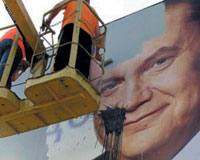
Running repairs: Ukrainian presidential candidate Viktor Yanukovich is unpopular but is backed by the political establishment which has thrown the government’s resources behind him |
Ukraine was evenly divided ahead of presidential elections on October 31 as leading opposition candidate and liberal reformer Viktor Yushchenko faced off with the establishment’s candidate, prime minister Viktor Yanukovich. Campaigning has been dirty and the threat of riots will hang over Kiev if the opposition feels it has been cheated out of an election victory that could shake up the balance of power and define foreign policy after a decade of dithering between turning east or west. The stakes are high: the two candidates were running neck and neck on the eve of the vote and Ukraine is the only former Soviet republic that can boast a grassroots political opposition.
Both camps have everything to lose. After two terms, president Leonid Kuchma must stand down, but Yanukovich, his choice of successor, is deeply unpopular. He faces Yushchenko, also a former prime minister, in 2000, who is now a sworn enemy of Kuchma after the two fell out. The country is riddled with corruption and a change of guard could end cosy relations between the state and the local oligarchs.
In a show of force, 50,000 people took to the streets a week before the poll to protest against the government’s blatant attempts to sway the electorate towards Yanukovich. And they have real cause for concern, as the mud has been flying thick and fast.
Yushchenko’s team caught local KGB officials spying on their campaign headquarters. Channel Five, the only independent TV station in Ukraine, has been shut down several times by authorities. And in what amounted to a dry run of the presidential elections, the government simply ignored the opposition’s two-to-one landslide victory, according to independent exit polls, in mayoral election for the town of Mukacheve in May.
“The abuses were blatant,” says Olesya Oleshko an election observer for non-government organization the Committee for Voters of Ukraine. “There were thugs in black leather jackets standing outside the polling stations intimidating people as they went in and in some cases these men simply walked off with the ballot boxes.”
After the electoral commission declared the pro-government candidate Ernest Nuser the winner protests from domestic and international organizations forced the new mayor to resign inside a month, citing “death threats” as the reason.
The local election was both worrying and encouraging: worrying as the government showed itself capable of blatantly ignoring the people’s will; encouraging as the Ukrainians, unlike citizens of their neighbours to the east, are sufficiently politically active to force the government to listen to popular demands.
But this hasn’t stopped president Leonid Kuchma throwing the entire weight of government resources behind Yanukovich.
The two men come from opposite ends of the spectrum. Yanukovich represents the status quo, is aligned with the power Donbass “clan” – one of Ukraine’s three dominant business groups that makes its money from steel and coal – and is pro-Russia. Yushchenko is credited with kick-starting Ukraine’s ballistic economic growth of the past few years by pushing through liberal reforms as well as completing the bank sector reform. He is also pro-EU and a favourite of foreign investors hoping to tap into Ukraine’s red-hot growth.
Yushchenko led the polls by a healthy 10% margin over the past few months – until Yanukovich closed the gap as the vote approached. The last poll a week before the vote showed the two men had 29% and 31% of the vote.
However, everything in this debate must be taken with liberal pinches of salt as insults and outrageous accusations fly between the two camps. The prime minister was rushed to hospital and reported to “not be in a life-threatening condition” after an object was thrown at him during a stop over in Ivano-Frankivsk at the end of September.
Initial reports on the government-backed news agencies said Yanukovich had been hit on the head with a brick. However, the opposition were quick to counter with the information that an egg had been thrown – and it missed the prime minister completely.
Yushchenko was also “attacked” and rushed to hospital. He was flown to Austria for emergency treatment after a “biological weapon” was slipped into his food, according to an opposition spokesman. While he was clearly sick, a parliamentary investigation failed to determine the cause.
The opposition initially said that Yushchenko was suffering from “bad sushi and too much cognac” but later said his symptoms were more likely those of herpes.
While the international media billed the elections as a clash between the state-sponsored kleptocracy and liberal reformers, Ukrainian businessmen are more sanguine.
“It is difficult to say who will be elected, but there will be no fundamental change regardless of who is elected president. It is not a choice between the communists and the liberals,” said Alexander Dubilet, the chairman of Privatbank, on the eve of the election. Dubilet says that Ukrainian business is withdrawing from politics.
While GDP growth slowed to “only” 13.6% over the first eight months of this year the country of 50 million people has reached a point where there is more to be made from investment than from stealing from the state. At the same time the leaders of these big businesses want to secure the property rights on their assets and are increasingly backing market-based reforms.
One of the best examples is Viktor Pinchuk, Kuchma’s son-in-law, one of Ukraine’s richest men. Over the past year he has invited celebrity speakers to Kiev including former US president George Bush and general Wesley Clark to promote the country’s image abroad. Yushchenko’s camp also say he has opened discreet lines of communication with the opposition in preparation for possible regime change.
As Euromoney went to press on the eve of the election, Kiev was swirling with rumours. The army was said to have been moved to the outskirts of the capital and the government was warning of a half-million strong protest, “to foil ballot counting as the first stage of a so-called ‘chestnut revolution’,” Yanukovich’s coordinating council said.
Cynics say the government is preparing the ground for the use of force. Yushchenko’s supporters seized several participants in a rally in October who lobbed stones and smoke grenades at the electoral commission buildings, and handed them over to the police, claiming they were Yanukovich-provocateurs.
While protests are possible, the elections are unlikely to produce a clear winner and will almost certainly go to a second round in the New Year.