 < TD> < TD> |
|
President Hipolito Mejía failed to live up to the IMF agreement after his government took over two electricity distributors. Blackouts became a daily part of life in the Dominican Republic. |
The Dominican Republic, formerly a star regional economic performer, is officially the most risky country in the Caribbean in 2004. After the collapse of one of the nation’s largest banks, investors are looking to presidential elections this May as a way out of the financial gloom. “The country is going through a very delicate time,” says Carl Ross, head of Latin American sovereign research at Bear Stearns in New York.
The troubles began half way through 2003 after Banco Intercontinental went bankrupt amid accusations of fraud. Baninter’s spectacular crash damaged the financial system, which was weighed down with debts, hitting the currency and sending inflation spiralling to 42.8% in 2003, compared with 10.5% in 2002.
Rescue packages Analysts estimate that the country’s GDP will have contracted by 1.2% in 2003 compared with growth of 4.2% in 2002. According to the Economist Intelligence Unit, GDP is set to contract by 1% in 2004, hurt by high inflation, high interest rates and a fall in business confidence and investment levels. The sorry state of the economy is a far cry from the heady days of 1999, when the Dominican Republic’s economy grew by 7.8%.
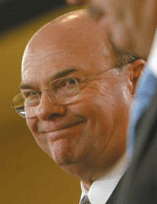
The republic began to get back on track last August with a two-year $657 million loan accord with the IMF. But the credit line was stalled after the government of president Hipolito Mejía (pictured above) took over two electricity distributors without IMF backing. After failing to live up to the IMF agreement, blackouts became a feature of daily life as a fuel shortage meant generators were unable to run and the newly nationalized distributors complained of a lack of liquidity to buy fuel. The government was left with debts of $400 million after subsidizing electricity in poor areas. Protests and strikes followed.
International investors suffered when the country missed a $27 million interest payment on its 2013 global bond on January 23. International rating agencies responded with downgrades. The finance ministry did make the bond payment a few weeks later, within the 30-day grace period, but the rating agencies maintain their negative outlook. “The situation is very precarious. Essentially the country has no monetary policy right now, the fiscal policy is off target, and they have very little in national reserves,” says Richard Francis, credit analyst with Standard and Poor’s.
In mid-February, the Dominican Republic was in talks to reschedule some of the $1.7 billion it owes the Paris Club of creditor countries. To investors’ relief, on February 11 the IMF released a delayed $66 million line of credit after approving its first review under the stalled August loan agreement. A day later, the World Bank granted loans worth nearly $120 million, mainly to help the electricity sector. The country is now counting on a $220 million loan from the Inter-American Development Bank to strengthen economic stability and finance social programmes.
IMF deputy managing director Agustin Carstens says the deal was possible because authorities had implemented new electricity reforms, tightened monetary conditions, ended foreign exchange intervention and cleared some external arrears. But he warned that additional reforms were needed, including changes to the taxation system and an overhaul of the banking and electricity sectors.
IMF support is crucial for the Dominican Republic’s short-term and medium-term fortunes. “If you fall out of compliance with the programme, then that’s when you run into the risk of the IMF money stopping. That’s a bad scenario for the Dominican Republic because they need those flows”, says Ross at Bear Stearns. Fitch voices similar concerns, noting that $504 million public sector medium and long-term debt amortizations, which are due this year, cannot be covered by reserves, which are estimated at $260 million.
Economic stability is the top issue in the forthcoming May 16 elections. The biggest task for a new president will be to restore investor confidence, cutting interest rates and putting public finances back on track. Though Mejía is seeking re-election, the favourite is economist and former president Leonel Fernández, a member of the opposition Dominican Liberation Party. Fernández says that if elected he would assure bondholders that the country would not alter its payments schedule before reaching a restructuring deal.