 |
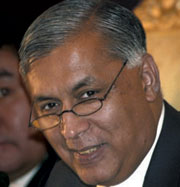
| Shaukat Aziz |
FINANCE MINISTER SHAUKAT Aziz is bullish. “Pakistan is on a roll,” he proclaims. “The economic situation is looking better by the day and the country is on an accelerated growth path.” The economic team put in place after General Pervez Musharraf seized power five years ago in a bloodless coup has achieved a remarkable turnaround. GDP growth for the financial year ended June 30 is expected to nudge 6%, per capita income is forecast to rise from $450 to $600 and industrial output is up by a record 15%. Exports are ahead by about the same percentage as output, private sector credit has increased threefold, and foreign reserves have soared to $12.5 billion, more than 10 times the 1999 level.
“This is the best macroeconomic picture we have seen since Pakistan was created 55 years ago,” says Sirajuddin Aziz, senior executive vice-president of Bank Alfalah.
Foreign banks are equally enthusiastic. “After several years of consolidation, Pakistan is poised for an acceleration in growth,” says Sakib Sherani, analyst at ABN Amro. “All in all, the country appears well positioned for further upgrades to its sovereign credit rating [currently B/B3].”
Merrill Lynch analyst Arshad Arif concurs. “The past three years have seen a significant impact on all spheres of life in Pakistan,” he says . “Economics, privatization, corporate fundamentals, governance and politics – all these factors are different and for positive reasons. Investors who have been looking at Pakistan and have withdrawn their interest owing to various reasons may find it a different country now.”
Yet foreign investors remain sceptical, and therein lies Pakistan’s Achilles heel. Foreign direct investment was some $800 million last year, roughly the same as the amount the country expects to attract in the current fiscal period. Much of this came from the privatization receipts of two bank sales. United Bank went to a group of Middle East and overseas Pakistani investors, and the Aga Khan acquired Habib Bank, the country’s second-largest bank.
Perception of instability Two attempts on Musharraf’s life, the army chasing Al Qaeda militants along a volatile border with Afghanistan and tension with India do not project a picture of political stability – the primary concern of most potential foreign investors. “If you are looking at Pakistan from London, what you are likely to see are images of fundamentalist mullahs with big beards and this is what has earned the country an extremist reputation,” says Zouhair Khaliq, chief executive of mobile telephone company Mobilink. “It’s only when people come here to see for themselves that you get a huge change in that perception.”
Mobilink is itself a foreign investment venture, owned by Egypt’s Orascom. The company is now Pakistan’s top mobile operator, having committed some $750 million to the country. “This is a growing market that has experienced tenfold growth in the past three-and-a-half years, yet there is less than 3% cellular penetration,” says Khaliq.
The telecom sector is one area that shows some signs of renewed confidence from overseas investors. The government recently awarded two cellular licences for $291 million each, well above expectations. The licences went to Syrian-based Space Telecom Pakistan and, perhaps more significantly, to Norway’s Telenor Mobile Communications. “If investors are willing to pay $291 million for these licences it tells you something about Pakistan’s economic potential,” says Zaigham Khattab, vice-president of Dubai-based private-equity group Abraaj Capital. “We are now complete believers in the future of Pakistan. This is the first time we’ve seen the level of debt coming down, which has given the country some fiscal space for expenditure on areas like education and infrastructure. We also see the rupee remaining stable for the next three years and we’re looking for opportunities in sectors such as financial services, telecoms, food processing and infrastructure.”
Finance minister Aziz acknowledges that the government needs to make more of an effort to attract domestic and foreign investment, as well as reduce the cost of doing business and the amount of red tape involved. “The image issue Pakistan suffers from until people come here and see for themselves needs to be tackled, locally and internationally,” he says.
The country has certainly made its mark in the international debt market, recently issuing a $500 million Eurobond. Central bank governor Ishrat Hussain says: “Our policy is to continue to pre-pay our external debt to official creditors as well as the private sector in order to reduce our debt ratios. That, along with assistance from the World Bank and Asian Development Bank will increase the quantum of development expenditure. My guess is that next year we should be able to boost our development expenditure from $3 billion to almost $4 billion. This will have a multiplier effect on the economy as public investment grows but it also crowds in a private sector facing shortages of infrastructure, skilled manpower and supply problems.”
Weaning itself from the IMF Pakistan will complete its poverty reduction and growth facility with the IMF by November and is not going to go for successor arrangements. “So we went to the international capital markets to make a strategic re-entry and have an external disciplining tool in economic management,” Hussain says. “When you don’t have the IMF you need market discipline to keep on track.”
The deal was a great success. Hussain says: “We wanted to test the confidence of the European and Asian investor base. The bond was four times oversubscribed and we achieved very good spreads compared with countries like the Philippines, Turkey and Brazil, which enjoy higher credit ratings than Pakistan. We may go back to the market on a regular basis, but first we will see how this issue trades. In future, we might want to diversify into the US dollar market.”
The Karachi Stock Exchange (KSE) is on its way to another record year, with the index up nearly 20% in the first quarter and market capitalization standing at $24 billion compared with $3 billion some 10 years ago, although its weighting is less than 1% of the MSCI and IFC indices. The market now stands on a P/E ratio of 10.9, the most attractive valuation in the Asian region apart from Indonesia. With dividend yields in the 8% to 12% range, compared with 4% for Bombay, domestic liquidity is pouring into the stock market. However, like other areas of the economy the KSE suffers from a lack of foreign capital. The foreign investment portfolio, which not long ago was $1.4 billion, has now dwindled to less than $100 million, even as the KSE has shot ahead.
The financial sector has provided a lot of momentum. Banks appear to be making a smoother-than-expected shift from the bonanza they enjoyed on the back of fixed-income capital gains to having to rely on traditional sources of income in the new low interest rate environment. Earnings were expected to take a severe hit this year as the central bank slashed rates to the point that 10-year treasury bills that stood at 17.5% a couple of years ago are now yielding 6.5%. Deprived of this free earnings ride, the banks have been feverishly dusting off their traditional retail business skills, primarily in consumer financing.
“We expect to at least double our profits,” says Shaukat Tarin, CEO of Union Bank. “The first-quarter momentum is there and we are putting on high-yielding assets in credit cards, auto finance, revolving credit facilities and other areas of consumer finance. Pakistan’s burgeoning middle class is now getting a taste of banking services to which they did not have access in the past, and the spreads are very good.”
It has been a difficult adjustment as banks struggle to roll out new products and improve service quality. Mohammad Aftab Manzoor, CEO of Muslim Commercial Bank, offers a word of caution. “There is a lot of surplus capital around and all banks are chasing the same business,” he says. “My hope is that credit standards will not be relaxed. In the past management’s message to people in the field was to bring in those deposits. Now we’re dealing with a major culture change as branch managers learn to analyze lending in areas like small projects and business start-ups.”
Ayaz Ahmed, CFO at Habib Bank, says the new environment requires a change of mindset. “We’ve had to shift our people’s skills from deposit gathering to lending and consumer finance,” he says. “Branch managers need to become more credit oriented as the dynamics of the industry have undergone a dramatic change. But the potential is there. A lot of banks are competing for a small slice of the pie, but that pie can grow very quickly.”
A number of foreign banks, including BancAmerica, Société Générale and Crédit Agricole, have exited Pakistan. The big names that carry on – Citigroup, Standard Chartered and ABN Amro, for instance – all report healthy earnings growth. Restoring the faith of these global players is one of the tasks facing Shaukat Aziz and his team. “The most important factor is time,” says Farrukh Khan, chief executive of securities house BMA Capital Management. “The continuity of the current administration is what counts. Success largely depends on the degree to which the government can deliver on its political agenda and how effective policy measures can result in a greater degree of optimism and a positive perception of Pakistan in the investment community.”


