 |
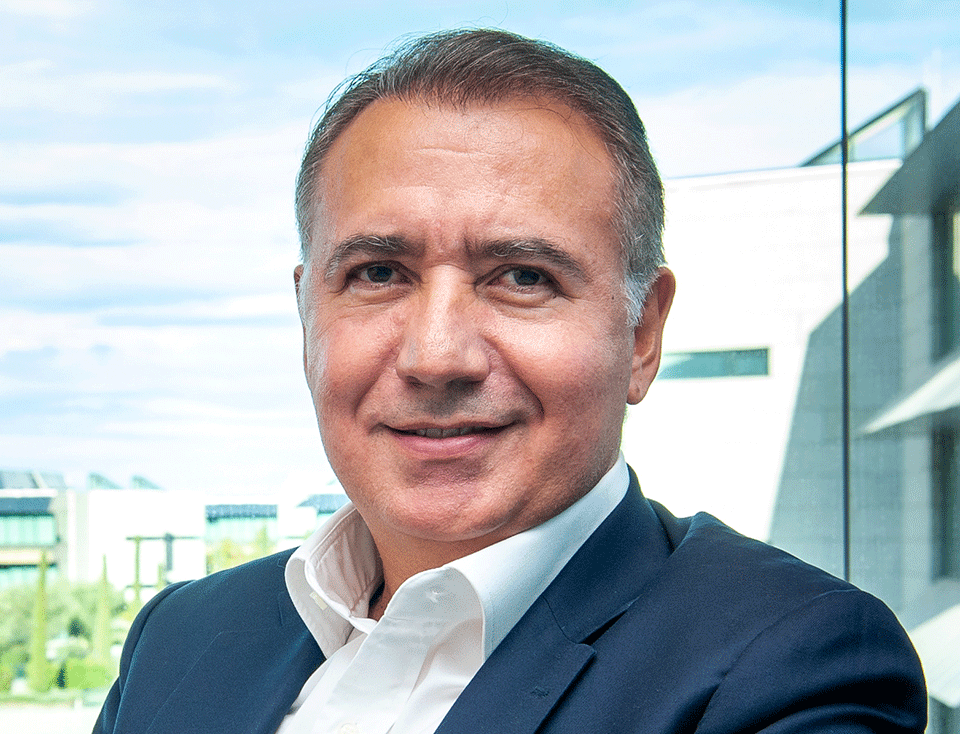
| Rafael Buenaventura |
THE STICKY MORNING chaos on Manila’s Roxas Boulevard seems a thousand miles away from the cool equanimity that pervades the top floor of Bangko Sentral Ng Pilipinas, which sits imposingly on the busy thoroughfare. The central bank’s governor, Rafael Buenaventura, Pa Eng to his friends – a nickname is de rigueur in the Philippines – is busy putting the finishing touches to a press release explaining in the simplest terms the difference between debt refinancing and debt restructuring. The text reads like a teacher’s gentle admonition of a schoolboy dullard. That would not be so far from the truth. The worrying thing for the future of this nation of over 80 million is that the recalcitrant pupil is Fernando Poe Junior, one of the leading candidates in the May 10 presidential elections.
In a campaign speech in March, the retired movie star, alternatively known as Da King or FPJ, addressed the serious issue of the government’s burgeoning debt mountain, floating the idea of a restructuring if he were elected. His timing was impeccable. Buenaventura was just putting the finishing touches to a $500 million debt issue to help plug the government’s funding gap. FPJ’s remark, later explained as a misuse of the term – he had apparently meant to say “debt refinancing” – cost the government dear on the issue price and knocked several centavos off the exchange rate.
A high-price faux pas “I’m telling them, don’t use that term, ‘debt restructuring’,” says Buenaventura, smiling calmly. “It’s not helpful.” That is something of an understatement. The fact that the central bank governor is already putting out fires started by a candidate who is not even elected yet says a lot about the parlous state of the Philippines’ political system. Despite Poe’s own goal, Buenaventura got the issue away, although he was clearly realistic in his expectations.
“We raised $500 million – we felt that we might as well do some of the fund raising ahead of the polls. It wouldn’t be credible to come up with a full programme ahead of the election. But we can start it, so the incoming government can understand it.”
According to one banker close to the deal, if it hadn’t been for FPJ’s faux pas, pricing would have indeed been tighter and the issue perhaps larger. “We rounded up demand at 8.75%, he says, “and the feeling was $750 million was likely. The Poe statement obviously spooked people and gave investors more leverage. So the deal was kept at half a billion and priced at 9%.”
Given the market’s perception of the economic prospects for the Philippines, it is a wonder the issue worked at all. In a recent issue of its Eye on Asian economies, stockbroker CLSA Asia-Pacific Markets wrote under the heading “Philippines: heads you lose, tails you lose” that “very little has been accomplished by President [Gloria Macapagal] Arroyo in the three years she has been in office … she does not enjoy broad public support while her natural allies in the business sector have lost confidence in her management skills. This means that even in the best-case scenario of an Arroyo re-election in May, we remain pessimistic on the economic outlook. In the event of Fernando Poe Jr being elected president, the prospects are a lot worse. Get ready for an Estrada re-run. Last investor out of the door, please switch off the lights.”
This outlook reflects key concerns about the state of the Philippine economy. Top of the list is the growing budget deficit, which shows no sign of abating. Attempts to reduce it have failed thus far, not because the government is overspending but because revenues have plummeted. This despite a major initiative, the 1996-98 comprehensive tax reform package (CTRP), the aim of which was to broaden the tax base, reduce the overall taxation burden but improve revenue collection. The attempt achieved none of its goals.
“The CTRP was flawed,” says Buenaventura. “That needs to be addressed: it gave up more than it was going to take. Tax collection has gone down from 17% to just 12%.”
Guillermo Luz, executive director of influential businessmen’s forum Makati Business Club, is less diplomatic in his assessment of the government’s CTRP initiative. “It just didn’t live up to its name – for all the effort that went into it, the result was a squeak, it was a disaster,” he says. “The original idea was to increase revenues; the trade-off was a reduction in the corporate rate, higher collection on VAT. Here we are years later, and the corporation tax rate is 32.5%. We still don’t index excise taxes, so they’re falling behind. We don’t benchmark and VAT would have been better fixed at 5% instead of 10% with so many exemptions.”
Jody Santiago head of equity research, Philippines, at UBS Securities, says: “Everyone knows the reason that we have a deficit is not that we don’t have enough taxes. It’s because we don’t collect due to corruption. If you could solve the corruption, you wouldn’t need new taxes.”
Deficit reduction failure The sharp drop in revenues from tax collection is a serious problem. According to Alex Pomento, CLSA head of research in the Philippines, too much of what little the government does collect ends up funding its deficit, a situation that cannot continue given the chronic need for infrastructure spending.
“The government doesn’t spend because there’s nothing to spend,” he says. “Forty per cent of revenues go on debt finance, 40% maintains a bloated bureaucracy and just 20% gets spent on capital expenditure. It’s not enough; those ratios should be the other way around.”
Buenaventura is equally frustrated with the government’s failure to deal with the deficit. “We had a budget deficit reduction programme in place in 2002 and we blew it,” he says. “We went from 4.7% to 5.2% [of GDP]: it was collections again and the CTRP was a problem. The target must be that the government doesn’t need to borrow new principal: then we can talk about 6% to 7% growth rates. We can’t afford new debt. Eventually, if the economy looks good, we can extend the maturity: if we get more foreign direct investment. It’s a bit chicken and egg: you have to reduce the deficit to get people to come in and if they come in it’ll reduce the deficit.”
Although Buenaventura acknowledges that the loss of foreign capital is a direct consequence of the deficit issue, he remains surprisingly optimistic that this vital source of capital will reappear after the election. “Clearly, FDI is on temporary hold because of the political noise we have leading up to the election,” he says. “I’m confident when we have a new mandate things will move again.”
Arguably, FDI is not on temporary hold but has in large part disappeared altogether. According to CLSA, having reached a post-Asian crisis high in 1998 of $1.8 billion, it collapsed to a paltry $200 million in 2003.
With elections due this month, neither of the two leading candidates, the incumbent Gloria Macapagal Arroyo (GMA) and main
challenger Fernando Poe Junior, showed a significant lead by late April, an issue that Buenaventura clearly regards as important.
“It has been a difficult three years,” he says of the GMA administration. “The feeling was, ‘do you really have a mandate?’ The senate majority was never there: there was too much compromise. We’ve had mutinies, the impeachment of the chief justice. It’s ridiculous: we’ve just had too many events. Whoever wins, we hope they get strong legitimate support.”
Leonilo Coronel, executive director of the Bankers’ Association of the Philippines, is pessimistic about the prospects of a clear winner in May’s election. “Stability will only happen if there’s a clear mandate – that doesn’t look likely unless the three other [candidates] back down,” he says. “If GMA wins, it’ll be by what share of the vote? Maybe 40%. Which means that 60% didn’t vote for her.”
Constitutional change Buenaventura takes a neutral view. “If you look among the advisers to all candidates,” he says, “there’s a recognition that the fiscal deficit needs tackling. The debt is not sustainable. The FPJ camp has come up with almost the same policies.”
Absence of ideological difference between the candidates misses the point. Whoever wins, little is likely to improve unless the political system is overhauled to eradicate cronyism and corruption.
“We are fed up with the politicians,” says Makati Business Club’s Luz. “What they’ve done is to destroy value. It’s the one thing that’s dragged down the Philippines: the politicking that’s done by the politicians and the executive branch. You can’t quantify it but it’s got to be 1% or 2% [of GDP]. It’s at every level: the confirmation process for new appointments; the legislation destroyed, from anti money laundering to tax reform.”
Luz points to the “pork barrel” in the Philippines congress as an indication of systemic corruption. “The pork barrel is the power to allocate money to a named project, and the power is absolute,” he says. “[As a legislator], you can say what project [receives funding] and where. Presumably they know who the contractors are for these projects. It’s been Ps25 billion [$450 million] for the last two years, so it’s not small money.”
Such are the failings of the current political system that there is serious debate about changing the constitution, which for now allows presidents a single six-year term. “There’s talk of maybe moving towards a parliamentary system where you can stay [in power] longer,” says Buenaventura, “but you’ve got to perform; produce the goods. We need a strong leader – yes. But six years is enough if you have the political will.”
Luz says: “I’m more pessimistic about the elective positions, especially in Congress. There’s a serious drop in the candidates: no institution reflects this more than the senate. It used to have a lot of good minds. Now we have comedians, actors, retired athletes and media personalities. They can’t hold a candle to the great senators of the past.”
CLSA’s Pomento believes a more radical solution will be required to fix the country’s political, economic and social problems. “If I want to get economic growth,” he says, “I need to surrender some of my rights. We cannot apply US standards of democracy on a third world economy.” He draws an example from regional competitor Thailand “Look at what [Thai premier] Thaksin’s doing now. He has curfews, laws against drugs. People are willing to surrender some of their rights in Thailand on assurance that there’s more money in their pockets and more food on the table.”
The Philippines is living on borrowed time. The birth rate in this overwhelmingly Catholic country points to a population of 100 million by 2012, a prospect that no-one relishes, given slow economic growth and a lack of capital for infrastructure spending.
Buenaventura also compares the situation with Thailand’s. “If you just look at the population factor, Thailand and the Philippines 20 years ago, we were both at 50 million,” he says. “Now we’re at 80 million; they’re at 60 million. That needs to be addressed. The Catholic issue is no excuse. There has to be the political will to change that.”
Perhaps the only silver lining to the black economic cloud that hangs over the Philippines is the remittances of the more than 7 million Filipinos working abroad. Buenaventura says: “It’s $8 billion through the official channels. I’d suggest that it’s another $2 billion unofficially. In some ways, that money represents investment in SMEs, education and consumption. If you go to the provinces, you can see a lot of wealth being created. It’s in Manila where the real problem is.”
By some reckoning, the overseas remittances are single-handedly propping up the Philippine economy, which has been hit by government attempts to clamp down on expenditure.
With a slowing economy, funding so tight, significant political uncertainty and a looming demographic issue to cap everything, one would be forgiven for wondering just how Rafael Buenaventura manages to keep the boat afloat at all.
Lack of political ambition Buenaventura claims that the country’s funding situation is not dire. “Only about 10% of our national debt is short term,” he says. “We’re still trying to stretch as much as possible of our medium-term debt to longer-term debt. We’re paying a higher than expected rating than our peers purely because of the perceived political issues and the new government – will it persevere to reduce the deficit?”
While most people in the international business community are complimentary about Buenaventura’s abilities and his performance to date, some are also becoming worried that the worsening macroeconomic picture and the outlook for global bond yields will inevitably make his task much harder.
“It’s increasingly difficult to maintain the view that they can continue to manage the financing side,” says a banker. “They’ve been very smart and also lucky in managing the international community. They’ve been able to overcome a lot of issues by being credible people during an amazing rally for emerging-market debt. The Philippines still represents good value. The challenge is: how do they continue to fund themselves when interest rates go up and investors can get their yield more safely elsewhere? There’s going to come a crunch time soon when people say: ‘What’s the future?'”
Many in the local business community remain supportive of Buenaventura. “The Philippines needs people like Rafael Buenaventura,” say Luz. “We joke about it all the time but we do wish some of these guys would run [for political office]. But the way the deck is loaded, we don’t see many businessmen wanting to run.”
Buenaventura himself is adamant that politics is not his suit and confirms that he harbours no such ambitions. He emphasizes his point by reciting the precise status of his term in office. “I’ve served four years, eight months and 21 days,” he says. “I have 15 months and 16 days left – that’s the end of my term.”