THE WORLD’S DOCTORS write more than 1,100 prescriptions for GlaxoSmithKline medicines every minute. The company made pre-tax profits of £6.7 billion ($11 billion) last year. Making people better is big business.
UK pharmaceuticals group GSK’s products treat asthma, depression, diabetes, migraine, nicotine addiction and a host of other ailments. But GSK hasn’t always been so multi-faceted. Long before its merger with SmithKline Beecham, Glaxo Wellcome’s growth was largely driven by the success of a single product, Zantac, which soothes ulcers, indigestion and heartburn.
“That’s the beauty of this industry,” says Chris Collins, chief executive of life science and medical technology specialist Code Securities. “You can suddenly develop a blockbuster that sells in billions every year and is protected by patents for 10 or 12 years.”
Because blockbuster drugs that generate over $1 billion a year can transform a company, global pharmaceuticals companies like GSK ? big pharma ? invest heavily in research and development. GSK spent £2.7 billion on R&D in 2002.
But internal R&D programmes are not providing enough blockbusters. So big pharma is turning to smaller companies specializing in biotechnology that, in Europe at least, are often short of cash.
Biotechnology is any process, such as brewing, that uses living organisms to make or run a commercial or scientific product or process. Today, the term is commonly used to describe the use of genetic science to create medicines and drugs.
A modern biotech is unlike any other business, and financing it is concomitantly difficult. Getting a drug from the idea stage to regulatory approval can take more than 10 years. Last December, management consultant Bain & Company calculated that the average cost of discovering, developing, and launching a new drug had risen 55% since 2000 to a staggering $1.7 billion. The figure is so high because it includes the cost of discovering, developing and testing drugs that don’t make it to market. For every Zantac, literally tens of thousands of potential new products fail.
So a biotech can burn cash for a decade before it starts making any money. Even the earliest stages of drug research involve testing as many as a million combinations of chemical compounds and proteins. This is technology intensive and needs large investment.
After refinement, human testing starts in three-phase clinical trials. Crudely, phase I establishes if a drug is safe. Phase II finds out if it works. Phase III repeats phase II on a larger sample of patients.
A developer then takes its drug to the regulators. Roughly two-thirds of drugs are denied approval. With these rates of attrition, investing in a biotech business is a high-risk affair.
“If done the wrong way, this can end up like making massive bets at the races,” says David Schulman, a London partner at law firm Dechert. “Risk one is whether you can tell good science from bad science: will things work therapeutically and in a safe way? Risk two is patent law: do you have a monopoly and for how long? Risk three is the regulatory wild card, because sometimes approval doesn’t come through in a timely way or with the right prescription label.”
Investors trying to spot the next GSK by investing in biotechs are playing molecular roulette.
This is less of a problem in the US. The American biotech industry is 10 years older than its European counterpart, and a specialist investor community has grown up to fund it. “In the US there are funds focused on healthcare and biotechnology that can analyze this sector to death,” says David Rasouly, a biotech specialist with Nomura International in London.
London’s potential Europe is different. Outside the US, the UK biotech industry is the most advanced in the world. And while US healthcare and specialist biotech funds are dispersed around the country, London is potentially biotech’s single most important financial centre.
“There is more money for biotech in London than in New York, although probably less than in New York and Boston combined,” says Code’s Collins. “If we can get the London market excited, it has the greatest concentration of biotech finance in the world.”
The problem is that London has been excited about biotech before. The industry caught the imagination of the mid-1990s’ bull market, and investor interest peaked with the mapping of the human genome in 2000.
As biotechs failed to deliver not just blockbuster drugs but, in many cases, any revenue-generating products at all, the bubble burst. It has taken some high-profile casualties with it. PPL Therapeutics, which cloned Dolly the Sheep, was once valued at £500 million. But it ran out of cash and put itself up for sale last year. In February, PPL confirmed that it was in talks with an unidentified potential buyer, which reportedly values the company at around £6 million.
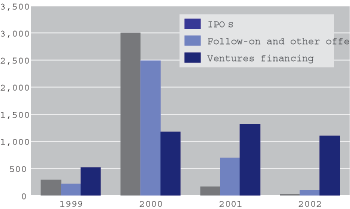
European biotechs faced a funding crisis last year. It is the public markets, not the private equity markets, that have dried up. According to Ernst & Young’s 10th annual European Biotechnology Report, published in May, the amount raised through biotech initial public offerings in Europe collapsed from over e3 billion in 2000 to e24 million in 2002. In the same period, the amount of venture financing raised hovered between e1.1 billion and e1.32 billion.
“Venture capital funding has been pretty constant,” says Tim McCarthy, finance director of UK drug development company Alizyme. “The VCs are not short of money, and the specialist biotech funds have raised money quite successfully over the last couple of years.”
They’ve had little choice. Because of the dearth of IPOs and other exits, they’ve had to keep investing. London-based Merlin Bioscience raised e62 million for the first major seed fund for UK biotechs in 1997. Its fully committed Fund II, which closed four years later, totalled e247 million and is one of the largest dedicated healthcare venture capital funds in Europe.
A handful of listed European biotechs went back to the markets in 2003. In February, Alizyme raised £16.1 million by issuing over 57,000 new shares at 28p a share. By the time it raised £11.5 million in October, Nomura was able to place new shares at 168p each. Antisoma, which is developing anti-cancer drugs, completed its £15.2 million placing and open offer in December. In the same month, Xenova Group’s £21.1 million financing through UK and US share placings and an open offer was the largest fundraising by a UK-listed biotech company in 2003. Xenova also specializes in cancer treatment.
Alizyme was one of the biotech success stories of 2003. Seriously undervalued at the beginning of the year, its share price rose on the back of a Japanese licensing deal worth up to $42 million, and strong clinical trial results. It has a new biotech business model. Its drug development programme is focused on obesity and gastrointestinal disorders. And it has taken steps to limit the horrendous costs associated with R&D by outsourcing as many jobs as possible.
Access to the best
|
Equity financing Money raised (emillions) |
 |
| Source: Ernst & Young |
McCarthy can sympathize with those biotechs that are still forced to go cap in hand to investors for incremental funding every year. “We’re not living from hand to mouth now but we were. Before last year, we had a cash horizon of 12 to 18 months. Now we don’t anticipate going back to the markets before we’re generating significant revenue from licensing deals.”
But how many more Alizymes can Europe produce? Venture capitalists that are prepared to fund start-up biotechs are keener on those that are spun out from the larger pharmaceuticals companies.
VCs have shifted their attention to more-established companies. Merlin’s Fund II, for example, is focused on mid-stage and late-stage biotechs with marketable drugs. Its intended hold period for each investment is four to five years. Once that period is up, Merlin needs an exit.
The biotech funding gap is due to the public equity market reaching the same conclusion as the VCs and wanting to invest in more-established companies. It has raised the hurdles for biotech IPOs. In the mid-1990s, a UK biotech float might typically have raised between £20 million and £30 million for a company with a market capitalization of around £80 million. To list these days, a biotech needs to aim for a market cap of between £200 million and £300 million. And the least investors want to see is phase II products and clinical data.
They have probably over-reacted. “There isn’t an unquoted company in the world that has all of the things that institutional investors want for an IPO,” says Code’s Collins. “There’s certainly not a single company in Europe that is worth £200 million to £300 million and has a broad pipeline of products and two or three technical platforms producing a never-ending supply of drug candidates.”
The history of biotech suggests that such companies have never existed. California’s Amgen is the world’s biggest biotechnology company. It employs more than 10,000 people and had annual revenues of $5.5 billion in 2002. Collins points out that Amgen’s IPO in 1983 valued the company at $100 million. “When it floated, Amgen was raising $15 million here and $20 million there.”
A more mixed message comes from the recent history of US IPOs. Last October, after 20 months without a single biotech IPO in the US, five biotechs floated on Nasdaq. By the end of the year, two more had followed. But at the beginning of January, more than half of the seven newly listed companies were trading well below their issue price. Acusphere, which uses its proprietary technology to improve the ways drugs are administered, priced its October IPO at $14 a share. In late February its shares cost $7.
“The US aftermarket performance was disappointing,” says Collins. “Had their window stayed open, sentiment in Europe might have improved.”
Still, there are at least half a dozen credible European candidates for IPOs this year. These include Sweden’s Biovitrum, which is developing drugs for metabolic diseases such as obesity and is 19% owned by Pfizer. Scotland’s Cyclacel, thought to be the first European university spin-out to raise over $100 million in private equity, is another example.
Pace setter in Europe Ark Therapeutics has set the pace in Europe. On February 17, it announced its intention to raise around £55 million on the London Stock Exchange. On March 3, Ark successfully competed its IPO, meeting its target by selling over 41.5 million shares priced at 133p.
Ark exemplified the dilemma that Europe’s most promising biotechs face. Having called off a planned IPO in 2002, it was keen to take advantage of recovering markets.
In the run-up to its IPO, Ark stressed that it wasn’t doing the deal out of desperation and could quite easily return to its backers for another round of private funding. It had around £8 million in cash left, which should have sustained it for at least another 12 months. And it is an advanced company, with three late-stage products and one marketable product.
But the stakes were high for Ark. A biotech’s cash burn intensifies as it gets more products into expensive later-stage trials. So Ark needs to spend more than its current £7 million a year to complete its final push into profitability. One industry observer estimated that its £8 million would have lasted six months, not 12.
And two of Ark’s four lead products are gene-based. No regulator in the world has approved a gene therapy product. If regulators are unsure about a product they will sometimes ask for more data. This means more clinical tests, which take more time and burn more cash.
In the documents prepared for its IPO, Ark posited its closest competitor as Alizyme. But investors should be wary of the comparison. “We invest in Alizyme. We wouldn’t invest in Ark,” says Andy Smith of 3i Asset Management. “One has had a significant success in clinical and regulatory terms, and one hasn’t.”
With CSFB acting as bookrunner and sponsor, Ark got its IPO away. After briefly rising to 141p, the shares had settled at 133p to 134p a fortnight after the flotation. “If the price had gone up to £2, everyone would have seen Ark as an undervalued company with great prospects,” says Smith. “But it has stabilized at the issue price. At that valuation, we can buy better in the US.”
CSFB is committed to stabilizing Ark’s share price for 30 days after the IPO. With the bank also working on the IPO of Basilea Pharmaceutica, an independent Swiss biotech spun out from Roche four years ago, it will be keen to see Ark succeed. At the time of writing, Basilea was aiming to list on the Zurich bourse by the end of March.
But the subsequent performance of Ark’s shares is crucial for European biotech as a whole, not just for Ark and Basilea. “If the first new IPO disappoints, generalist investors might move out of the sector as a whole, as they did in the US,” says Smith. “Ark is possibly overvalued, but a generalist investor won’t see that, because they won’t compare Ark with global biotechs but with other small-cap names in the UK.”
The European IPO window needs to open and stay open. VCs being asked to commit to third and fourth rounds of private funding are wondering who will take them out. If venture funding is stretched and straight appeals to the public markets won’t sustain European biotech, what will? The answer is a combination of US money, big pharma, and some innovative financial technology.
US investors are looking to invest in European companies. When Xenova, which has had a Nasdaq listing for 10 years, raised £21 million in November, just under half the funds came from the US. “The growing US interest in European small-cap public biotech companies is an important consideration that the sector needs to think about now,” says Xenova CEO David Oxlade.
It’s not just institutional investors that are crossing the Atlantic. American pharmaceutical forms are buying what they perceive to be cheap European companies. Pennsylvania’s Versicor merged with BioSearch Italia in February 2003. At the end of December, Seattle’s Cell Therapeutics bought another Italian biotech, Novuspharma.
As well as acquisitions, big pharma is investing in biotechnology in other ways. At the beginning of 2003, Antisoma completed an alliance with Swiss pharmaceuticals group Roche. The agreement gives Roche exclusive rights to Antisoma’s pipeline of oncology products that are in clinical development, and the option of jointly developing and commercializing products that enter clinical trials in the ensuing five years.
Blockbuster status Roche initially paid $37 million upfront for the product rights. It also paid £4.15 million for just over 20 million new Antisoma shares. It now owns 9.1% of Antisoma. Total payments from Roche to Antisoma could exceed $500 million if all Antisoma’s pipeline products were successfully launched.
The Roche-Antisoma alliance was seen as very creative for both sides. Antisoma got £40 million in cash. Roche gets first refusal on research products that wouldn’t necessarily have survived in its own portfolio ? drugs that will make money, but could fall short of blockbuster status. “The larger pharmas see biotech companies as a good source of in-licence products,” says Nomura’s Rasouly.
Biotechs need to be cautious when they pursue alternatives to straight equity financing. Because so few biotechs are cash-generative, bonds are, or should be, off limits for all but the most successful companies.
“Debt financing is inappropriate because so many biotech companies are not cash generative,” says June Scott, director, quoted equity, at Sagitta Asset Management.
Scotia Holdings was one of UK biotech’s highest-profile biotech collapses. In 1998, it raised £46.2 million through a convertible bond. The money was to help fund development of its anti-cancer drug, Foscan. But in 2001 Foscan was turned down by the European regulator. That meant there was no prospect of converting the bond. At the same time, without the revenues that Foscan would have generated, Scotia couldn’t meet its interest payments. Within a week, it was in administration.
A new financing option for European biotechs that have approved or late-stage trial products is a royalty deal. These envisage a biotech selling a proportion of future royalties to specialist investors. The likes of Amgen and Genentech, which makes human growth hormone, used royalty deals back in the 1980s to help them become major biotech companies.
Royalty Pharma was set up in 1996 and initially raised $60 million from a small group of investors to buy royalty interests. The majority of its investments are in approved products, although it occasionally buys into the future royalties of products in phase III clinical testing. So it sticks to commercialization risk and avoids biotech’s very high development and regulatory risks.
Why would a well-funded biotech that is on the point of generating substantial royalties need to sell them? Phase III testing involves many more patients and so is exponentially more expensive than phases I and II. Royalty Pharma has invested in four phase III products, each time paying between $60 million and $70 million.
“Say you have a market capitalization of $300 million and you need to raise $30 million for phase III testing,” says CEO Pablo Legorreta. “You can avoid diluting the existing investors by 10% on the whole company by selling us a percentage of the royalties that product will generate.”
A less dilutive royalty sale can help preserve a public biotech’s share price. “A royalty deal is attractive to investors as well as management,” says Ken Macleod, who joined Paul Capital in London from Schroder Ventures Life Sciences this year to help find European royalty investment opportunities. “It is a unique source of financing.”
Greg Brown, who co-heads Paul Capital Partners’ royalty fund team, says: “In the continuum of risk, we’re above mezzanine debt but below the VC community or equity capital markets, and we are comfortable with the lower return.”
Unlike VCs, royalty companies are not looking for an exit. “We expect to hold our investment for 10 years,” says Brown.
Royalty companies have a lot of money to invest. Paul Capital’s second royalty fund totals $650 million of committed capital. According to Macleod, that makes it the largest dedicated healthcare fund ever.
After Memorial Sloan-Kettering Cancer Center, a New York cancer care and research centre, patented two genetically engineered anti-bacterial proteins, Neupogen and Neulasta, it licensed them to Amgen. The deal lasts until 2014, when they lose patent protection. In January, Royalty Pharma paid $263 million for a portion of the US royalties that Amgen pays MSKCC.
With their cashflows so dependent on single products, biotechs are highly illiquid. By selling royalties, MSKCC gets cash upfront to fund other research and capital projects, and it transfers commercial risk to Royalty Pharma.
As part of its royalty deal, MSKCC made a $7 million investment in Royalty Pharma. As a Royalty Pharma shareholder, MSKCC retains some upside from the success of its own drugs as well as the rest of the porfolio. “This is an excellent way for biotechs, research institutions, and inventors to diversify themselves,” says Legorreta.
Last year, Royalty Pharma embarked on the first securitization of pharmaceutical royalties. The company took royalty interests that it had acquired in 14 products, including thalidomide, which is now being used as an anti-cancer drug, and put them into a unit trust. The trust issued $200 million of bonds backed by its different royalty payments.
The larger sums of cash that royalty companies can provide could change the shape of Europe’s biotech businesses. SkyePharma of the UK used the proceeds of a $30 million deal with Paul Capital to help pay for its acquisition of RTP Pharma.
“Royalty deals can become transforming deals for companies that are stepping out from their role as pure drug development companies,” says Macleod.
Royalty funds offer the best chance for European biotechs to break away from their timid approach to funding growth.
An industry as volatile and exciting as biotechnology should be able to turn itself around quickly. “It just needs a few successes to remind investors of the potential returns,” says Collins. And don’t be surprised if the European biotech that works out the best way of raising the right money at the right time seeks patent protection on its financing as well as on its scientific formulas.