URUGUAY’S TRANSFORMATION IN 2003 from pariah to economic miracle was the result of the hard work of many people and organizations.
President Jorge Batlle deserves a huge amount of the credit – not least for hiring an extraordinarily competent economic team and then shielding them from political interference.
The Washington crowd deserves praise too. Batlle is no fan of the IMF, but when the Fund finally signed on to Uruguay’s plans, it did so wholeheartedly.
Then, when Uruguay found itself having to go to the international capital markets to restructure all its bonds, it got flawless execution from its advisers at Citigroup and law firm Cleary, Gottlieb, Steen & Hamilton. Behind the scenes, the country was receiving invaluable advice and support from the US Treasury, from the capital markets team at Deutsche Bank, and from the president of the Federal Reserve Bank of New York, William McDonough.
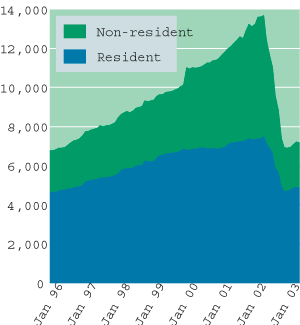
The Uruguay story started at the beginning of 2002, when Argentina’s default coupled with a high-profile banking fraud to undermine confidence in Uruguay’s banking system. By the middle of 2002, the country was experiencing possibly the worst bank run the world has ever seen, culminating in a bank holiday, devaluation and an IMF bailout in August.
Attention then turned to the government’s debt situation, which had become unsustainable overnight. Debt service was much more difficult in the wake of the devaluation, and total debt had increased massively when the IMF loaned the country $1.5 billion. Uruguay faced its problems, and in April 2003 launched a $5.3 billion bond swap that was successfully concluded in May. From that point on, Uruguay’s weak currency was an asset rather than a liability, and the country ended the year with 12% GDP growth. It even managed to tap the capital markets in October, with an inflation-indexed bond denominated in Uruguayan pesos and payable in dollars.
Astonishingly, Uruguay had managed to sell bonds on the international capital markets in 2002, warn its bondholders that they faced default, restructure its entire debt, and then sell bonds again in 2003.
The cause of the Uruguay crisis can be summed up in one word: Argentina. Uruguay has always been very much in Argentina’s shadow, with an economy largely based on providing nice beaches for Argentines’ summer holidays, as well as offshore banking services for Argentina’s middle classes. So when Argentina imploded at the end of 2001, Uruguay was hit by a double whammy. The last thing that Argentines were thinking of was spending their summer holidays in Uruguay. More important, Argentina froze all its bank accounts, which meant that many Argentines’ only source of funds was their deposits in Uruguay. Thus began the run on Uruguay’s banks.
Things went from bad to worse when a fraud was discovered at Uruguay’s largest private-sector bank, Banco Comercial, and depositors began a run on the bank.
Credit rating humiliation
 |
 |
 |
|
Batlle, McDonough and Taylor (top to bottom): the Uruguayan president used his good relations with the New York Fed president to persuade the US Treasury deputy secretary to temporarily bail out Uruguay with $1.5 billion |
Simultaneously, Uruguay was losing one of its greatest sources of national pride, its investment-grade credit rating. Standard & Poor’s was the first to act, in February 2002, followed by Fitch in March and Moody’s in May. “Our credit rating was downgraded every month, an announcement from one rating agency after another,” recalls Júlio de Brun, now president of the central bank. “The people received a clear notice that you could cast doubts on the capability of Uruguay to support its debt, and probably its capacity to support the implicit debts in the financial system.”
By June, things were getting very bad, in full view of the public. Uruguay had already signed up to an IMF programme, which required the central bank to publish daily data on reserves. Each day, these were $50 million lower than the day before. “It was inviting people to retire their deposits from the banking system,” says de Brun.
Then, another fraud was discovered, at Banco Montevideo – the second-largest private bank in Uruguay, after Banco Comercial.
The government had faced this sort of problem before: in the 1980s it had taken over failing banks, guaranteed deposits, and, by stepping in early, avoided panic.
In 2002, though, people could see what was going on in Argentina: accounts were frozen, dollars were forcibly converted into pesos at a completely unrealistic exchange rate, and funds that people thought were safe vanished into thin air. There was no reason it couldn’t happen in Uruguay, too. And the data being published by rating agencies and the central bank indicated that matters were deteriorating fast.
What’s more, depositors had no way of knowing which banks were solid and which were not. “This country’s deposit run was much more dramatic than Argentina’s,” says Eric Simon, the country representative for Uruguay at ABN Amro in Montevideo. “In five months it lost 50% of its deposits; Argentina lost 27% in a year.”
The IMF, at this point, was not being particularly helpful. In a way, the Fund’s reluctance to throw good money after bad was understandable. If Uruguay was going to devalue and default, better it do so sooner rather than later, and without the added burden of extra multinational debt.
Batlle, in a television interview in July 2003, identified Uruguay’s low point. It had taken place a year previously, when he was sitting with his wife and received a phone call from Eduardo Aninat, the deputy managing director of the IMF.
“The most bitter day was the 20th of July, a Saturday, at midday,” Batlle recalled.
“Mercedes was sitting next to me. Aninat called. Aninat told me that we had to do the same thing as Argentina. Mercedes said she thought that I was going to have a heart attack. And I told him no. Under no circumstance. That if we had to sink with the ship, we would sink, but that we wouldn’t be the ones to do it.”
Salvation demanded a lot of money, and in one big up-front sum, not dribbled out in $100 million or $200 million disbursements. The IMF was unsympathetic. It had learnt its lesson in Argentina, and lobbying activity from the likes of Enrique Iglesias, the Uruguayan president of the Inter-American Development Bank, was falling on deaf ears.
Batlle, however, was fortunate to have friends in even higher places. Former Federal Reserve Bank of New York president William McDonough is “a friend of Uruguay”, in the words of finance minister Isaac Alfie. The friendship dates back to the mid-1960s, when McDonough was working at the US embassy in Montevideo.
It was fortunate, as far as Uruguay was concerned, that the crisis hit when Batlle was president and McDonough, a personal friend of the president, was at the height of his influence at the New York Fed.
McDonough was not the only important person to come to Uruguay’s aid. “A lot of people helped us: we have a lot of friends in New York, Washington, and London,” says Alfie.
In fact, it’s probably no coincidence that in April 2002 Batlle sponsored a resolution at the UN Human Rights Commission in Geneva, calling on Cuba to give its citizens more civil and political rights. Uruguayan observers say that the resolution helped get Uruguay the support of the White House in an administration where the Treasury Department is far less autonomous than it was under Clinton.
In Batlle’s TV interview, however, McDonough was singled out for praise as being even more important than the US Treasury in the rescue. That’s saying something, because it was the Treasury that ultimately stepped in, at this point, and saved the day.
The US Treasury in general, and its deputy secretary for international affairs, John Taylor, specifically, were never likely candidates to come up with 10-figure sums aimed at shoring up a tiny country that posed no systemic risk and that had no geostrategic importance.
For even in the days of monster bailouts, when Alan Greenspan, Robert Rubin and Lawrence Summers comprised, in the words of a 1999 Time magazine coverline, the “committee to save the world”, the US was happy to let Ecuador default.
The difference between Uruguay and Ecuador was certainly not that the Bush administration was more prone to provide financial aid for crisis-hit Latin countries – quite the opposite. Batlle was at pains to point out that Taylor “worked Saturdays and Sundays all day, with his assistants, to find a legal space which would permit him
to find a legal mechanism to lend us the money without reversing what the American government had sustained in its electoral campaign.”
So how did the Uruguayans, with the help of McDonough, persuade Taylor and then Treasury secretary Paul O’Neill to front them the $1.5 billion they needed to save their banking system from collapse?
What Uruguay had – and Ecuador lacked – was a sterling reputation in financial markets. It was known as an honest place to invest that had been hit hard not only by the Argentine crisis but also by the noise leading up to the 2002 election of president Lula in Brazil.
A clear signal on default Paradoxically, though, it’s possible that Brazil’s woes were actually to Uruguay’s advantage. Brazil was a systemic risk, and it was far from clear that the IMF and the US Treasury had the means or the motive to bail it out. By coming up with just $1.5 billion – nothing in the context of Brazil’s national debt – Washington could send a clear signal that it was uncomfortable with sovereign debt defaults.
In fact, it was not long after the Uruguay bailout that Brazilian spreads started tightening. Far from being a costly bailout of Uruguay, it’s possible that the $1.5 billion was actually a very cheap bailout of Brazil.
On its own, however, the deal was certainly exceptional. It amounted to a lump sum of about $500 for each Uruguayan – a record amount by IMF standards, and vastly more than Uruguay’s IMF quota. Also, there was that whole issue of bilateral aid. As the IMF’s single largest shareholder, the US could and did essentially instruct the Fund to give Uruguay the money. But Uruguay needed the cash immediately, so the US loaned it the $1.5 billion for a couple of weeks before the IMF funds became available.
The money came just in time. Uruguay’s banks had reached breaking point: the country had devalued at the end of June, the central bank president was replaced on Friday July 26, and in the following days some $600 million was withdrawn from the system. On Wednesday July 31, the new head of the central bank, Júlio de Brun, announced a bank holiday.
The banks needed to reopen, of course, and quickly – but in a manner that would reassure the populace. So the US wired the $1.5 billion to Montevideo by the following Monday, August 5, to allow banks to open before the IMF funds arrived.
There was one simple governing principle when it came to using the money. “We supported all that we could support with that money, and nothing else,” says de Brun. That meant that sight deposits and savings accounts in public banks would be freely available, but term deposits would be pushed back by three years.
Private banks that were solvent could continue their operations without interference from the government, but those that were not – Banco Comercial, Banco Montevideo, Banco Caja Obrera, and Banco de Crédito – were intervened in by the government and closed down. The assets of the first three were bundled into a new bank, Nuevo Banco Comercial.
All of this – shutting down four banks that between them accounted for 30% of the banking system, reprogramming deposits at the public banks, and generally making hard, final decisions about the most important sector of Uruguay’s economy – took place in 72 hours.
It worked like a charm. When the banks reopened, Uruguay’s central bankers braced themselves for a record day of withdrawals; instead, total deposits went up.
Uruguay had survived. The cost, of course, was in debt. Between the devaluation and the extra $1.5 billion in obligations to the IMF, there was no way Uruguay could continue without a restructuring.
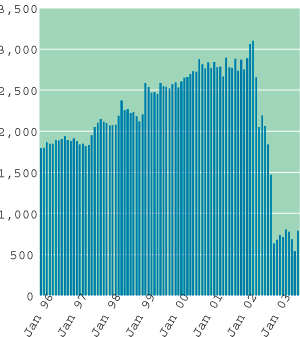
Nominal GDP, in dollars, was about $20 billion in 1998; by the end of 2002, it was a good $7 billion smaller. Central bank reserves had dwindled to $550 million in July 2002, from $2.8 billion six months earlier. Looking forward to 2003, not only did the government have to repay $500 million to the IMF, it also had another $1.4 billion of bond amortizations coming due. The market was certainly not happy: Uruguayan spreads were above 2,000 basis points, so there was no way the government could roll over its obligations.
The IMF made it clear what it thought was needed. Uruguay should default on its bondholders, catch its breath, and then come back to the market with a bond exchange offer a bit like Ecuador’s, forcing its private-sector creditors to take a haircut on their debt. The Fund itself, of course, as ever, would remain a preferred creditor and be repaid on time and in full.
The Fund had many reasons to take this stance. First, it would increase the amount of cashflow available to repay preferred creditors. Secondly, it would slash Uruguay’s debt, making the country’s burden sustainable in the long term. And thirdly, it would force bondholders to suffer some pain – which might help bring them around to the Fund’s concept of an international bankruptcy court.
The bondholders, naturally, did not see it like that. Since most of them mark their positions to market, they reckoned that they had already suffered most if not all of the pain that was likely to come their way. And Uruguay, for its part, was determined not to default if it could possibly avoid it.
“For us, this was an unthinkable situation,” says Carlos Steneri, Uruguay’s financial representative in Washington. “Uruguay, over the past 30 to 50 years, has been a trusted creditor. To do anything market unfriendly was impossible.”
There was also a less idealistic, more practical reason not to default first and try to restructure later. The central bank’s de Brun says: “We were afraid what the reaction of the domestic financial system to an approach like that would have been. We were very afraid that if we announced a default on the debt, maybe with haircuts and so on, we could trigger a new run on the deposits of our banking system.”
Uruguay started thinking about the kind of market-friendly exchange offer it could afford, and started talking to its advisers, including Deutsche Bank. The first thing it had to do, however, was to take a breath.
In the space of little more than a month, Uruguay had devalued, declared a bank holiday, intervened in the four largest private-sector banks in the country, and forced term depositors in the public-sector banks to wait an extra three years before they could get their money back. The IMF’s economic projections were grim, and it was clear that it would not sign off on any plan that didn’t include a major haircut.
Over the next six months, however, Uruguay’s economy started picking up, and it became clear that the country was on the rebound. De Brun says: “The diagnosis of the IMF about the sustainability of Uruguayan debt changed substantially between August 2002 and February 2003. And that gave us a lot of support with the argument that Uruguay had mainly a problem of liquidity in its debt, and not a problem of long-term sustainability.”
 |
|
Alfie: “In the next two to three years, the currency will stay as weak as it is now” |
The Uruguayans were the first to be convinced that they didn’t need to reduce the nominal amount of debt outstanding. “Since September 2002, we were sustainable in the medium to long term,” says finance minister Alfie. “But we needed to avoid rollover risk.” In the beginning, says Steneri, “the IMF believed that our voluntary exchange didn’t provide enough alleviation in terms of cashflow over the next decade. But small changes in the assumptions generate big results over the medium term, and with our growth rate and real exchange rate appreciation, little by little the actual situation was closer to our assumptions than theirs.”
Once again, McDonough was a strong advocate for Uruguay and its market-friendly solutions, but he was up against opposition at the highest levels of the IMF.
Among the multilateral institutions, the World Bank was the first to agree to Uruguay’s plan, in November 2002. The Inter-American Development Bank signed off in December. The IMF waited until February before giving in. Even today, after the successful exchange, Uruguay’s debt is enormous: about 110% of GDP, compared with about 35% just seven years ago.
As late as March 27, Anne Krueger, the IMF’s first deputy managing director, gave a speech in Boston in which she discussed the collective action problem – the “danger that individual creditors will decline to participate in a voluntary restructuring in the hope of recovering payment on the original contractual terms”.
Advocating default Krueger said that “the problem of collective action is most acute prior to a default,” warning that “if a numerically significant proportion of creditors elect not to participate in a restructuring, each hoping to be part of a small minority, the restructuring will inevitably fail.” Krueger continued by noting that “following a default, the options facing creditors – particularly those who have no interest in litigation – are more limited and so the problems of collective action may be less acute.”
By the time the speech was given, the IMF had signed off on Uruguay’s plan, and the country was talking to its investors, trying to find out what they would like to see as part of a deal. But Krueger was also distancing herself from Uruguay’s actions, essentially setting herself up for a big “I told you so” if things went wrong.
Her wariness was understandable. As Steneri says: “We were trying to implement something that nobody had done before.” Uruguay’s general plan was clear: to get bondholders into the deal, maximizing carrots and minimizing sticks.
As the structure of the Uruguayan exchange offer developed at the end of 2002 and the beginning of 2003, Bill Rhodes, vice chairman of Citigroup, decided that Citi needed to be involved. Citi, together with Cleary, Gottlieb, Steen & Hamilton, had done a stunning job in the Ecuador exchange, and a deal of this size could certainly do with having a co-lead manager.
So in January, Citi sent down Chris Gilfond, its co-head of Latin debt capital markets, to talk to the economic team, and got the mandate it was looking for.
It became clear that many creditors, especially retail investors, were keen not to see any nominal reduction in principal. At the same time, Uruguay’s reserves were so low that it couldn’t add any kind of cash sweetener to the deal, making that decision an easy one. And with one-third of the private external debt being held domestically in Uruguay, there was a series of meetings with stockbrokers in Montevideo, working out how to persuade them to get their clients into the deal.
The most intense discussions, though, were with the IMF. Without its stamp of approval, no deal would ever be accepted, so Uruguay went to a huge amount of effort, meeting individually with every executive director, and lobbying tirelessly.
After finally getting Fund approval, Uruguay was set to hit the road with its advisers and embark on a public consultative process at the beginning of March. But suddenly, Deutsche Bank got cold feet.
The most likely explanation has to do with the fact that Deutsche was the last bank to lead manage one of Uruguay’s bond deals, at the beginning of 2002.
Deutsche’s close relationship with Uruguay – it lead managed a $300 million 10-year bond for the country in November 2001, followed by a $250 million seven-year in March 2002 – was certainly responsible for its getting the restructuring mandate in the first place. But it also set up a tension between its buy-side and sell-side clients: Uruguay was now paying Deutsche to push out by five years the bonds that the bank had sold little more than a year previously.
Whether Deutsche was told to withdraw by a large fund manager, or whether it unilaterally decided to do so for fear of saddling Uruguay with a noisy lawsuit, Citibank ended up the sole lead manager on the exchange.
During the consultative process in March, Uruguay tried to address the concerns of all of its investors, be they big or small. Many, of course, were keen to keep their principal intact. That was easy, since Uruguay had already decided to do that and more – the general plan was simply to extend maturities by five years across the board, without touching the coupons.
Others, however, were worried about liquidity, since many of these bonds were very small. No problem, said Uruguay, we will include an option to swap into a big benchmark bond instead. Depending on the maturity of the initial bond, it could be swapped into one of three new benchmarks, maturing in 2011, 2015 and 2033.
Uruguay also made sure to include all of its debt in the swap, even the long-dated stuff that didn’t present any cashflow problems, to ensure that the relative maturities of different bonds were not changed.
Uruguay also included collective action clauses (CACs) in its new bonds that were more sophisticated than those used by Mexico, the CACs pioneer.
For one thing, it decided to use a trustee, rather than a fiscal agent, to handle payments. This made it much harder for holdouts to attach coupon payments.
It also included an aggregation clause. Just as in Mexico’s, 75% of the holders of any individual bond can change its payment terms. But, unlike Mexico, or anybody else, payment terms can also be changed if two-thirds of those bondholders vote for it, along with at least 85% of all Uruguay’s bondholders in aggregate.
There were many other small clauses, as well, at least one of which was inserted at the request of an individual bondholder. When Ben Heller of HBK Investments saw all the CACs, he worried that in any future exchange Uruguay might use not only the CACs but also coercive exit consents. So a clause was inserted ruling that out.
And although Uruguay did use exit consents in the exchange, it did so relatively mildly, allowing bondholders to opt out of the consents if they wanted to.
The insertion of CACs, and especially the aggregation CAC, was clearly a way of making any future debt restructuring easier. But the market approached the CACs maturely, and didn’t seem to worry that Uruguay was sending a signal that it was going to go through the whole process all over again once the new bonds started coming due in five years’ time. Everybody understood, it seemed, that the lack of a haircut this time around meant a higher debt burden, and therefore a higher marginal probability of future default. But certainly on a net present value basis, it is better to get cashflows for another five years and then worry about default than to suffer a default today in the hope of minimizing the chances of another later.
The international bond exchange was complex. For one thing, it had to deal with four currencies: dollars, euros, pounds and Chilean pesos. And in the end, Citi received some 2,500 letters of transmittal. That’s not the same as the number of bondholders: it’s the number of stockbrokers that the bondholders used. To put that number into context, a normal bond exchange generally gets between 300 and 600 such letters, while even the Ecuador exchange got fewer than 1,000.
Crucial smaller deals The $3.5 billion international exchange was only a part of the whole deal. There were two others, which took place simultaneously, that had to be a success for everything to work out.
The first was a $1.6 billion local exchange, which also involved presenting investors with a choice between a maturity extension and a new benchmark bond. Many investors in Uruguay actually held physical bonds, and a lot of work was needed to ensure that they could exchange their paper anonymously.
And then there was a single $250 million samurai bond. This, unlike all of Uruguay’s other external debt, already had a collective action clause. So Uruguay needed to persuade the holders to vote to change the
payment terms on their own bonds, rather than to exchange their old bonds to new ones. There was only one problem: no-one in Japan seemed to know that these clauses existed, and no-one had ever done such a thing before.
To make matters worse, the Uruguayans’ first visit to Japan coincided with a visit by Guillermo Nielsen, the unpopular Argentine debt negotiator who has generally been seen as about as market-unfriendly as could be. It was hard to persuade the Japanese that Uruguay was a different kettle of fish.
In the end, the Uruguayan team made three visits to Japan in 40 days, which culminated in the big vote. Bondholders were asked essentially to turn their 3% bonds maturing in 2005 into 3.5% bonds maturing in 2010. The net-present-value loss, of between 18% and 20% at exit yields, was the same as everybody else’s, although Uruguay made out much better because of the swap rates.
The meeting was a big success. The quorum was only 50% of bondholders, but more than 80% turned up, either in person or through representatives. And although only a two-thirds vote was needed to change payment terms, more than 90% were in favour. It was also crucial. Had the samurai not been amended the entire exchange offer would have failed.
The samurai bondholders’ meeting was on May 15, the same day as the expiration of the international exchange offer. Four days later, the results of the international and domestic offers were released: a total 93.5% participation rate, comprising 98.7% of Uruguay’s domestic dollar-denominated debt and 89.2% of its international bonds. In the most difficult case, the 2003 bonds, which were pushed out either to 2008 or 2011, fully $180 million of the $190 million still outstanding was tendered.
The offer did everything Uruguay had hoped for, and more. The exchange rate stopped falling, sovereign spreads started coming down, and the economy – which was already growing – started accelerating.
Helped by its weakened currency, exports and tourism have started booming in Uruguay again. Alfie is determined that this will continue. “In the next two to three years, the currency will stay as weak as it is now,” he says.
He’s even looking to reclaim Uruguay’s historical investment-grade credit rating. Already, he has started issuing new debt. In October, Citigroup lead managed a three-year local-currency bond that attracted sufficient international interest – only 8% was sold in Uruguay – to allow an upsizing from Ps4 billion to Ps5.6 billion (from roughly $150 million to $200 million).
Uruguay’s continued progress is far from certain. What is important, and what is a huge achievement, is that it extricated itself from a crippling crisis in one of the smoothest and most elegant operations ever seen in international finance.
This, without doubt, was the Latin American deal of 2003.
| Foreign currency deposits ($mn) |
 |
| Central bank reserves ($mn) |
 |
| Source: Citigroup |