HEDGE FUNDS MUST strive to keep up with returns offered by the cash equity markets this year if they are to continue to attract funds at the same rate as in 2003.
Moving into hedge funds in 2001 and 2002 was a good way for smart investors to preserve their money in a bear market. In 2003, though, even as the industry enjoyed record inflows estimated at $60 billion by Tremont’s Tass Research, hedge fund indices underperformed the S&P500.
To compete this year if cash equity markets keep rising, hedge funds must focus on product innovation and the development of new strategies.
Among those now emerging are credit long/short, a quasi-private-equity approach and what are called new alternatives, such as weather derivatives and catastrophe bonds. Another tactic for hedge fund managers may be to seek flows of money coming out of bond allocations.
Most hedge fund managers expect the equity markets to continue to thrive in 2004. It follows that the hedge fund strategies with the best prospects tend to be those that did well in 2003, for example, event-driven strategies and global macro.
Hedge fund managers, fund of funds managers and advisers are more cautious on emerging markets, distressed debt and high-yield strategies this year.
The record inflows into hedge funds in 2003 compare with much more modest inflows of $16.3 billion for the full year 2002 when the bear market in straight equities was still raging. This raises the question whether the growth in hedge fund investing is now so well established as to be immune to cycles in conventional market returns.
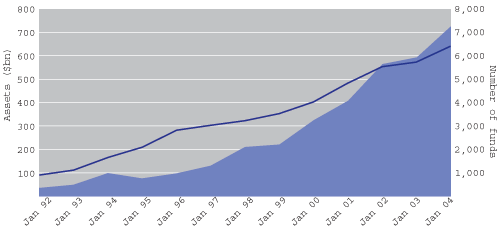
According to the Goldman Sachs/Russell alternative investment survey, the number of organizations – out of the 325 that responded – that invest in hedge funds increased by 40% globally in the two years to summer 2003. There is currently about $725 billion invested across about 6,380 hedge funds globally, according to figures from hedge fund advisory Hennessee Group (see chart). Philippe Bonnefoy, independent adviser to Commerzbank Securities’ Alternative Investment Strategies, says: “I predict that there will be $1 trillion in hedge funds by 2006.”
But many in the industry feel that a sustained rally in the equity markets could yet stem the inflow. George Van, chairman of Van Hedge Fund Advisors International in the US, says: “A little [movement of funds from hedge funds to equities] has happened already because hedge funds are struggling to keep up with equity markets.” Chris Woods, head of the hedge fund division at State Street Global Advisors, says: “If hedge funds only deliver single-digit returns this year people won’t be interested, unless the equity markets drop.”
Others expect a speedy return to the old styles of fund management as cash equity continues to revive. Charles Gradante, CIO at Hennessee Group, says: “The [state of the cash equity] market in 2003 resurrected a euphoria about long-only money management. I think the rate of money flowing into hedge funds will slow down.”
One fund of funds manager even predicts net outflows from hedge funds if the stock market continues to rise rapidly. Craig Reeves, managing director at fund of hedge funds Platinum, says: “Investors have very short memories from a hedge fund buying view. They wanted risk-adjusted returns but mandates change quickly from fear and protection to greed and gluttony.”
Other industry players suggest that while cash might flow into equities, hedge fund managers might still benefit from reallocations from other asset classes.
Hennessee’s Gradante says: “Institutions are getting out of the bond market in droves. Some of this money will go into hedge funds because they’re reluctant to put more into equities.” He adds: “People are asking us: ‘can we get those returns [such as those expected from bonds] from convertible arbitrage and other arbitrage strategies?’ The answer is ‘yes’.”
Sticking with diversification To ensure continued investment, hedge funds must remain diversification plays and show little to no correlation with equity markets. Bonnefoy says: “The question is, how to create value without directional exposure. This is our key job.”
The credit long/short strategy has gathered momentum over the past year. This is a result of the increased liquidity of the credit derivatives market over the past 18 months. Sanjay Tikku, head of investment strategies for Europe and Asia at fund of hedge funds Tremont Capital Management, says this strategy is one of the most interesting new areas. “Two years ago there were only a couple of [credit] long/short experts. Then, last year alone at least 10 new funds were launched.”
There is also some development in the long/short equity world. Strategies are becoming more specialized. For example, some managers focus on a specific industry sector or geography and some are developing a variation on the style. Lindsay Jones, head of business development at Orn Capital, says: “For example, there’s a quasi-private-equity approach where you take a fairly significant stake – say 10% – in a publicly listed company and hold it for a period of time.Very few funds are doing this at the moment. [But,] the idea is gathering momentum.”
New alternatives, such as weather derivatives and catastrophe bonds are also slowly gathering momentum as liquidity picks up and hedge funds are playing their part. Jones explains: “Instead of passing off their risk to reinsurance companies, insurance companies are starting to [securitize their insurance policies and] issue catastrophe bonds where they pay a coupon to investors but if there’s trouble the investor pays up.” One hedge fund that invests in both instruments is Systeia Capital Management. Jean-Louis Juchault, president and CEO of Systeia, says: “We are arbitraging the risk, so, the probability of the event occurring.”
Juchault explains: “For example, an earthquake in San Francisco could happen once a century and, say, the insurance company is willing to pay over 1% over the probability of the event occurring. So, what we’re doing here is benefiting from the fact that they’re ready to pay more than the mathematical price [in order to get rid of their risk].”
One strategy that isn’t new but that some believe is making a comeback relates to Reg D private placements. This is a strategy where managers negotiate private deals with listed companies at a discount to the issuer’s market price. The private placement security is usually a convertible. This kind of deal can be beneficial for a company that is looking for quick financing. Hennessee’s Gradante says: “Hedge fund managers making loans to small-to-mid-cap companies is coming back. This is mainly because banks are reluctant to add risk to their balance sheet. Hedge funds have picked up some of the void.”
Funds of funds will play an important role in the development of the hedge fund industry. They enforce some regulation on the hedge funds they invest in by demanding transparency. Many countries now allow retail investors to put their money into onshore funds of hedge funds. “Funds of funds have been, and will continue to be, primary innovators,” says Van. “The past year has seen RICS [regulated investment companies] introduced in the US – that is, hedge funds regulated with the SEC, and investors can invest a much smaller amount of money [$20,000 to $40,000 rather than $250,000 to $1 million] and they can be marketed more openly.”
Similarly, the French regulator allowed retail investors to invest in onshore funds of hedge funds last year and the German regulators are working out the details for similar regulation in Germany.
The biggest draws The strategy that attracted the largest inflows in the third quarter of 2003 was long/short equity, with $5.9 billion, according to the latest figures from Tass Research. This was followed by event driven with $5.6 billion and global macro with $3.1 billion. The top performing strategies for 2003 include emerging markets (28.75%), event driven (20.02%), global macro (17.99%) and long/short equity (17.27%), according to the CSFB/Tremont index. In comparison, the S&P500 finished up 28.68% and the MSCI World Index was up 33.76%.
Some hedge fund participants suggest that long/short equity will continue to perform well this year. “Maybe it will beat the broad equity markets in 2004,” says Gradante. In 2003, he says, “the market was less rational than hedge funds like. I expect it to become more rational and long/short to outperform broad equities.” That is, as the markets become more efficient and liquid this year it’s easier for managers to find good opportunities to buy and sell. Last year, even poor companies saw stock price rises in a broad and indiscriminate market recovery.
Event-driven strategies may do better in 2004 than last year, in particular merger arbitrage and convertible arbitrage. At the end of 2003, convertible arbitrage and merger arbitrage were up 9.4% and 9.9% respectively, according to the Hennessee Hedge Fund Indices. “I think we’ll see double digits [for merger arbitrage] in 2004,” says Gradante.
If the merger last year between Fleet Boston and Bank of America and, more recently, that announced between JPMorgan and Bank One signal the return of sizeable M&A deals, more opportunities for merger arbitrage will arise. Jones says: “The confidence levels of decision makers are higher.” Deal flow is expected to pick up by 35% in 2004 for both Europe and the US.
The pick-up in M&A deals also improves the outlook for convertible arbitrage. “Corporate events, such as acquisitions, lead companies to raise money so they might issue debt or equity, which creates opportunities,” says Jones. Many expect volatility to pick up this year from its low levels in 2003, which also contributes to the good outlook for convertible arbitrage.
However, some feel that wringing returns from convertible arbitrage will be more difficult than last year. Gilles du Fretay, president of French fund of hedge fund HDF, says: “It’s been great in the past but it may not be as easy for some managers in the future.” He explains: “That is because out of a total market of around $750 to $800 billion, around 60% is traded by hedge fund managers. This means that hedge fund managers are fighting against each other. Some will win, some will lose.”
The industry believes there will also be a lot of opportunities for global macro and relative value interest rate trading this year, but succeeding with these strategies won’t be easy. “A key event we’re looking out for in 2004 is Fed action on interest rates,” says Tremont’s Tikku. “The expectation is that they’ll go up, but when?” Many feel that those able to trade shorter term should be able to make money. Gradante says: “It’s going to be choppy. In 2003, nine out of 10 macro managers did well. In 2004 maybe six or seven out of 10 will do well.”
Less distress
Distressed and high-yield strategies both performed well in 2003, finishing up 27% and 18% respectively, according to the Hennessee Hedge Fund Indices. Industry players feel they are now running out of steam. “It’s a shorter cycle because funding rates are at significantly lower levels. So, it’s cheaper and easier to fund a company that’s in trouble and therefore work through it quickly,” says Bonnefoy. These strategies will also be affected by further spread contraction due to the continuing search for yield. Gradante says: “Although I think distressed and high yield will have positive performance in 2004 I think its best days are behind it.”
Emerging markets was the top-performing strategy for 2003, finishing the year up 28.75%, according to the CSFB/Tremont Index. However, industry players are mindful of the strategy this year. “We’re cautious because we’ve seen a lot of money flowing in,” says Tremont’s Tikku. “It’s easy to get money into these markets but it’s not always easy to get money out.”
Therefore, many steer clear from investing directly in emerging markets but, rather, gain exposure through, for example, companies in Japan that have exposure to emerging markets in Asia (see box).
Hennessee’s Gradante says: “If we were to think about including one sector strategy that we don’t already have an index for, it would be a Japan only index because we are seeing more money flows into Japan and more hedge fund managers are dedicated to Japan only versus the general Pacific Rim/Asia region.” He adds: “We expect Japan to outperform the US over the next two years.”
|
The rise and rise of hedge funds The number of funds and their assets |
 |
| Source: Hennessee Group |
>


