Citigroup, Deutsche Bank, Morgan Stanley and CSFB are all leading contenders in this category. Citigroup, in particular, has won our regional debt house awards in Asia and emerging Europe this year. But leading the debt arranger rankings for emerging markets as a whole across the globe in the past year – most notably in Latin America, the largest regional market – is JPMorgan. As well as leading significant transactions for emerging-market borrowers worldwide, it ranks highly with investors for emerging-market debt research, topping that part of Euromoney’s April 2003 credit research poll.
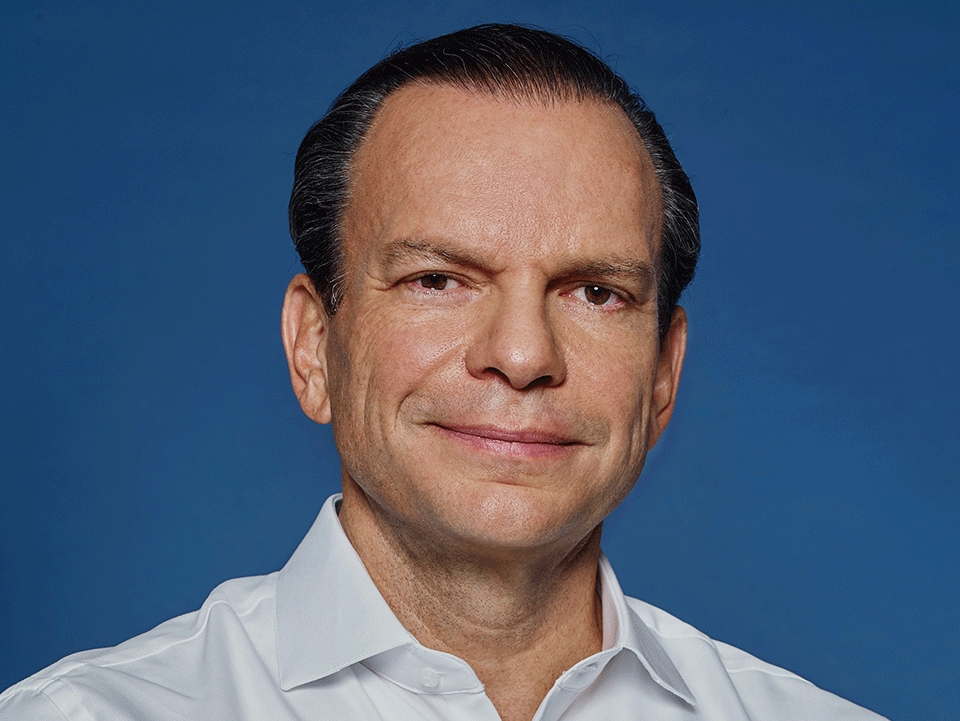
Moctar Fall, head of emerging market debt capital markets, traces JPMorgan’s recent successes to a decision taken 18 months ago. “Prior to that, the capital raising topic with a client used to be a bond discussion, rather than a debt discussion,” he says. “The loan market was something quite separate.” Fall notes that US corporations had, much earlier, re-evaluated banks’ provision of credit to look across both bonds and loans. “We decided that if that was what our emerging-market clients want, we should combine all those services – syndicated loans, bonds, structured finance, liability management and a new debt restructuring group – into one integrated group. That’s the way we’re set up now in New York and we’re moving towards that in Europe.”
It’s clearly a sensible change. A lot of emerging-market business at the sovereign level – especially in Latin America and emerging Europe – now revolves around liability management more than pure capital raising. Such exercises can require debt raising across markets. An example is the transactions through which Mexico retired its Brady bond debt in April 2003. These included a $2 billion bridge loan, two tranches of global bonds totalling $2.5 billion and the exercise of a call on outstanding Brady debt. JPMorgan worked on all tranches. Fall says: “It’s a case where you have to be thinking in sync with the client, anticipating needs and suggesting ideas. The integrated debt model helps you to do that. In this case, loans and bond transactions resulted from a liability management discussion.”
Another example of the integrated approach – this time between domestic currency markets and international currency – was the funding for Coca-Cola Femsa’s $2.05 billion acquisition of Panamco Beverages to create the world’s second-largest bottler.
This involved a Ps4.25 billion ($408 million) issue of certificados bursatiles – the largest ever fund raising for a Mexican corporate in the local market on a single day – an $833 million bridge loan and a $750 million multi-currency syndicated term loan.
“There was a very significant bridge right before the year-end when banks don’t normally want to take on such commitments,” recalls Fall. “Meanwhile the local market issue was a crucial component of the funding solution.” He predicts: “There will be more peso issuance. More and more Mexican corporates are funding only in local currency.”
Anticipating such trends, and coping with highly inconsistent activity across countries and regions, is a challenge for the head of any emerging-market debt business. Not so long ago it was the Brazilian domestic capital market that looked set to boom. But high interest rates have put paid to that.
Organizing appropriate coverage of countries is demanding. Fall says: “Two or three years ago Poland didn’t borrow very much at all. But this year it’s been a little more active. South Africa will do one international deal a year and everyone fights tooth and nail for it – but there’s a lot of follow-on business.”
But Fall is far more worried about another new trend: the extravagant fee-cutting in emerging markets this year.
The emerging-market debt asset class has enjoyed a nine-month boom since last October. Investors overcame their fears about Lula’s election victory in Brazil, and with yields declining on developed-world government bonds, loaded up on emerging-market assets. Cross-over investors and conventional investment-grade buyers have driven this boom.
That has partly disguised a troubling trend, for banks at least, in emerging markets, where below investment grade sovereign borrowers can now command fees of a mere fraction of what similarly rated corporates might pay in the US high-yield market.
“Some banks have been ultra-aggressive just to win volume,” says Fall. “If a country’s debt manager says ‘this is all we’re going to do this year’ and one bank cuts fees way down to win it, then it is politically almost impossible for the country to go to a higher-cost provider, if that is the sole selection criterium. Any other bank brought in to assist in the transaction will be held to that cut-price fee level.”
Fall says that JPMorgan has found itself in this predicament. “Do you say ‘no’ to a deal and so harm your relationship with the client. Or do you agree to do it at the lower fee and so appear to endorse it? Public officials in certain countries will play this game well.”
He says JP Morgan has not yet refused to participate in a deal when the borrower has asked it to, in protest at low fees, “but it may get to the point where we have to”.
The emerging-market debt business is buzzing with complaints of deals done for 15 basis points when bankers say 125bp might be more appropriate. But is this any more then bleating?
Fall clearly thinks so. “Is such behaviour making the market less sustainable? It’s an important question for the health of the industry and for the quality of services that issuers and investors want. At these fee levels, some very good banks are reducing the follow-on services they should provide, such as in research and secondary market support.”
He adds: “It’s the new investors which have sustained the rally in the asset class that most need research – sovereign analysis, corporate analysis and quantitative. At these fee levels, quality of research is only going to deteriorate in the long run.”
It’s when the bull run in emerging-market debt ends that borrowers and investors may suffer the consequences of fee-cutting.