|
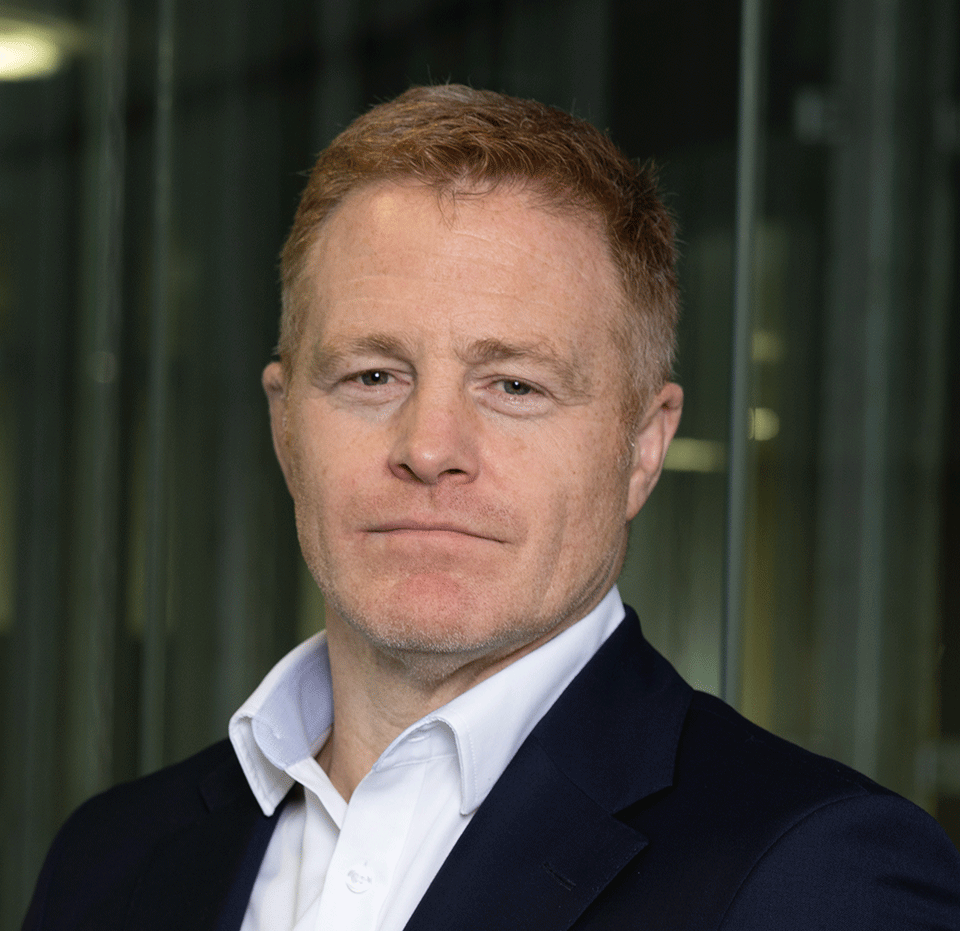
Jean-François Théodore, CEO of Euronext: possibly the most influential man in European securities trading |
THE OCCASION WAS the announcement of the merger of the London Clearing House and Clearnet in London in late June. “After a number of years of dating one another, we are now announcing our engagement, with the wedding well in sight,” enthused David Hardy, CEO of LCH and now CEO of LCH.Clearnet,
Also speaking was Jean-François Théodore, CEO of Euronext, who declared himself honoured to be there. “I think we were born to be engaged,” he quipped, much to the amusement of the audience.
The two bodies certainly took their time deciding how to tie the knot – they first announced their intention to merge in spring 2000, leaving brokers, exchanges, regulators and other clearing houses puzzling for years over whether to bother buying a hat for the big day.
The result is a complicated transaction with a simple aim – to save money for exchange users by creating an efficient international central counterparty for Europe. In the process, Euronext appears in the short term to have given up a slice of power in the notoriously fragmented pan-European securities infrastructure.
In the long term, though, it has completed the latest in a series of M&A transactions that now gives it a presence in all the major products – international cash equities, derivatives, fixed income and commodities – and at all stages of the trading process, from trading through to clearing and settlement. And it has done it all without reducing the independence of any of the institutions in that complex relationship.
Théodore is often seen as the key to these achievements. He has certainly risen through the ranks: from CEO of the Paris Bourse in 1990 to CEO of the merged Paris, Brussels and Amsterdam exchanges (Euronext) at its creation in 2000. In 2002, Euronext bought London derivatives exchange Liffe. Then it brought the Lisbon stock exchange into the fold. This now makes it the most liquid single cash equities exchange in Europe – bigger than the London Stock Exchange, and bigger than Deutsche Börse. And now it has been instrumental in forging the LCH.Clearnet agreement.
Observers are impressed. “Jean-François Théodore has raised a lot of eyebrows,” says Richard Berliand, global head of futures and options at JPMorgan. “In some people’s minds he has given up the possibility of being the head of a wholly owned integrated trading and clearing function in one environment. But he is very discerning. He thinks he would be better off to have a small percentage of something very good rather than having 100% of something that needs a lot of investment, with a less than top-quality product and being constrained in what he can do.” An impressive piece of manoeuvring indeed, and very different from the tactics employed by Werner Seifert, CEO of Deutsche Börse, which is vertically integrated, with its own clearing network.
And Euronext has succeeded in its ambitions where others have failed. The proposed merger of the LSE and Deutsche Börse to create a single exchange – iX – failed. Then Swedish technology group OM failed in its hostile bid to buy the LSE. Euro.NM – the loose alliance of European growth markets, fizzled out when the equities boom ended. Nasdaq Europe, the US-led venture that subsumed Easdaq and had clear and aggressive ambitions to become the single growth market for Europe, also struggled and eventually closed, ironically at almost the same time as LCH.Clearnet was born.
While Deutsche Börse continues on its vertical strategy and the LSE, itself a large customer of LCH’s, wonders what to do next, Euronext knows it has developed an important role for itself. “If you look at the situation in Europe, you have one integrator, and that is Euronext,” says its CFO, Serge Harry. “It is the only one to merge several exchanges in Europe, maybe the only one in the world.”
Harry has been busy. Having been in the exchanges industry for 21 years, most recently as general secretary of French central securities depository Sicovam, he has worked at Euronext since early 1999, giving him an important role in structuring the company’s acquisitions. Around 10 people worked alongside him in structuring the LCH.Clearnet deal. “This is a very very interesting period,” he says. “We are building the future, even if that means we are very busy.”
|
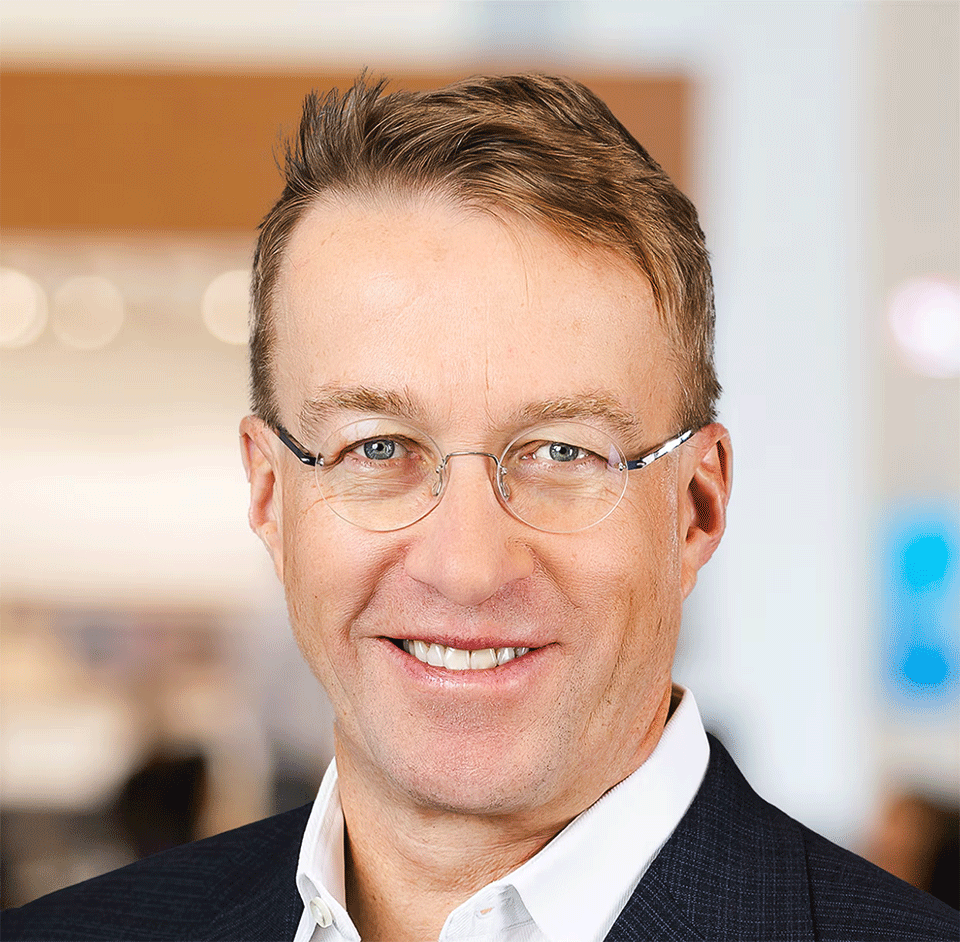
Richard Berliand, deputy chair of Euronext.liffe: “In an ideal world we would have banged the two together and created one clearing house” |
Compelling reasons for marriage The case for the merger was clear. Research from the European Central Bank shows that despite an increase in cross-border equities investment in Europe, particularly by pension funds, a domestic bias prevails. It costs tens of euros to settle cross-border trades in mutual funds in Europe, compared with the equivalent of less than a euro in the US. The LCH.Clearnet merger will not wipe out these inefficiencies, but it will help. On top of that, the deal fits nicely into the broad, almost philosophical debate about the ideal structure for European securities trading – a debate crystallized in the Giovannini report, which called for horizontal integration between exchanges, between clearing houses, and between settlement houses. This is more like a diagonal structure, but it is a fair compromise.
Even aside from that, the clearing houses’ members had been calling for this kind of move for years. If LCH and Clearnet had not merged now, the extra funds that they would soon have required would have been balked at by the banks, which are not making huge amounts from equities at the moment. JPMorgan’s Berliand, who is also a director at LCH and the deputy chair of Euronext.liffe, says: “If there had been no merger, both clearing houses would still have needed to spend money – they both needed new technology.”
The financial structure of the deal reveals the motivations and concerns of all the interested parties behind it. “We never considered buying a majority stake of this company,” says Harry at Euronext. “The aim is to attract new business, and we could not do that if we had a majority stake.”
It is a merger of equals, valuing each side at e600 million. To achieve that level, LCH will, subject to approval, give a fee rebate of £23.6 million ($37.8 million) to its members, which are the banks. Similarly, Clearnet will distribute e150 million to its shareholders.
|
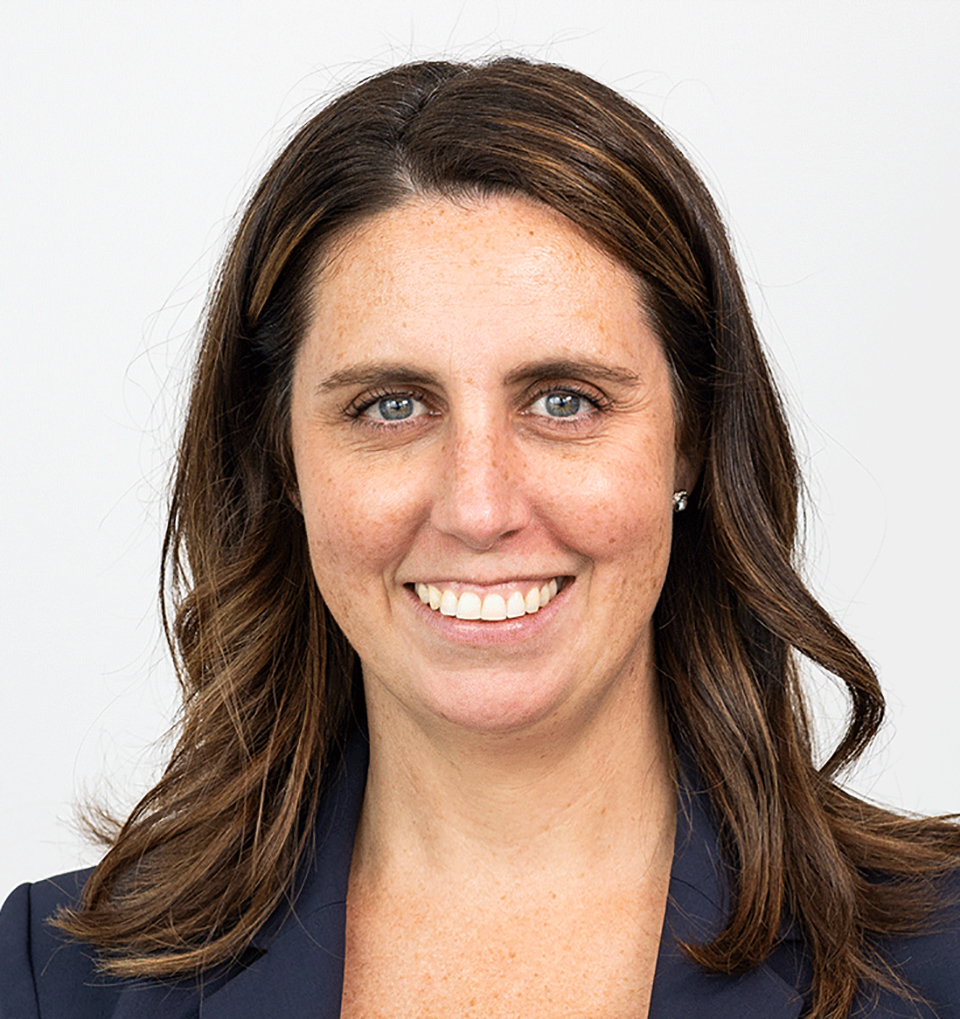
Serge Harry, CFO of Euronext, is busy building the future |
The new shareholder structure of LCH.Clearnet goes even further to restrict the influence of Euronext – a move designed to keep the new clearing entity separate from the exchange. At the moment, Euroclear owns 19.7% of Clearnet. Euronext owns the remaining shares, and it owns over 17% of LCH through Euronext.liffe. The London Metal Exchange (LME) and the International Petroleum Exchange (IPE) between them own a further 7.3% of LCH. The rest of LCH is owned by its members. The merged entity has to unravel this ownership tangle to leave LCH shareholders and Clearnet’s shareholders with 50% each of LCH.Clearnet – a balance between clearing users and an exchange.
To do that, Euronext will sell some of its shares in the new entity to LCH members, taking its stake down to 41.5%. That will be divided into 24.9% ordinary shares, with 16.6% in preference shares, which it can sell in the months or years to come, at which point they will carry voting rights. In the meantime, those preference shares will deliver bumper dividends to Euronext, to make up for the loss of voting rights.
What comes out is that LCH.Clearnet will be 41.5% owned by Euronext, with that cap on its voting rights. The other exchange ownership will come from the LME and IPE, which will own 3.6% combined. Users will own 45.1%, and Euroclear will own 9.8%. The merged entity aims to earn e150 million annually from 2006, feeding any additional revenue through to its users.
It is not a simple deal, and it has taken years to put together, but Hardy, the new CEO of LCH.Clearnet, says it has been worth the wait. After several other acquisitions, Harry at Euronext seems to have taken it in his stride. “It took a long time because we had to solve a lot of questions, and the main ones related to the regulators. This is the first time that there has been a cross-merger between a UK and a continental company of this kind. We needed time to present it to the regulators and allow them to appreciate the risk. Even if you view the deal positively, we needed to do stress tests and you cannot do that in two weeks.”
The integration work will not happen overnight either. The merger terms are likely to be approved in late 2003. Then, in phase one of integration, in 2004 and 2005, the two clearing houses will harmonize aspects of their work where they find common ground, standardizing practices where possible. In a slightly overlapping period from 2004 to 2006, they will gradually migrate to a common IT platform.
The plan is that by 2007 LCH.Clearnet will offer its users freedom of choice. Regulation will remain separate, with LCH under the UK’s Financial Services Authority, and Clearnet under the Commission bancaire in France. This sounds complicated, but it is the best way to keep the regulators happy with the deal. “In an ideal world we would have banged the two together and created one clearing house,” says Berliand at JPMorgan. “But by 2007 we will have achieved 80% of what it would have been possible to have saved if it had been one body.”
Intriguing LSE questions All eyes are now on the LSE. Its users are also the users of LCH – the very people who have called for LCH and Clearnet to merge and who are overwhelmingly likely to approve the deal. Without doubt, as it clears through LCH, the LSE is an important part of the deal, and of the revenue structure that the merger is based on. And it is considering taking that business away from LCH. “It’s like 3-D chess,” says one banker.
The LSE declined to comment on the merger aside from a brief statement, saying: “The Exchange strongly supports the vision of an independent pan-European CCP but the announcement made by LCH and Clearnet leaves a number of questions unanswered. As a result, we are seeking specific assurances through a new clearing services agreement with LCH.”
What those questions are is the subject of plenty of rumour. Some people think the LSE will stick with LCH.Clearnet, thus making the case for it to merge with Euronext too compelling to resist. In that situation, the LSE could eventually even bring the cross-listing knowledge that has enabled it to cooperate with the Hong Kong exchange and others over the past few years to Euronext, making an
exchange formed by a merger with Euronext an exciting opportunity to bring stocks to a worldwide audience.
Others think it will join up with Deutsche Börse. Either way, unlike the LME and the IPE, it does not have a shareholding and cannot block this deal. “The cash equity business that comes through Sets that is cleared on the LCH is an important part of the entire deal, but it is not crucial to its success,” says one person who is close to the merger. “The deal would still make sense without it, but our strong preference is that we want the LSE to be involved.”
In a sense, LCH and Clearnet are getting on with the deal regardless of what the LSE does. The exchange’s new management team is likely to clarify its views on consolidation at all levels within the next couple of months. Meanwhile, the Scandinavian clearing houses are concentrating on consolidation among themselves first, at which point they are likely to sell to the highest bidder. And in a brochure outlining its merger, LCH.Clearnet says its plans are not limited to Europe. “Our corporate vision is for LCH.Clearnet to become the partner of choice for CCPs and international markets around the world,” it says.
Even now, while vertical structures persist in Italy and elsewhere in Europe, that does not really matter. As long as those independent clearing houses are open minded and willing to integrate with LCH.Clearnet on an operational if not a shareholder level, then LCH.Clearnet will continue to spread its influence.
For now, banks, exchanges and others need to note that the integration will be a long process. “There will certainly be more consolidation in securities infrastructure over the next five years,” says Berliand. “This is just one step in that, but it does give a platform – a practical possibility for other institutions to coalesce around it.”
Open market infrastructure
Click to enlarge