 |
|
Gartmore’s new chief executive, Glyn Jones, is determined to press ahead as a specialist fund manager with alternative investment styles |
YOU COULDN’T ASK for a better place from which to make a quick getaway than Gartmore Investment Management. A vulture-like rank of taxis lie in wait immediately outside its City of London entrance. And Fenchurch Street Station is next door.
For many people working there in the last few years, this range of escape routes came in very handy as Gartmore’s revolving door almost spun off its hinges in the stream of departing staff and new arrivals.
At one stage the joke churned out by its rivals was that the internal phone directory was written on a blackboard because the line-up changed so often.
Once one of the top-five firms in traditional UK balanced fund management, in the 1990s Gartmore suffered more than most from poor investment performance, leading to client defections, management upheaval and regular changes of ownership. Its assets under management have shrunk from a height of £59 billion to £28 billion ($45 billion) in the past four years, not helped by the equity market plunge.
Indeed as the markets tumbled in the late 1990s, each of the UK’s Big Five managers struggled. Mercury Asset Management, now Merrill Lynch Investment Managers, took a hit for its poor performance, Phillips & Drew, now UBS Global Asset Management, suffered because of its distinctive value style and Gartmore suffered from its significant positions in equity.
One leading UK investment consultant says: “The two that suffered the most were Gartmore and Merrill Lynch. Next was Schroder, then UBS and lastly Deutsche Asset Management.”
Gartmore, once a byword for sensible, successful, institutional management, reeled under successive blows, losing key accounts and long-standing staff. At one stage it seemed it might disappear as an investment force completely.
But tough decisions have been made and Gartmore has been busily reinventing itself, at first quietly, and now much more prominently.
It has been one of the first and most successful of the traditional institutional money managers to embrace hedge fund styles of investment. It now makes more money than five years ago, even though assets under management have shrunk.
As world equity markets revived this year, some fund managers may have been tempted to fall back on old-fashioned long-only investment. Not so Gartmore’s new chief executive, Glyn Jones (pictured right). He is determined to press ahead as a specialist fund manager with alternative investment styles. From being a laggard, Gartmore might be becoming the new type of institutional fund manager that other leading firms will follow.
The firm is starting to show signs of success, achieving higher revenues in 2003 than 1998 despite a 36% drop in assets under management. And it is not yet done with making changes.
Gartmore took its first steps towards building up its expertise in alternative investments in February 1999 when Citibank asked the firm to manage an account on its behalf. “It was almost by accident rather than strategy,” says Jones. One former colleague recalls that a Gartmore fund manager called Roger Guy was singled out to run the new hedge fund because the bank thought he had great market-timing skills.
Guy had already been managing a long-only account for Citibank and had displayed good buy and sell disciplines. The bank felt that his skills would transfer well to managing long/short money. At the time Guy was also running other institutional money, retail onshore/offshore funds and investment trusts with a decent record. From when Guy took over management of Gartmore’s European Selected Opportunities unit trust (which has recently been converted into an open-ended investment company, OEIC) in 1993 to the end of February 1999, when he began managing the new long/short account, the fund had increased by 325.44% with gross income reinvested.
Now, despite accounting for just over 7% of the £28 billion Gartmore had in assets under management at the end of October 2003, hedge funds are its second-largest revenue generator.
Hedge fund revenues come in behind the retail business which, together with the continental European business, accounts for just under £8 billion in assets under management. The institutional business, which makes up around £18 billion and includes the $550 million fund of hedge funds business Gartmore Riverview, follows just behind in revenues, as does the continental European business.
Gartmore declines to disclose exact revenue figures but it is clear that the firm is delighted with margins on hedge funds that are greater than those for conventional institutional funds and is keen to grow this part of its business further.
Jones was appointed at the end of 2000 but got stuck into his new role in 2001 after spending his first few weeks attending Christmas parties. Having previously set up and managed the hedge fund business at private bank Coutts, Jones saw the potential advantages of doing the same at an institutional business like Gartmore. “It was under my strategy that Coutts got into fund of hedge funds so I’m a big believer in absolute-return investing rather than relative return.”
As a result, six more of Gartmore’s AlphaGen hedge funds were seeded during that year. And the firm has pursued modest acquisitions in the field. In June 2002, Gartmore acquired US fund of hedge funds business Riverview International Group.
Much credit for the strategic decision to build up a hedge fund business goes to Roger Guy. “He started the equity long/short fund and showed it could work,” says one of Gartmore’s ex-employees. Guy still runs the managed account for Citibank as well as the European equity long/short fund called Capella, which was launched in November 1999.
He also runs four long-only funds – a unit trust recently converted to an OEIC, a Jersey-domiciled fund, a Luxembourg-domiciled fund and an investment trust. This year to end-October, the Gartmore European Selected Opportunities Fund has returned 15.86%, the Gartmore Capital Strategy European Fund 9.09% and the Gartmore SICAV Continental European Fund 10.03% with gross income reinvested. The net asset value of the Gartmore European Investment Trust increased by 15.56%. All returns cited throughout the article are net of fees.
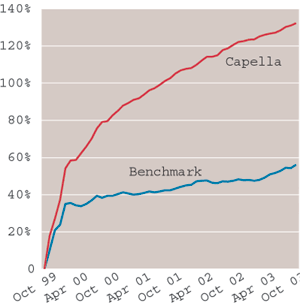
Since being launched in November 1999, the Capella fund’s US dollar class has returned 130% and its Euro class 132%. This year to end-October they returned 3.5% and 4.3% respectively, which sits in the mid range of its peer group performance. The fund uses the MSCI Europe index (hedged) as the proxy for its US dollar class and the MSCI Europe index for its eurodollar class. These were up 7% and 8%, respectively, year to end-October. The fund has $1.436 billion invested and is closed to new investment.
Gartmore now has 11 AlphaGen funds. Nine of these are equity long/short funds and all but one, the Credit fund, are named after constellations.
One fund of hedge funds manager says that Gartmore’s equity long/short funds have done well against a backdrop of difficult times for this strategy. The fall of the Iraqi regime in March led to a sentiment-driven global equity market rally in which weak and poorly managed companies have seen their stock valuations rise along with more deserving companies. In such a market it pays simply to be long and equity long/short managers were caught out.
But Gartmore now has other strings to its bow. The best performing from its stable this year to end-October are its UK small-cap, Pacific and Emerging markets, Japan and US healthcare equity long/short strategies.
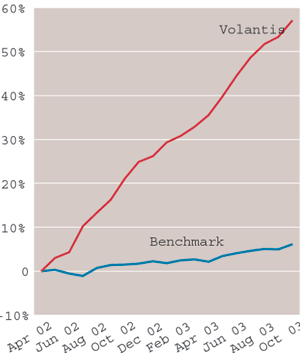
The UK small-cap fund, Volantis, was launched in May 2002 and offers US dollar, eurodollar and sterling classes. Rob Giles, senior investment manager, who helps run the fund, says: “The first six months after opening the small cap the market was dire but we did well.” He adds: “UK small-cap went down around 20% to 25% and we still got positive returns against that.” One fund of hedge funds manager says the size of the fund means that it is “quite nimble”. This means “it’s easier to trade and easier to get into quite small names”. She also says Gartmore’s Volantis fund has an excellent research team.
Flying high
| Volantis fund vs benchmark |
 |
| Source: EuroHedge |
Giles says the difficulty with this strategy is the lack of liquidity in the small-cap market. Nonetheless, the Volantis fund is traded quite aggressively, with more than 40 to 50 trades, around 25% of the fund, on a good day. “I think that’s been one of the secrets of our success,” says Giles.
The fund also has up to 200 positions open at any one time, compared with about 75 for the UK large and mid-cap fund, Avior. Giles says the strategy for the small-cap fund is to make a lot of short-term trades. This, he says, is because “it lends itself to volatility because it’s poorly researched”. He adds: “And, we’re not looking for the stocks to double every time we trade. Five, 10, 20p is okay.”
One recent trade that made money for the fund involved UK consulting civil engineer WSP, which has a market capitalization of £100 million. “The stock is trading at 170p [late October] and actually got down to 35p towards the lower end of the market,” says Giles. “One of the reasons it got down to that level was because within the UK small cap market we get movement in and out of the indices. WSP, unfortunately, fell out, which meant the market cap would have been about £40 million at that time. We went in and basically bought 15% of the company down at 35p. At the time we were buying the stock at a P/E of around three times. And, we’ve traded all the way up to these levels. We’re now out of the stock.” He adds: “That was a really satisfying trade because nobody wanted the stock at 35p. We were brave enough to step up and it has worked out well.”
Although the fund was reopened to new investment once in October 2002, Giles says this is unlikely to happen again in the near term as with existing assets the fund is currently only 60% invested. “We would consider reopening the fund if we could trade it easily, have more than 100% invested and display the returns,” he says.
The most recently launched funds include Gartmore’s US healthcare equity long/short fund Arneb, which was launched in October, and the global Credit Fund, which was launched in August. Martin Phipps, who became the head of hedge funds in 2000, has been instrumental in establishing the hedge fund business. A former Gartmore employee says: “He’s been incredibly successful in the reality of pushing those products out to the fund of funds community even when they didn’t have a track record.”
Unusual strategy
| Capella fund vs benchmark |
 |
| Source: EuroHedge |
She argues that “running long/short with long only is beneficial. It keeps managers in touch with the market, keeps them sharp and broadens their experience.” Jones believes that “the main thing is that people don’t take on more money than they can manage”.
In recent years many long-only managers have fled institutions to set up their own hedge funds but Gartmore’s strategy has helped the firm to attract and retain talent, according to Jones. “When long/short is doing well people lose [long-only] managers. We’ve been more successful at retaining good managers because we’ve given them the opportunity [to manage hedge funds within Gartmore],” he says.
Paul Hondros, CEO and president of the overall Gartmore Group, says: “Our culture is much more geared to individual accountability for performance than other firms.” That is, when Gartmore launched its first hedge fund it realized that one of the issues it had to get right was compensation. Phipps says: “Successful hedge fund managers are paid in a certain way and we had to compensate our hedge fund managers in a similar fashion.” A hedge fund manager at another firm attributes it to good timing. “They did it at a time when it wasn’t as easy for people to leave to set up their own hedge funds.” He adds: “They couldn’t have done now what they did then.”
Despite successfully setting up and running several hedge funds, Gartmore has also been forced to admit some failures and the limits of its expertise. In September, it was forced to shut its macro hedge fund because of poor performance. Jones says: “It wasn’t achieving the investment targets we were looking for.” He adds: “I’m not going to make any apologies. If we’re going to drive the business forward we’re not going to achieve everything. This one failed.”
In the same month Gartmore entered into a joint venture with hedge fund manager Aspect Capital. As a result, Gartmore will distribute Aspect’s managed futures funds to its clients. Jones says: “We recognized that we never want to develop a managed futures capability but that it had a role.”
In June 2002, Jones led Gartmore farther down the alternatives route when he decided to buy US-based fund of hedge funds business Riverview International Group. Jones’s previous experience in setting up and running a fund of hedge funds at Coutts put him in a good position to research this move.
At the time of the acquisition the business, which has been rebranded as Gartmore Riverview, had around $350 million in predominantly US institutional assets under management. The business has since grown this to $550 million. Around 50% of this $200 million growth in fund of hedge funds assets can be attributed to expansion into Europe, which has been led by Steven Attenborough, and Japan.
Here to stay Riverview’s flagship fund of hedge funds is market neutral and was launched in August 1999. It invests in four broad hedge fund strategies: market neutral equity, event-driven, equity derivative arbitrage and fixed-income arbitrage for diversification and low correlation to the equity markets. To avoid any conflict of interest Riverview does not invest in Gartmore’s AlphaGen hedge funds.
The fund has posted an annualized return of 8.18% since its launch in 1999 to the end of October 2003, compared with –4.02% for the S&P500 and 7.98% for the Lehman Aggregate. This year to end-October the fund has returned 3.86% compared with 21.2% for the S&P500 and 2.81% for the Lehman Aggregate.
Despite the fact that a significant proportion of the company’s revenues now comes from the hedge fund business, Jones says he is not concerned about the possibility of a prolonged rally in the market causing investors to lose enthusiasm for the asset class. “I think hedge funds are here to stay,” says Jones. “They’ve been growing for 10 years through difficult cycles and there’s big interest in absolute return products.”
In September Gartmore broadened its alternatives business to include private equity.
The firm has been managing private equity since the early 1990s and on a larger scale since 1996. Jones says the portfolio has a good track record in that it has substantially outperformed its target return but Gartmore declines to disclose actual performance figures and targets. Peter Gale, managing director of the private-equity unit, has been involved with the asset class since the early 1990s before NatWest acquired Gartmore. He feels that private equity will become a large part of Gartmore’s business, just like hedge funds. “UK pension fund exposure is only around 2% and I can see this growing to 5% in Europe,” he says. “Private equity means exploiting the private economy, which accounts for more than 40% of the European economy,” he adds.
Gartmore has built its private-equity team up to eight. Nick Shaw, who was previously CIO of Shell Pension Management Services and also managed its private-equity programme, joined in September as deputy managing director. Gale says that other major figures with expertise in private equity will join the team by the end of the year.
In addition to Gartmore’s emphasis on developing its alternatives business it has been revamping its traditional institutional business, something it desperately needed to do after suffering significant outflows from its balanced funds in the mid to late 1990s. Hondros says: “Balanced mandates are going the way of the Model T.”
Another result of Jones’s strategic review after taking over was to focus on active management, which generates higher fees. He realized that Gartmore did not have a competitive advantage in the passive area and sold its passive equity business to State Street Global Advisors in 2001. Jones says “active and passive don’t sit well together”. He adds: “Being third or fourth in the marketplace meant we were never going to succeed.”
Throughout this period of dramatic changes in its marketplace and business strategy, Gartmore has been sold three times in just over a decade. It was founded in 1969 by British and Commonwealth and first sold in 1989 to Banque Indosuez. “B&C had transformed from a shipping company into a conglomerate and some bright guys at the company got it [B&C] into trouble,” says one Gartmore employee. “Gartmore was the jewel in the crown so they sold it to Indosuez,” he adds. Then, in 1996, Indosuez sold Gartmore to National Westminster Bank. Once again the asset manager was a non-core disposable asset and as NatWest ran into trouble in 2000 the firm was sold to its current owner, US-based insurance and financial services company Nationwide Mutual Insurance Company.
It was at least a good trade for NatWest, which bought the company in 1996 for £400 million and sold it to Nationwide for £1 billion in 2000. Hondros, who hails from the Nationwide stable, says: “At the time it [the acquisition price] was right.” But he adds that in retrospect: “We bought it at the top of the market.”
Gartmore’s senior management does not feel it is likely that Nationwide will sell the company soon. The UK-based Gartmore has been merged with Nationwide’s US fund management business, previously known as Villanova Capital, to create a global firm. Jones says: “Nationwide is very clear that asset management is one of its core businesses.” Hondros, who founded Villanova, adds: “Nationwide has said that within a four- to five-year period asset management will be a big contributor to their bottom line.”
Hondros is based in Philadelphia and works closely with Jones, visiting the London offices once a month. He’s no stranger to sorting out difficult situations, having been a policeman for four years in his twenties.
Assets under management for the combined business are now at $84 billion, as at the end of October 2003. The UK-based business makes up £28 billion of the total for Gartmore Group and accounts for about 70% of group profits. Hondros says: “I think we have a shot at achieving $100 billion plus within 18 months to two years.”
Understandably, given its recent history, Gartmore is keen to stress that the size of assets under management does not equate to good financial performance. The firm’s CFO Mark Robertshaw says: “We pay almost no attention to the size of assets under management. It has no relevance to financial performance.”
The sale of the passive business meant Gartmore lost a chunk of its assets and its hedge fund business is small in comparison. However, hedge fund fees are much higher. Jones explains: “You get three to four basis points on £1 billion passive assets and 300bp in terms of management and performance fees on hedge funds,” says Jones.
In November, Gartmore bought more assets, which are not included in the figures above. This was the acquisition of two-thirds of the assets run by fund management firm Govett Investments, a subsidiary of Allied Irish Banks. Gartmore expects to pay up to £14 million for the £1 billion of assets. This includes institutional mandates along with mutual funds, investment trusts and private-client assets.
While Jones says the strategy is primarily one of organic growth, Hondros admits: “We’re looking at other small acquisitions. Mostly in the long-only space.”
In January 2002, Frances Davies was brought in as global head of the institutional business, which includes Riverview. Since then she has gutted and rebuilt the traditional long-only side of the business.
Before Davies joined there had been a large gap in leadership. The previous head of the institutional business, Sally Tennant, had departed at the end of 2000 after five years in the role and only seven months after the business was acquired by Nationwide. After more than a year without a permanent business head, Davies joined and went straight into action. “Three new business heads joined on the same day: the head of retail, the head of institutional and the head of bank assurance,” says Davies.
Hiring Davies seems to have been a good move for the institutional business. Since she joined at the beginning of 2002 Gartmore has brought in e5 billion in new institutional money spread over seven different products.
Dire state Davies brought with her the experience of setting up the UK pooled business at Morgan Grenfell Asset Management (now Deutsche Asset Management) and 12 years in investment banking at SG Warburg. Her last role at Warburg had been as head of the risk management advisory group, which advised companies on their currency and interest rate exposures.
When Davies joined she found the institutional business in a dire state. “It was withering and dying and it just needed someone to take it on,” she says. She “found lots of goodwill towards Gartmore but it had an old-fashioned structure, poor performance and the client base was declining”.
The first problem Davies took steps to rectify was the poor performance of the institutional equity team. The main changes to the manufacturing side of the institutional business involved firing and hiring employees for the UK equity and credit teams. Davies says: “In conjunction with the CIO I sorted out the equity team and created a credible fixed-income team.” Jones confirms that the UK equity team now has “about 70% to 80% new people on the [equities] desk”. He adds: “[Past UK equity] investment performance suggested we didn’t have good people.”
The most significant changes to the way equities are run at Gartmore have been the new hires, the fact that the two hedge fund managers running the UK equities fund, Avior, are also part of the team and the integration of the institutional and retail pooled fund businesses. A clearly defined risk platform with four categories within which all funds, whether retail or institutional, fall has also been implemented. As a result there are signs of an upturn in performance. For example, Gartmore’s core institutional product has outperformed its benchmark by 3.3% in the past 12 months, compared with a 2.1% underperformance over three years.
The change is being noticed. One long-term client confirms: “We’ve seen, over the past 12 months, an improvement in the performance of our particular fund.” He attributes the improved performance to new personnel. “The benefit of these changes is beginning to show.”
Since Davies joined, nine new hires have been made to the equity team. In January 2002, Jon Thornton joined as head of UK equities. He had previously been the head of mainstream UK equities at Aberdeen Asset Management. Chris Burvill joined as head of UK equity income in December 2002 from Investec Asset Management. In March this year, Quintin Price joined as CIO for equities from Putnam Investments, where he had been head of global fundamental research.
Davies says: “We relaunched the UK team and it’s been winning business quicker than I expected due to its very impressive performance over the past year.”
Another key change was building up direct sales teams in the UK, continental Europe and the US. “[We] shifted emphasis from client servicing to active sales,” Davies says. Elaine Gordon was appointed as head of client service and Davies describes her and the team as having a “sales edge” adding that “her team all had fund management experience”.
Karl Bergqwist was hired as head of credit research in August 2002 from Barclays Global Investors. The credit team is centred on Bergqwist, says Davies. In August 2002 Alok Basu joined the team as a senior credit analyst from Barclays Capital where he was a fixed-income strategist. Varkki Chacko joined as head of US credit in April 2003 from Goldman Sachs where he was head of global credit strategy. Another four hires have been made to the fixed-income team since Davies took over. She feels that these recruits have brought real discipline and a good track record to Gartmore.
Client wins Since Davies joined, Gartmore’s institutional business has built up some impressive business. In July last year it won a e120 million pan-European equities large-cap mandate from European utilities company E.ON Energie. Other notable institutional wins include a e150 million small-cap European equities mandate from Swiss Social Security Fund and a e100 million currency overlay mandate from a large European pension fund.
Despite taking great strides in the long-only institutional business, Davies admits that Gartmore’s balanced business is still in decline as pension funds continue to move out of balanced funds. She adds that Gartmore hasn’t seen the end of outflows from its balanced funds yet. “We’re still losing balanced mandates but some of the money has stayed as pension funds have restructured because our UK performance has picked up,” says Davies. She adds: “We wouldn’t have got this last year [because of poor performance].”
Although the long-only institutional business continues to lose more assets than it is winning, Davies hopes the trend will be reversed early next year.
It’s unfortunate for Gartmore that UK consultants have such long memories. One large UK consultant says: “It all went badly wrong for them. They haven’t come out of that yet.” However, Davies says: “Some have been quick to note the changes and have been quick to put us on their lists.” She adds: “Thirty per cent of consultant meetings are resulting in a ratings upgrade.”
Out of the five firms once known as the Big Five traditional balanced managers Gartmore is still perceived by some consultants as having regained the least in terms of UK institutional assets. One consultant lists them from top to bottom as UBS GAM, Schroders, DeAM, MLIM and lastly Gartmore. But, he adds: “Gartmore is probably the leader in terms of hedge funds.”
It seems that there is some confusion about what Gartmore has to offer. A consultant says: “They’ve tried to reposition themselves in terms of specialist mandates and do, inevitably, have some products that could be looked at highly enough to be bought but they’re focused on the hedge fund area. Our client is in the long-only space.” Even Jones says: “One of my hedge fund clients recently asked ‘Do you run long-only money?’ “
The focus for next year for Davies is to expand sales efforts in Europe and to further develop specialist areas such as emerging markets, global equities and Riverview.
The alternatives business will continue to dominate the attention of the Gartmore Group. Jones says: “The hedge fund business has been growing faster than the institutional business.” Hondros is keen to add that: “We want to be known as more of a specialist manager rather than an alternatives manager. Alternatives are one piece of it.”


