 |
|
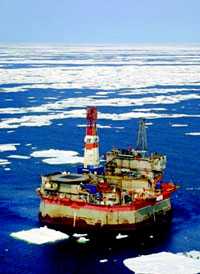
Offshore oil platform near Sakhalin Island: the area is the site of a £10 billion gas liquefaction plant being developed by Sakhalin |
FOREIGNERS HAVE BEEN eyeing Russia’s wealth of natural resources and 145 million-strong consumer market hungrily for most of the past decade. But the few that attempted an investment often came away with their fingers badly burnt.
Foreign direct investment has remained stuck at about $20 to $25 a head of the Russian population. By contrast, most other countries in eastern Europe can boast per capita FDI of several hundred, if not thousands, of dollars. But on the back of stellar economic growth and a return to political stability this year the first big foreign investments have arrived since the fall of the Soviet Union.
Measuring foreign investment is difficult as so much of Russia’s trade is done under the table and many of the big companies are registered offshore for tax reasons. However, even the official balance of payment statistics show that FDI was up 326% to $1.6 billion over the first quarter of this year compared with the same period in 2002 and the real figure is likely to be much higher.
FDI turning point According to the official statistics, FDI has been stuck at about $4 billion a year for most of the past decade and despite its fundamentally improved macroeconomic health, Russia has attracted even less FDI since the 1998 crisis than it did before. All that changed this February when British oil company BP committed itself to a $6.1 billion joint venture with Tyumen Oil Company (TNK), spending as much in one deal as all the foreign investors of the past three years had spent between them.
“BP’s decision was a massive vote of confidence for Russia and for the changes in the country that we have seen over the past four years,” says Roland Nash, head of research at Renaissance Capital.
The BP deal was shortly followed by an announcement from Sakhalin Energy, an international consortium developing oil and gas resources on Sakhalin Island in Russia’s far east, that it had raised the financing to spend $10 billion on a gas liquefaction plant. The first $2 billion of contracts have already been awarded, half to Russian companies.
These two deals alone would add up to $16 billion, the equivalent of the past four years-worth of investment put together. But little of this money will actually show up in the statistics. Typically, the new BP-TNK entity has been registered in the British Virgin Islands and will not count as domestic investment.
Most Russian deals are done this way for tax purposes and to avoid regulations covering hard currency brought into Russia. (Nearly all of Russia’s stock market trades are settled in such offshore havens as Cyprus for the same reasons.)
Likewise, last year’s biggest investment, UK investment management house Fleming Family & Partners’ multi-billion tie-up with Russia’s number two aluminium producer SUAL in 2002, also involved the creation of an offshore entity, and didn’t show up in the statistics.
If these numbers are included, the real levels of investment are closer to $20 billion a year and climbing. Yet even these levels are disappointing given Russia’s massive economic potential and investment remains concentrated in only a few sectors.
Prime minister Mikhail Kasyanov announced in June that Russia had attracted an official $6.3 billion of total foreign investments (including loans and trade financing) over the first three months of this year. Half of this was invested in trade and catering, while industry attracted a disappointing $1.7 billion.
Although the big-ticket items are still being done through offshore entities, the smaller investments in greenfield production facilities are increasingly coming onshore.
In the past, multinationals have set up representative offices in Russia and maybe built a packaging plant, but the bulk of their goods have been imported. With retail sales now rising by a robust 8% a year – having almost doubled in the past four years – these big companies are now scrambling to build factories in Russia to cut costs and ease distribution problems.
About a dozen new factories costing from $50 million to $150 million are either under construction or have been built in the past 18 months, mostly producing consumer goods, especially food products. Many are located in the investor-friendly Leningrad region around St Petersburg and more projects are being launched each month.
At the same time, the big retailers are now leaving Moscow and St Petersburg, the two traditional markets, to roll out distribution across the whole country. German cash-and-carry retailer Metro announced in June that it would spend $1 billion on opening 100 mega stores throughout the country. And Sweden’s flat-pack furniture company Ikea, which pioneered the big retail store business, continues to sink hundreds of millions of dollars a year into new stores and furniture factories.
Foreigners are cashing in on Russia’s recovery, but most of the so-called investments from the “far abroad” – countries outside the Commonwealth of Independent States – are actually trade credits boosting imports of such goods as machinery. The real money going into factories and production is actually Russian flight capital returning home.
Germany is ranked as Russia’s biggest foreign investor, accounting for $8.1 billion of a total $42.9 billion accumulated by the end of 2002. Of this, though, direct investment only accounted for $1.7 billion, with the rest being in the “other” category – largely trade credits extended by the export credit agencies (and so not really investment at all).
Although tiny Cyprus ranks second in this investment table with $5.6 billion in total investment, it easily beats Germany with $3.9 billion in direct investment and only $1.4 billion in “other” investments.
Politically motivated funding The US was the third-largest investor, investing a total of $5.5 billion, of which $4.2 billion was direct investment and only $1.2 billion was “other”. But here too the numbers are distorted, as much of this so-called investment is politically motivated money funding such projects as the defence conversion programme.
Germany, easily Russia’s most important trade partner, turned over $14.9 billion last year. This means that for every dollar German businesses invest in Russia they do another $8.50 in trade. France and Italy are also active trade partners but have not yet invested much and the ratios between trade and investment are 1:15 and 1:48 respectively.
However, the US is investing a lot more than its trade with Russia justifies, and has a disproportionately high investment to trade ratio of 2:3.
Despite the incoming deals, foreigners are still playing a relatively small role when compared with Russians, who are finally bringing home part of an estimated $250 billion of flight capital – four times the entire country’s hard-currency reserves.
Russia was haemorrhaging between $2 billion and $2.5 billion a month for most of the 1990s, but flight capital has fallen to less than $500 million a month this year. Thanks to an economic boom at home and an economic disaster everywhere else, Russian fight capital is flooding home to where fat returns are easily made.
Look down the list of the largest foreign investors into Russia and the Russian money is obvious. The second-biggest investor into Russia is Cyprus, which barely even registers in the trade turnover statistics yet put a whopping $3.9 billion of direct investment in Russia last year.
Also high in the table are other favourite Russian offshore havens such as the UK offshore dependencies Jersey and the Isle of Man, the Netherlands Antilles, Luxembourg and Switzerland, although most countries also have a component of “real” investment.
The Russian government has been taking a tough line with its foreign trade partners, imposing high tariffs and trade barriers. The strength of demand for these trade credits underlines the robust growth in Russia.
The government has bet that foreign manufacturers that are seeing Russian sales continue to rise, despite the trade barriers, will be encouraged to invest and so cut their costs considerably. And it looks to be a bet that is starting to pay off.
“Russia can claim infant industry status and so justify high tariff barriers,” says Peter Westin, an economist with Aton in Moscow. “What the government has created is a sexy market that is looking increasingly attractive to investors. Consumption is not going to slow for a couple of years, which will support more FDI.”
Most of the investment to date has been concentrated in either the fuel and energy sectors, or consumer goods products such as lipsticks, but Ford’s decision to invest in production of the Focus car is a move into traditionally one of the most unattractive sectors for foreign investors.
“It looks like the gamble has paid off as without the local sales to pique manufacturers’ interest in the first place few would follow through and set up a Russian production base,” says Westin. “But the coming together of several positive economic trends such as rising consumption and the exchange rate dynamics, means that investments are on the point of reaching critical mass.”
| Accumulated foreign investment by country (millions of dollars)* |
| Total | Direct | Portfolio | Other | |
| Total investment | 42,928 | 20,351 | 1,473 | 21,104 |
| Total investment for top 10 investors | 35,343 | 16,121 | 915 | 18,307 |
| Germany | 8,146 | 1,714 | 384 | 6,048 |
| Cyprus | 5,627 | 3,927 | 305 | 1,395 |
| US | 5,522 | 4,220 | 68 | 1,234 |
| UK | 5,054 | 2,190 | 128 | 2,736 |
| France | 3,033 | 303 | 0 | 2,730 |
| Netherlands | 2,850 | 2,398 | 21 | 431 |
| Italy | 1,526 | 194 | 1 | 1,331 |
| Luxembourg | 1,466 | 242 | 1 | 1,223 |
| Switzerland | 1,131 | 360 | 6 | 765 |
| Japan | 988 | 573 | 1 | 414 |
| *As at 1 Jan 03 Source: Goskomstat | ||||