When Allianz announced its first-half results in August, it fuelled both sides of the argument about Dresdner Kleinwort Wasserstein’s future.
“Allianz committed to DrKW…” said the headline “…for the next two years”. It sounded less like a declaration of undying love to a beautiful partner than a promise to stay faithful only until the other half got fat and ugly.
Allianz seemed to be damning its investment banking arm with faint praise.
But for DrKW this was the first public declaration for years that Allianz was not planning to sell. Deutsche Bank’s plan to “torch” the investment bank during their failed merger talks two years ago is still fresh in employees’ minds. Allianz could have announced it was time to sell.
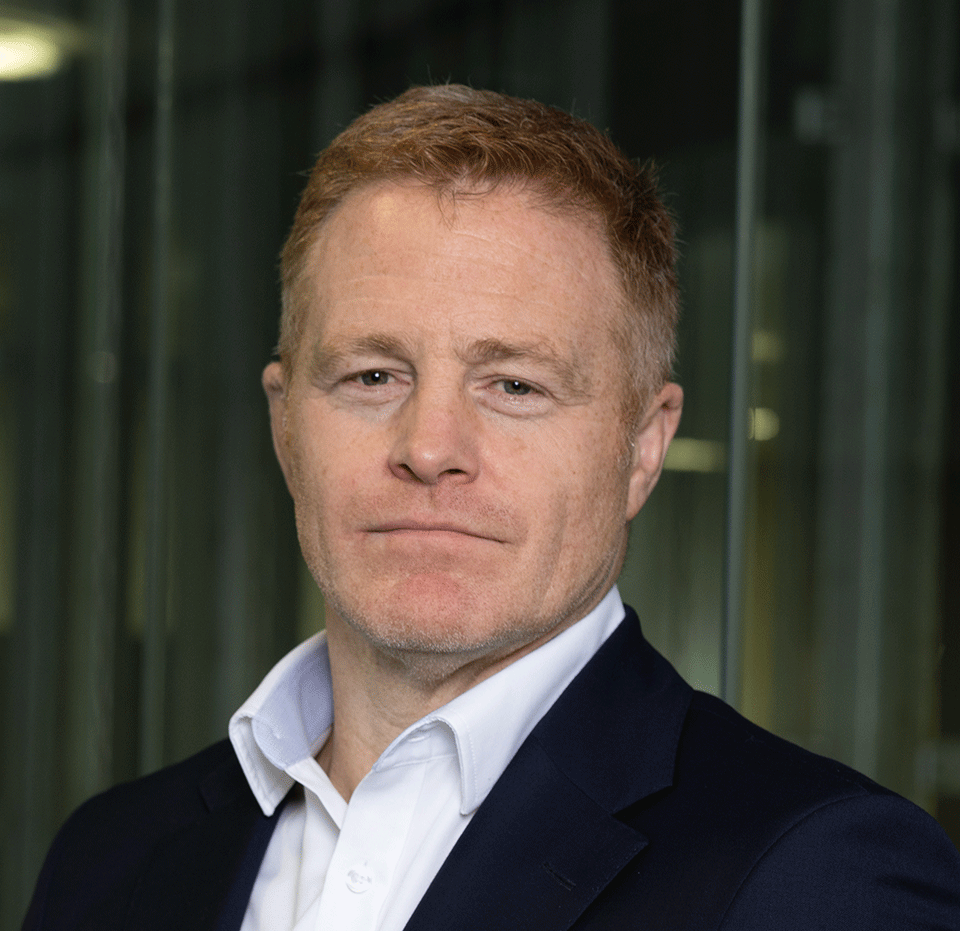
Andrew Pisker, CEO of DrKW, did not sound surprised at the market’s mixed reactions when he took time out from his holiday to talk to Euromoney. “Even in 2003 there has been a story that we would be sold, which was not realistic in any way.”
Certainly at the moment DrKW is doing better, with three successive quarters of operating profit. The fixed-income business in particular has shored up revenues. In the carefully worded Allianz statement, DrKW’s management staff were praised for meeting the market’s significant challenges.
Allianz added that DrKW had achieved sustainable levels of capital usage – enough to guarantee the parent’s support for at least two years. At that point, DrKW should be in a position to attract capital from outside. In other words, DrKW is absolutely not going to receive any more capital from the Allianz group. If it needs more, it will have to launch an IPO, seek a silent partner, or find some other form of joint ownership. At this stage, that is not so much a plan, more a possibility.
In any case, the promise of at least two years’ support is welcomed by Pisker. “It is important because it means that we will not wake up one morning and read in the paper that we have been sold,” he says. “People will stop referring to us in that way. It also gives us breathing space to ensure that three quarters of growth will become seven, nine or 10 quarters of growth.”
It is more tricky to predict whether capital will be needed. “If we have a roaring equity market and corporate finance comes back with a bang, all firms will be able to use more capital,” says Pisker. “At present capital is not an issue. Who knows what will happen two years from now?”