|
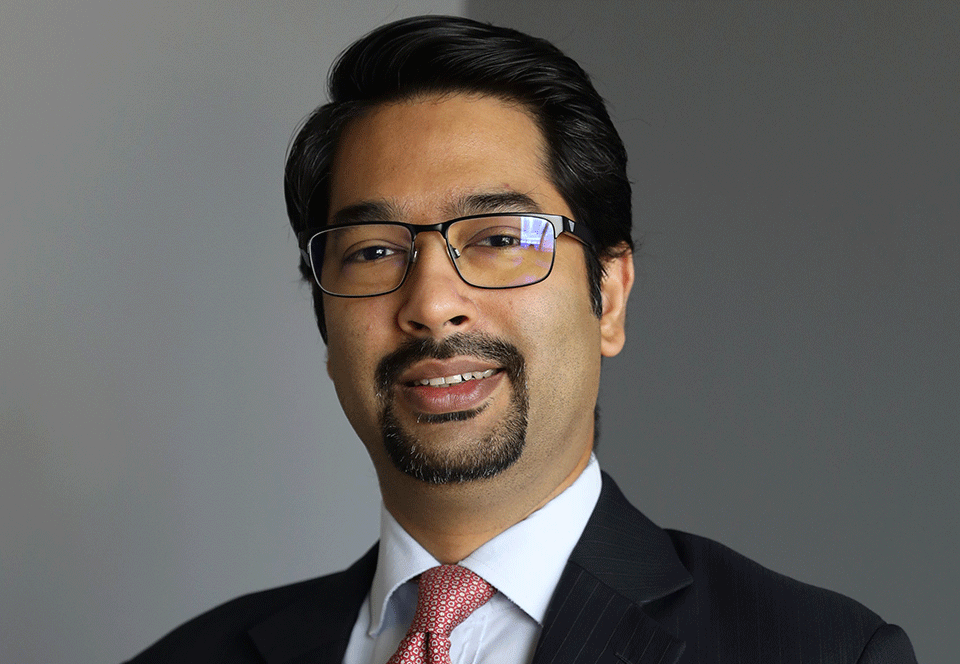
Mike de Graffenried |
||||||
Saudi Arabia’s banks are bracing themselves for a period of intense competition as they fight to win a bigger share of a rapidly expanding but increasingly sophisticated retail market. To meet this challenge, they have rolled out or are preparing to launch new products, particularly for Islamic and internet banking, and to develop personal and mortgage lending.
“The banking sector is coming out of a phase, which has lasted slightly more than a year, when there was a lot of liquidity and not much action on the assets side. We are beginning to get into a situation where the demand for funding is picking up from both corporate and personal customers,” says Mike de Graffenried, managing director of Saudi American Bank (SAMBA).
The 10 commercial banks in the kingdom are well placed to meet this demand. They are well regulated, among the best capitalized in the developing world, very liquid and profitable. And they have spent the past two years modernizing their internal systems and structures.
The focus is now on developing retail banking opportunities. The bulge in the population – 60% are under 20 – means that a large number of Saudis are entering the peak borrowing and spending age groups and looking for a wider range of services. There is, for example, the first sign of a demand for long-term savings products and insurance.
The strategy may be the same but banks are applying slightly different tactics. The larger banks are selling products across the whole of the market while some of the smaller ones, such as Bank Al-Jazira, are targeting specific sectors.
“We have most consumer products – we don’t sell them to the mass market but to the top end of the market. We are more successful than in 1994 even though we have only one-third of the customers,” says Robert Tranter, the bank’s assistant general manager for technology and bank operations.
The banks can meet the needs of their customers more easily and securely following a government initiative two years ago which encouraged salaries to be paid directly into bank accounts, stimulating a rapid expansion in the unsecured lending market.
“For Saudi British Bank and the other commercial banks, this has meant that personal credit has been a growth industry but not at the expense of storing up problems for the future. Delinquency rates are falling,” says David Hodgkinson, managing director of Saudi British Bank.
According to another banker, “the guarantee of receiving the salary has enabled us to extend consumer lending considerably. There is tremendous latent demand in this sector.”
The banks are also starting to dip their toes into the mortgage lending market. Local demand for housing is expected to grow dramatically, particularly in Riyadh, and law changes being implemented will eventually allow foreigners to own property.
The main constraint has been the difficulty under Saudi law in foreclosing on bad property loans. However, bankers believe the law will have to be adapted to make mortgage lending possible. “We are a young nation with 60% of our population under 20 years of age. There is a need for this sort of finance because not everyone can afford to pay a large amount of money for a house upfront,” says Abdulkareem Abu AlNasr, deputy general manager at the National Commercial Bank (NCB).
Saudi British Bank, for example, has launched what it describes as the kingdom’s first house purchase scheme. “It is effectively an Islamic lease, known as Ijara, with an option to buy. The level of pent-up demand was illustrated when we had 25,000 calls when the product was first advertised,” says Hodgkinson.
All the conventional banks are now developing Islamic products for both sides of the balance sheet and are mounting a serious challenge to wholly Islamic institutions such as Al Raji Bank, which has dominated the market until now. Some are marketing through their conventional branches, while others are establishing a network of specialist Islamic outlets.
Some of the commercial banks are appointing Sharia council boards to supervise and approve their products. “The challenge that banks face is to innovate and come up with Sharia compatible substitutes for conventional products. Once these products have been approved by the Sharia board, we found that a growing number of customers tend to prefer them over the conventional ones. question is to define what is an Islamic product and make it acceptable to those customers who are content as long as the product has been endorsed by the Islamic court,” says AlNasr.
Riyadh bankers are convinced that this will be the most rapidly growing section of the Saudi market. “There is clearly a demand for Islamic products on both the corporate and retail side. We have a number of corporate Islamic products and have spent some time developing the retail side – there is now, for example, an Islamic charge card,” says SAMBA’s de Graffenried.
Hodgkinson at Saudi British Bank believes that the joint venture banks in Saudi Arabia will win as much business as those that are totally Saudi owned. “Joint venture banks were not initially seen as Islamic by customers but they have been pleasantly surprised. We have appointed a Sharia committee. The sector has grown rapidly and financing products have seen a low delinquency rate.”
The banks have also invested large amounts in creating new delivery channels, including the internet. Some, headed by Arab National Bank and NCB, have already created sophisticated internet platforms for their corporate and retail customers. Others are rolling out their products more slowly but most are convinced that it will be very popular, particularly with the growing number of technologically-literate young customers.
NCB, which also offers internet brokerage and WAP phone banking, has set up a call centre that receives 1 million enquiries a month. SAMBA has also introduced corporate and retail products and Saudi British Bank launched a basic internet service this summer.”We view the internet as another delivery channel. We launched in June, and, without promoting it, we gained 2,000 customers. We also have 24-hour phone banking and we take 250,000 calls a month,” says Saudi British’s Hodgkinson.
One of the driving forces behind these changes is the possibility of international competition as Saudi Arabia moves towards membership of the World Trade Organization. There are also divided opinions about the likelihood of more consolidation following the three-way merger of SAMBA, United Saudi Bank and Saudi Cairo Bank, which brought the number of banks down from 12 to 10. Some bankers believe more consolidation is essential. “I believe there will be more mergers when everyone has assessed how well the mergers involving SAMBA have worked. The challenge is to find the right balance between competition and having large banks that can compete globally,” says a Saudi banker.