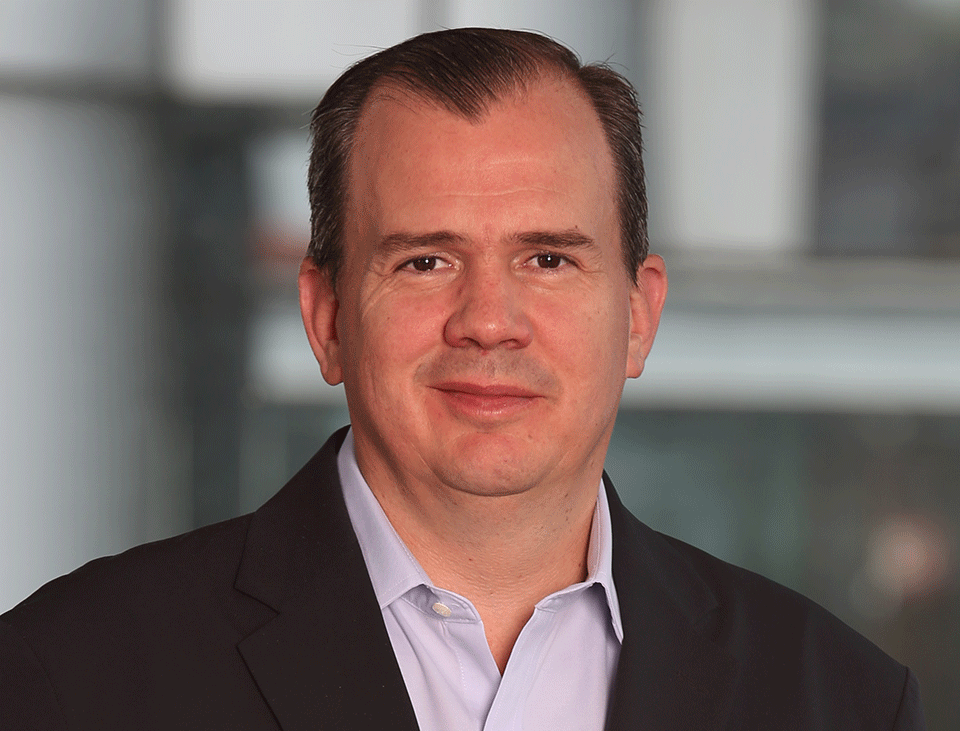
Marc Viénot, a small coffee by his side, lights his cigar with an elegant match as long as a credit card. Here, on the 37th floor of the Société Générale headquarters at La Défense in Paris, the honorary chairman oozes French tradition. It seems remarkable that he is also responsible for revolutionizing the way French companies are being run.
Viénot describes himself as “independent-minded”. Others describe him as a godfather – not a mafia don, but rather a mentor to many French executives. It is only a man like this who can drive nearly all the companies in the CAC 40, France’s blue-chip index, to accept and apply principles of corporate governance without any prodding from the government.
Indeed, that is what makes France’s acceptance of corporate governance impressive. In a country known for its old-boy network, large companies have begun to regulate themselves and get rid of practices that are imbedded in the culture.
Now the government wants to get involved. The French parliament is debating a bill on economic regulation that would make principles of corporate governance obligatory. Analysts agree that some aspects, such as greater transparency and guidelines for the role of chairman and selection of the executive board, are appropriate for French companies. But the firms themselves don’t want the government involved in corporate governance. But can France’s top companies really be trusted to discipline themselves?
“What is surprising is that in France a group of 12 executives of big companies have an agenda or set some rules and they seem to be applied – in a country where everybody loves the state, the law,” says Viénot. “Nothing has come from the state. I think that’s important. Private companies are self-regulating.”
Viénot happens to be the leader of the 12 executives. His two reports on corporate governance have led to an overhaul of the boards of French companies. The Viénot reports, published in 1995 and 1999, gently introduced such ideas as independent board members, the separation of the roles of chairman and chief executive, and publication of the chairman’s renumeration.
“In fact, the reports were written as a way to avoid legislation,” says Fabrice Rémon, a partner at Déminor, a Belgian consultancy that specializes in corporate governance. Viénot agrees, claiming that companies were feeling pressure from regulators.
“To be frank, we were afraid the Commission des Opérations de Bourse [the stock exchange’s regulatory commission] would enter,” says Viénot. “It would be normal as a bank for a regulator to appear. So we said we should do something on our own and fast. I was given two months.”
International exposure
At the time, Viénot was the chairman of one of France’s largest banks, Société Générale. Eight years earlier, in 1987, he privatized the bank when the Conservatives came back into power. Earlier stints as a French counsellor in Washington DC for the IMF and the World Bank and his assignment to develop Société Générale’s international presence had brought him into close contact with the business world outside France.
In 1995 he was asked to chair a group of chief executives and write a report on corporate governance. What came to be known as the first Viénot report was sponsored by the French lobbying groups Conseil National du Patronat Français and Association Française des Entreprises. It was written for the “same reason the British had the Cadbury report,” says Viénot.
The first Viénot report “was very light but had to be so because the habits were so strong,” says Rémon. It concentrated on the management of the board of directors, including cross-participation and introducing independent members to the board. “We suggested that committees look at well-known ideas in the Anglo-Saxon world that we wanted to introduce,” says Viénot.
Because the report was filled with suggestions and not obligations it attracted much criticism. Supporters of corporate governance called it vague and not demanding enough.
Viénot counters that “there was no authority behind it, no sanction, nothing”.
But the idea slowly caught on. Viénot jokes that the CAC 40 companies were receptive to the reforms because the 12 companies whose “chairmen were members of my committee by instruction were due to do something.” This committee included the chairmen of Alcatel, Paribas, Lafarge, and Saint-Gobain.
The real incentive to accept corporate governance and, as a result, make companies more transparent came from the influx of foreign investment. Paris Europlace, an association representing the French financial markets, reports that 35% of the Paris Bourse’s market capitalization and 50% of trading volumes are controlled by foreign investors.
Investors interested in putting money into France wanted more information about how individual companies were run. “It is foreign investors who have influenced the acceptance of corporate governance here,” says Rémon.
Jean-Claude Buono, executive vice-president of Air Liquide, a French company with an enviable corporate governance record, relates changes among French companies to the disappearance of borders within Europe.
“French companies must adapt to be more competitive in the European and global market. They must be more reliable and easier to understand,” says Buono. Viénot adds: “Surprisingly we have seen that the pressure of the market has been strong enough to make some chairmen and CEOs tend to act very quickly.”
A stronger second draft
By 1999, the market wanted more. Instead of being called upon to write a report, this time Viénot called a meeting of the chairmen on his own initiative. He wanted to clear up two issues that weren’t addressed in the first report.
| Fabrice Rémon | ||||||
The first recommendation supported the separation of the offices of chairman and chief executive. The traditional French combination of the two jobs has “given rise to a lot of criticism, the all-powerful, the czar,” says Viénot. He clearly admires those British and American companies that have divided the two offices.
The second tenet called for transparency of information about the compensation of corporate officers, a sensitive topic for the French. A Catholic and conservative culture respectful of privacy makes talking about money taboo. So, Viénot says: “We took a rather discreet approach on that.” That discretion consisted of publishing the lump sum instead of a detailed report on compensation.
The report was – and still is – attacked for being too soft on French executives, dashing hopes that the old-boy network business culture was really reforming.
The committee folded under pressure. But two months later, says Viénot, “we took a much bolder initiative and said: ‘Well, we’ll tell everything.'” The changes included outlining the principles for allocation of salaries and bonuses as well as the amount of compensation paid to corporate officers.
Despite the report only suggesting reform and none of the principles yet being law, Viénot says that this year will be the first time that most of the listed companies will publish the renumeration of their chairmen. It’s an improvement on the six companies that published 1999 compensation figures. That’s not to to imply that he is unsympathetic to the traditionalists: “Why say how much compensation one earns when the prime minister doesn’t give the statistic?” he asks.
Six years after publication of the first report, it is evident that changes have been made but it is difficult to evaluate progress. “It is difficult to say that one company is good in corporate governance,” says Déminor’s Rémon. “So many criteria have to be taken into account in order to assess one company.”
Déminor breaks down companies’ application of corporate governance into four categories: disclosure of company activity, structure and functions of the board, shareholders’ rights, and hostile takeover defences. The 2000 ratings of French and other European companies showed that absolute acceptance of the Viénot reports’ recommendations has been rare.
Société Générale and Lafarge both performed well in the first category – disclosing company activity. It’s a good sign for Viénot, because of his position with the bank. But the report judged French companies overall as having among the worst records for a simple reason: too often company documents that are important to shareholders, such as the annual reports, are not available in English. With such a large proportion of investment in France coming from abroad, vital company statistics are not readily available to non-francophone investors.
Rémon also points out that French companies don’t follow the British so-called comply or explain code whereby British companies have either to comply with the Cadbury report, the 1992 UK predecessor to the Viénot report, or explain why they won’t comply.
The report names Saint-Gobain, Suez-Lyonnaise des Eaux and Lafarge as three of the best companies when it comes to reforming board structures. They have been quick to divide the role of chairman and chief executive and to bring independent members onto their boards.
It’s a reform near to Viénot’s heart. “I agree [with the separation of the role of chairman and CEO], and I am experimenting with it myself today. I am chairman of a supervisory board for my first time and there is a real CEO. It’s a French and German company that has merged – Aventis.”
It’s a good sign since the pharmaceuticals company is one of the largest in the CAC 40. But Déminor’s stamp of approval only comes when one-third of the board is made up of independent directors.
A report recently issued by Korn/Ferry, a headhunting firm, attests to the progress made in France but, unlike the Déminor study, slams companies that have done least to accept corporate governance. Of the companies in the CAC 40, the report alleges, all but three have incorporated recommendations from the first Viénot report such as reducing cross-participation and introducing independent board members.
These dissenting companies are dragging their heels enough to overshadow the changes in the other 37 companies. Worst by anyone’s standards is tyre manufacturer Michelin. This is surprising because it has such widespread international operations. Yet corporate governance appears to be of no concern yet to the family-run business.
Viénot admits after hesitation that Michelin has not responded well to his reports. “The reaction of Michelin was not typical. I like the company – Edouard Michelin is a friend of mine. But there are still some opportunities for improvement.”
Michelin has remained mute on the subject of corporate governance. It is the only company on the CAC 40 to make no changes at all or even to address the subject. At least IT consultancy Cap Gemini – recently merged with Ernst&Young – and contract food services provider Sodexho, the other two disobedient companies according to the Korn/Ferry report, have begun to pay attention to the recommendations and are changing, slowly but surely.
Michelin could take a tip from another large French company, TotalFinaElf. Both count 80% of their sales outside France, but half of the oil company’s board are non-French, compared with zero foreigners on Michelin’s board.
Viénot remains optimistic. Young blood will change the business, he contends, as François Michelin takes over from his father.
Viénot cites Air Liquide, a company lauded in both the Déminor and Korn/Ferry reports, where change in leadership has brought the company up to speed with corporate governance.
“At the time of the reports, the chairman was not very excited about them, but his successor is complying very well,” says Viénot. Air Liquide has reacted particularly well to the recommendations in the second Viénot report, revealing compensation of its executives and changing the composition of the board.
In fact, Buono says that the principles in the Viénot reports were nothing new to Air Liquide since the company has been committed to serving its shareholders since its founding almost 100 ago.
The industrial and medical gases company is keeping up to speed with the reports, though. It has recently established formal salary and renumeration committees and has scheduled regular meetings of the board. Admirably, the board of directors lists only two members out of 11 who also sit on the executive board. Nine members, a staggering figure by French standards, are independent.
Overall, French companies are accepting corporate governance without the help of the government, even if the advances have been staggered. Viénot says France’s progress compares well with European neighbours. “I think every country in Europe has their reports, but they are not very ambitious and the companies often don’t apply the rules.”
Viénot ranks France behind only the US and the UK in implementation of corporate governance principles. Other opinions support this.
Singling out the UK as the constant leader, Rémon applauds France’s progress while scolding the Netherlands. Korn/Ferry praises the wide reception of the Viénot reports, compared with the situation in Germany, which has been slower to reform.
Acceptance of corporate governance is being tested as cross-border mergers are forged in Europe. German pharmaceuticals company Hoechst was forced to catch up with French company Rhône-Poulenc and fuse corporate governance policies when the two companies merged to form Aventis.
Some critics say that corporate governance is just a fad and France is jumping on the bandwagon. Viénot disagrees: “It is a big trend in Europe, but the investors are long-term investors.” They will continue to want to know the policies and actions of the companies, he says.
Legislating for the laggards
The French government clearly considers corporate governance important since it wants to legislate on it. Parliament now seems intent on reforming the remaining dissenters if they won’t willingly comply with the Viénot reports. To some, the law’s intrusion into matters of corporate governance is futile. “A framework should be established, but after that you do not need too much regulation and law,” says Buono.
|
Jean-Claude Buono |
||||||
For him, those companies that genuinely embrace corporate governance devote their effort to shareholders. Other companies simply install a form of compliance, but they don’t change their behaviour. “It is a matter of substance, not form. The law will never force companies into having more substance.”
Rémon says: “The beginning of the story of corporate governance was that the Viénot reports were written to keep control of its evolution.” Because not all of the companies have complied with the relatively flexible standards the reports laid down, it looks as though the power to set the rules will be taken out of the hands of the CAC 40 boards by the end of the summer.
It’s a disappointing solution for Viénot, who also opposes international organizations such as the OECD getting involved. “I happen to be afraid of international institutions interfering in a detailed way in the management of companies,” he says.
The paradoxical independent-minded old-boy network director has done things his way, keeping the government out of his mission so far. But regardless of what is best for French companies, the law is lurking just around the corner, anxious to take corporate governance into its own hands.