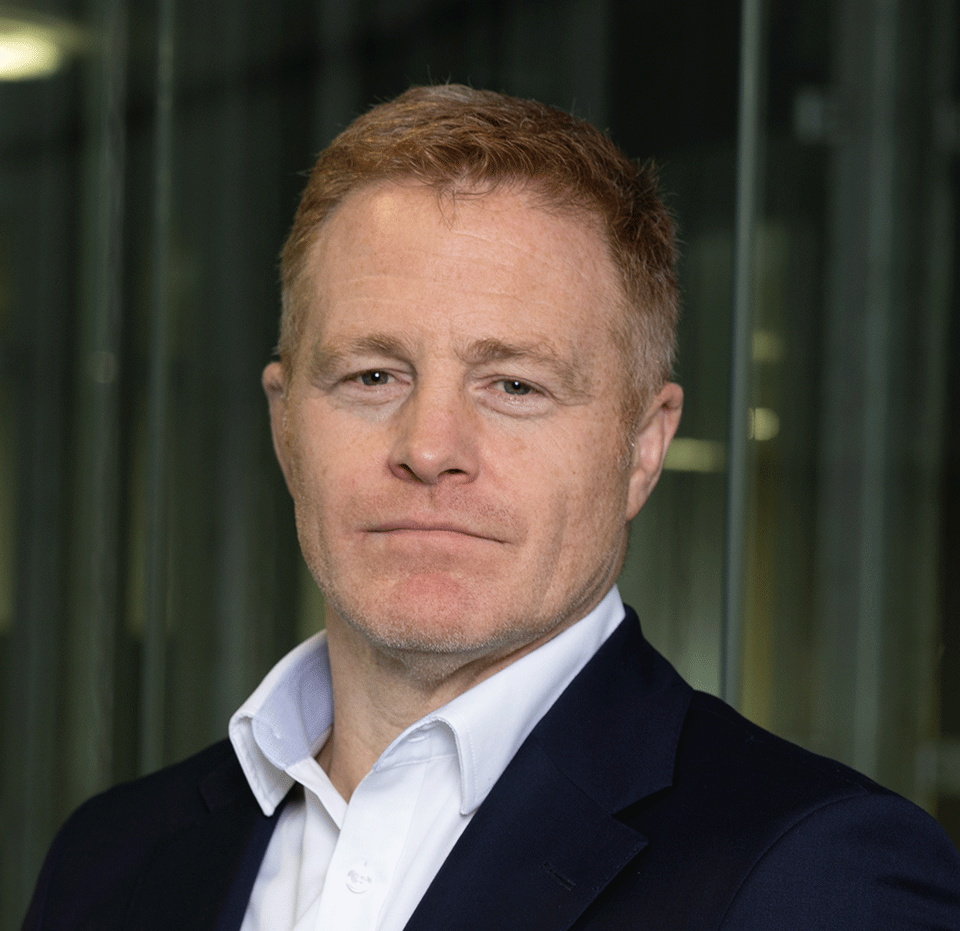
For Gazi Ercel life at the helm of the Central Bank of the Republic of Turkey has been a fast moving sequence of spectacular pursuits and narrow escapes, sea changes and dire straits, hair- pin bends and sharp drops. His may well be the greatest adventure in the history of central banking. To start with, in just over four years as central banker he has worked with five governments and 11 economy ministers. Meanwhile, the Treasury lost five secretaries general, and may be on the verge of losing the incumbent, Selcuk Demiralp, who has been rumoured to be on the point of resigning for months.
The saga includes suicide, military intervention, the first Islamic prime minister in a NATO country, and the worst international financial crisis since World War II.
Ercel’s unusual career as a central banker started in April 1996 when he got the job from Mrs Tansu Ciller, the country’s first woman prime minister. Ciller – a professor of economics and, by general agreement, one of the most inefficient economic managers the country has seen – spent central bank governors as if they were going out of fashion. Ercel was her fourth in half as many years. The second had tendered his resignation after Ciller threw a crystal ashtray in the direction of his head.
Ercel took office at a bad time which quickly got worse. Turkey was reeling from the after effects of the 1994 crisis which led to a massive devaluation and capital flight. The economy was shuttling between the frying pan and the fire as a series of corrupt and inefficient revolving door governments came and went.
In the Economist Intelligence Unit’s macroeconomic environment listing, Turkey was second from last among 60 countries, one notch above Iraq. “Turkey had inflation in the way that England has bad weather and fiscal deficit, in the way that Saudi Arabia has sand,” says a World Bank official. “These things had become a natural part of the Turkish economy.”
Ercel, a career financial bureaucrat, was chosen because he had kept his nose clean, stayed out of politics – “I took care to be nobody’s man,” he says – and was not controversial.
He quickly set about preparing a stabilization programme. He was well equipped for the job. He had extensive experience both in the public and private sectors and the International Monetary Fund and was part of an extensive and influential bureaucratic network.
Yet Ercel’s troubles started very quickly. Two months after he was appointed, the government collapsed. In June 1996 Ciller resigned. In July, to the shock and horror of most Turks, she formed a coalition with the Islamic Fundamentalists Welfare Party which had won the majority of the seats to become the largest party in the assembly. Its leader, Necmettin Erbakan, became Turkey’s first Islamist prime minister.
Erbakan was not only a fundamentalist Moslem but had odd ideas about the economy. “And the colour of things started to change,” recalls Ercel. “The easiest thing would have been to just resign and go away. But I decided to stick it out and fight. One cannot ever expect to have an easy ride in Turkey. At least, I never had one.”
It was good that his attitude was philosophical because this would be the beginning of a long roller coaster ride which would last for nearly three years. In quick succession, the following happened: in February 1997 the army issued an ultimatum; In March, Moody’s downgraded Turkey’s long term foreign debt rating; in July, Erbakan was forced to resign. Mesut Yilmaz, a liberal, incompetent politician, became prime minister and Bulent Ecevit, the veteran politician, became his deputy.
During this time Ercel, much in the manner of Coleridge’s ancient mariner, wandered around repeating to each new government the urgency of mobilising a stabilization programme.
In June 1998 a Memorandum of Economic Policies was signed with the IMF and a mild stabilization programme came into force. But before Ercel could reach for the champagne, the Asian crisis erupted and the programme had to be abandoned almost before it started. “Inside of a month the programme vanished,” says Ercel.
While still reeling from this shock, he watched the Russian economy, the biggest market for Turkish exports, collapse. “That was my darkest day, ” he recalls. “Within three weeks foreign investors and speculators pulled $7 billion out of Turkey. Interest rates shot up from 70% to 150%. We were afraid that there would be a panic… a rush to the banks.” Fortunately for him the Central Bank reserves were high and demand for cash abated when Ercel flooded the market with hard currency.
In late 1998 Yilmaz was forced to resign over a censure motion concerning his privatization activities. And in January 1999, Ecevit became prime minister. In April the same year another poll took place. This time Ecevit’s mildly left-wing Democratic Left Party (DSP) won the majority of the seats. He formed a coalition with the ultra Nationalist Action Party, which entered parliament for the first time in nearly 20 years in second place. Yilmaz joined in as junior partner.
Finally Ercel and the other bureaucrats were able to start negotiating a substantial stabilization programme with the IMF. For a while it looked as though things would go smoothly.
In the summer of 1999 agreement in principle was reached. A few days later, in June the minister in charge of the economy, Hikmet Ulugbay attempted to commit suicide. “He was tired so I told him to go on holiday,” said a perplexed Ecevit. “Instead he went home and shot himself. It’s inexplicable.” Ulugbay survived but quit his portfolio. A dark Dostoyevskian figure before, he became jolly and full of life.
One month or so later came one of the worst earthquakes in Turkish history which virtually halted economic activity. More than 17,000 people died, 45,000 were hurt and nearly half a million left homeless. The tremor shook Izmit and Istanbul, the most densely populated and industrialized provinces of Turkey, and cost $4.5 billion in lost production. 1999 became the worst year Turkey had experienced since World War II. GNP declined by nearly 6.5%.
In December 1999, a standby agreement with the IMF was signed and has been faithfully followed since. Although it is too early to be sure, Turkey seems to be headed towards defeating its endemic inflation and chaotic state finances. “The target is joining the Monetary Union of the European Union,” says Ercel. “There is no stopping until then.”
Ercel says that Turkey was able to weather the Asian and Russia crises and everything else because it followed a “realistic” foreign exchange policy.
“We always saw to it that the foreign exchange rate was competitive and favourable to maintaining high reserves,” he says. “That and the fact that the Central Bank was credible and transparent allowed us to sail through. If the market believes what you tell it, everything becomes easier. If you make a promise, you must keep it.”
In April next year Ercel’s five-year term in office expires. Will he be re-elected? “Who knows,” he replies. “In Turkey seven months is a long time.”
One searches in vain for signs of his vicissitudes in Ercel’s face. He is more corpulent than when he took office but definitely happier. Throughout our interview in his office in Ankara he wears a beatific smile. A slim, doe-eyed waitress in black oozes in and with nun-like reverence places a steaming cut of linden blossom tea in front of him.
He and I were contemporaries at university and as I watch him sitting (embedded would be a more accurate word) in one of the Central Bank’s hugely comfortable leather sofas, I realize how much in his element he is in this spacious, silent office. What they say must be true: he absolutely adores being Central Bank governor and nothing will make him resign. He is probably also aware of the old maxim that ‘being there is half the job done’.
Last December when the government announced that the shares of five smaller banks were being taken over by the Central Bank’s Saving Deposit Insurance Fund there was a fear that there would be a run on the banks.
Ercel went on television and said “I am the boss of these banks now. I have $23 billion in reserves at the Central Bank. And I have a printing press on which I can print as much money as I want. If you want to withdraw your money go ahead and do it.” No one did.
Exceptional return is the making of Ercel
Gazi Ercel took his undergraduate decree from Ankara University’s famous Faculty of Political Sciences, known as Mulkiye, where the Turkish bureaucracy’s elite is educated.
Turkey’s finance, interior and foreign affairs ministries have been drawing their senior bureaucrats from the graduates of Mulkiye since Ottoman times. There has hardly been a Turkish government which hasn’t had several of its graduates. Yilmaz, a minister of state in the present government, is one.
But the so called Mulkiye Mafia is not exclusive to the bureaucracy. Having reached seniority in the civil service many graduates go on to plum jobs in private enterprise in Istanbul. The majority never return.Ercel was an exception.
When the call came he was general manager of Yasarbank which belonged to the richest family in the Aegean city of Izmir. He must have been relieved to quit. The bank was in bad shape.
Some people blame Ercel for Yasarbank’s miserable performance but the truth is that the bank was already beyond salvation when he took over. It had been badly mauled by incompetent management.
“At least Ercel was honest,” says a senior manager who did not want to be named. “But all he could manage was to make a worse situation bad.”
Ercel left Yasarbank but Yasarbank did not leave Ercel. In December last year the Central Bank’s Saving Deposit Insurance Fund took over the shares of five banks which had become insolvent. Ercel found himself on television telling the country that he was running the five banks, one of which was his old friend Yasarbank.
The bank is also named in a dispute between George Soros and the Yasar family which also controls Turk Tuborg, in which a Soros fund holds more than 20% of the equity.
At Soros’ bidding the Turkish Capital Markets Board is examining whether the Yasar family made a good investment when it used Turk Tuborg funds to buy Yasarbank shares.
Ercel spent 22 years in the civil service, including a sabbatical during which he took a degree at Vanderbilt University in Nashville, Tennessee.
Between 1977 and 1982 he was deputy director of the treasury in charge of foreign exchange, World Bank, banking supervision and Research departments. Ercel worked with prime minister Turgut Ozal who introduced sweeping reforms which transformed the state-controlled, inward-looking economy, and in the process transformed Turkey into one of the most vibrant economies among emerging nations.
In 1982 he was seconded to the International Monetary Fund where he worked as assistant to the executive director. Ercel subsequently put in another two years in the treasury as its international economic affairs chief.