 |
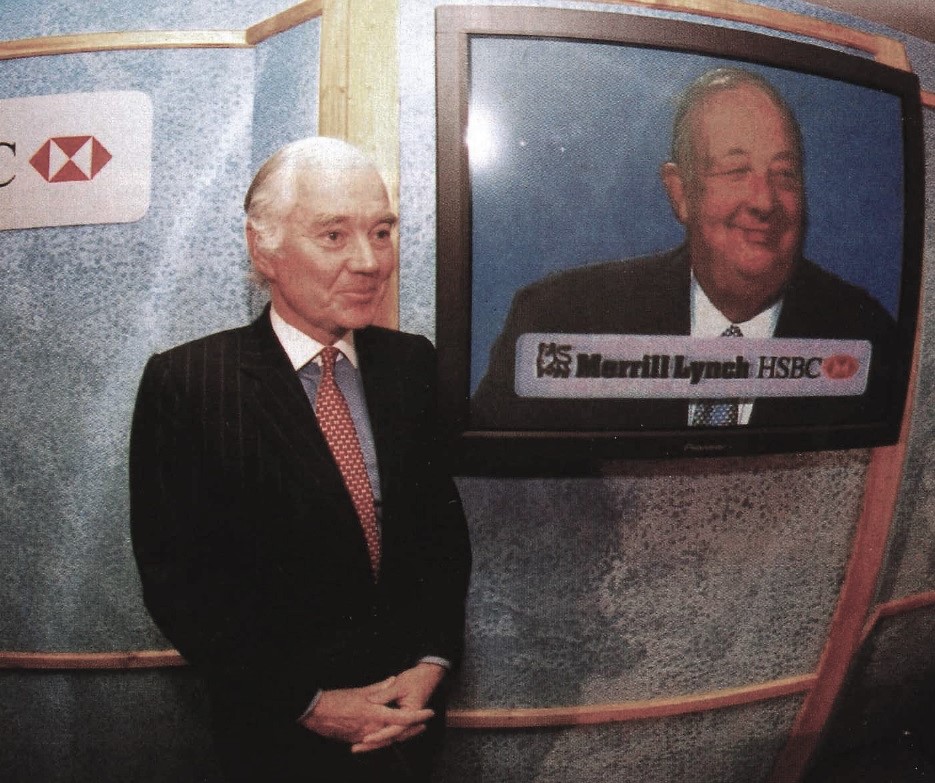
| John Bond (left) and Dave Komansky: aiming to go on-line to serve the “mass affluent” |
Listening to Dave Komansky speak was a little distracting. Each time the CEO of Merrill Lynch pronounced the initials “HSBC” it was as if Benny, a character from the old US cartoon series Top Cat had jumped into his larynx. “Okay TC” was Benny’s catchphrase – laced with the accent of the Bronx where Komansky grew up – whenever he agreed, as he usually did, with his feline boss.
But Komansky is no stooge – quite the opposite – and no cartoon character, although the trials and tribulations of Merrill over the past two years might make for a great show. Back in mid-1998 Merrill Lynch was king of the hill in investment banking, but was increasingly under pressure in retail broking – its cash cow – to respond to the rise of leading discount broker Charles Schwab. Komansky and John “Launny” Steffens – until recently head of the private-client business – had both made disparaging remarks about the role of the internet that had come back to haunt them. Despite similar problems at Salomon Smith Barney and PaineWebber, it was Merrill that landed the tag of internet dullard.
This year, though, Merrill has announced two new ventures. If successful, these could restore its image as a market innovator, and put it at the leading edge of retail e-finance. Last month’s announcement of a joint venture with HSBC to create an ex-US banking and investment services company was high profile. But two months earlier, Merrill had quietly let it be known that it was to revamp its cash management account (CMA), first set up in the 1970s, and begin offering federally insured deposits.
And this on the heels of evidence that its response last June to the rise of online trading is paying off. Until then customers could find themselves paying up to $400 to trade stocks, as opposed to $29.95 at Schwab. That was a fat premium. But changing it risked alienating its financial consultants – Merrill’s term for its brokers – while not to do so risked losing business fast.
So Merrill came up with a two-tier structure: to abandon the high fees for single trades in favour of an annual fee of $1,500 for unlimited trading and access to the FCs and the company’s research, and a discount online service of $29.95 a trade. In the first quarter of 2000, assets in the former had risen 21% to $203 billion, and in dedicated online accounts from $300 million to $2 billion.
Having first proved that it is able to defend the turf its founder, Charles Merrill, laid in the 1920s, the broker is now going on the offensive.
“The CMA would normally be called ‘banking’ but I’m not allowed to call it that”
Both ventures, the revamping of the CMA and the joint venture with HSBC, mark Merrill down as the first mover, and an innovative one, taking advantage of new regulations, new technology and new business models faster than its competitors. It’s virtually impossible to decide which of these two announcements is the more groundbreaking: the domestic announcement, because it has the potential to solve the growing dilemma for US brokers and investment banks of a lack of a strong, broad capital base long enjoyed and exploited by the likes of Chase Manhattan, or the overseas adventure, because it will use a completely new model to break into a new and rapidly growing market.
Each of the two institutions will commit $500 million over the next five years in 21 countries to build a combined banking and investment services company for what HSBC Group chairman Sir John Bond so delicately terms the “mass affluent”. That is those with, or likely to have in the near future, between $100,000 and $500,000 to invest.
It will be predominantly an online offering, with some branches and call centres, but it is aimed at those who want to make informed investment decisions for themselves without using a private banker or a financial consultant. It’s a model Merrill rejected until last year. The two partners expect to be turning a profit within five years.
The joint venture is a significant departure for Merrill Lynch which has been aggressively building through acquisitions since 1995, when Komansky was president and COO (he became CEO a year later). Merrill has made 19 significant acquisitions, including Smith New Court and Mercury Asset Management in the UK, the staff, assets and real estate of defunct Japanese broker Yamaichi, and Canadian broker Midland Walwyn.
HSBC is no different, having just won the battle to buy Crédit Commercial de France, buying private banking heavyweight Republic New York Corporation last year, and buying various institutions in Asia and Latin America.
So is this a case of the old leading the way to the new world of banking? A big hint that acquisitions are dead? Not completely. Neither institution could have participated in the new venture had it not been for all the acquisitions it had made; nor does the joint venture seek to limit either’s ability to continue to acquire. And the mass affluent sector is one that has not been adequately covered. It fell in the gap between the variety of full and discount broking services and private banking for high-net-worth individuals.
A hard act to match
Both HSBC and Merrill could have tried to go it alone, as others are planning to do. But Merrill, despite its CMA in the US, has no experience in banking globally, and HSBC’s retail broking is no match for Merrill’s. So instead, with the help of technology, the two are able to combine their complementary expertise and geographic presence and their brands without having to get into the destructive processes of a full-blown merger.
By acting first the two have pretty much cornered the best of the market. In terms of product offerings and geographic coverage the two combined are hard to match, if not impossible. “At a stroke this makes us major players, if not the major player, in global financial e-commerce,” claims Bond.
The venture puts Citigroup on the spot. On its own Citi has the best global presence of any financial institution, and the most products. That would have put it in the best position to dominate the mass affluent market, potentially a hugely profitable one. According to figures given by the two partners, in Europe alone there should be a 60% compound annual increase in online banking and investment accounts from now until 2004 taking the numbers up to 14 million.
And the figure rises to 50 million when including the top 25 non-US countries based on the size of the consumer market. And these, we are told, are conservative estimates. The HSBC-Merrill venture now has the same global reach, the right product mix, and the benefit of being a stand-alone entity which ought to be free of having to deal with the bureaucracy of a large institution still in merger mania. UBS has similar ambitions, but lacks a global presence.
That’s not to say that Merrill-HSBC has won the game. For a start, they are targeting a new market segment. Second, Citigroup, UBS and others are hardly going to stand back and concede defeat: they will put up some strong competition and solid product. And third, regardless of the two institutions’ willingness to opt for a joint venture and of all the sweet talking at the announcement of how much they respect each other, this is totally new territory for both of them.
Bankers, whether of the retail, commercial or investment variety, have usually worked in silos within organizations, and joint ventures are often an attempt at a quick fix that then founders on the conflicts of personality and mutual distrust. Analysts are rightly suspicious of joint ventures – Joan Solotar, brokerage analyst at Donaldson, Lufkin&Jenrette, brought it up at the conference, as to a lesser extent did Morgan Stanley Dean Witter analyst Henry Mcffey. Komansky acknowledged this by alluding to a comment from one of his colleagues when asked about it at the conference. “He has always told me that joint ventures are like having two people sharing a bed but having different dreams.”
But there are examples in other parts of the industry. ABN Amro Rothschild set up a joint equity capital markets operation in 1996, which despite competitors’ jibes at the time still refuses to collapse in a mess. Technology and e-commerce are making cooperation more common, but in commercial banking it has only really affected back- and middle-office operations. This is the first real example of a joint venture in retail for clients to use. But it’s increasing. According to James Gorman, executive vice-president and chief marketing officer at Merrill, and the driving force behind the venture, “the next strategic wave is more alliances and fewer mergers”.
To ensure that these two bedfellows enjoy the same dreams, the new company, still to be named, will appoint a chief executive from outside (until then Merrill veteran Ed Goldberg will act as interim CEO). “Ed will set it up and run it until we find someone from outside the firm,” says Gorman. “One of the advantages to having someone from outside as CEO is that they don’t feel that they have a passport back to their parent.”
Most of the staff will likewise come from outside the two partners, although the board will have four members from each firm. And it will come as no surprise that the countries targeted first are those where the two banks are best known: in the UK and Hong Kong from the HSBC franchise, and in Canada and Japan from Merrill Lynch. France may figure more prominently sooner now that HSBC owns CCF.
 |
| James Gorman: “the next strategic move is more alliances and fewer mergers” |
All credit to HSBC, but the idea originated at Merrill Lynch, and the model the new entity will use is very similar to the offerings Merrill Lynch has in the US, and which just three months ago it updated to take advantage of both the final repeal of Glass-Steagall and the growing role of the internet.
The most significant aspect to this move is that Merrill will now be offering federal insurance on customer deposits, rather than hold the cash in money market funds. This will allow Merrill to become a bank in the true sense of the word. That might seem rather dull at first, and even a bit stupid. This was the first real move by any US financial institution to take advantage of the repeal of Glass-Steagall last autumn (if we momentarily forget the bold creation of Citigroup a year and a half before the repeal). And the only thing they could think of was to join the overcrowded retail banking market in a country crying out for much more consolidation. At first sight it would not appear to be the smartest thing for a brokerage house to do.
On the contrary, “this is a potentially huge development,” says Solotar. “It’s a great opportunity for Merrill to gain market share from the commercial banks. And it will add some very liquid, high-quality assets to the balance sheet.” Solotar has been expecting this kind of development since the end of Glass-Steagall much more than the huge M&A activity others had predicted, saying at the time that it was more an “opportunity for the brokers to get into other businesses”.
Merrill is not starting from scratch. It has offered bank-like services since the mid-1970s with its CMA, which allows customers to combine their stock trading with a cheque account and pays money-market rates on the balance. It is, Komansky told an investor conference last May, “a very robust cash management system that would normally be called ‘banking’, except that I’m not allowed to call it that”.
Nor was Merrill allowed to get the same benefits as banks do. While the CMA along with the retail brokerage and its asset management operation has allowed it to become a massive asset gatherer – it now has more than $1.8 trillion under management – it does not carry these on its balance sheet. Now the firm can freely offer federally insured accounts on a large scale. And by keeping the assets in-house rather than managing them as money-market funds, they become part of Merrill’s balance sheet liabilities.
This means that Merrill will, if successful in luring customers, be able to reduce its cost of funds and also use its broader, more flexible balance sheet for other parts of its business. Banks such as Chase and Bank of America in the US, and universal banks such as Deutsche Bank and ABN Amro in Europe, call it leveraging the balance sheet: using a deeper and cheaper source of funds to win business for syndicated loans, bridge financing, back-up lines of credit, M&A.
In other words, Merrill is working to provide itself with a good capital base, the absence of which was, over the past two years, supposedly pushing the firm towards selling itself to Chase Manhattan.
There is a downside. “I’ve always thought that using deposits to fund loans and other products is a sell signal,” says Ray Soifer, a bank analyst with Brown Brothers Harriman until February when he left to set up his own consulting firm, Soifer Consulting. “I’ve always been concerned that it can be bad for the balance sheets of banks such as Chase and Citi when they do that. And thus bad for the shareholders.”
Merrill seems well aware of this. “We’ve had clients ask us in the past to extend the back-up lines of credit, and we’ve been reluctant to do so. Now we’re dipping our toes in the water to test it out,” says John “Launny” Steffens. He was executive vice-president in charge of the US private-client business until three months ago, when he became chairman of the unit and made way for Stan O’Neal, formerly the CFO. O’Neal appears to have assuaged Soifer’s fears. “O’Neal’s said that Merrill won’t be destroying shareholder value by extending loans all over the place,” says Soifer. “In some ways it’s cosmetic, allowing the company to show that it has the capacity to do it when required.”
As a first step, Merrill needs to build the assets into a big enough pool. Besides winning new customers, this means convincing its existing account holders to switch over from money-market funds and use Merrill as their bank account of choice. Existing customers account for about $150 billion in money-market funds, but Steffens estimates that no more than $90 billion could be switched once the scheme is open in June. At least $50 billion is in tax-free funds and it makes no sense to move it, and another $10 billion or so cannot be moved just yet for fiduciary reasons. Steffens hopes that at least $30 billion will be moved over by the end of the year, and about $70 billion within two years.
Why would customers switch? Steffens admits that the CMA never quite achieved its full potential. “The CMA has been a terrific asset-gathering vehicle, but until the 1990s one-stop-shopping wasn’t what most people wanted. Everyone was in their own little niche: banks were banks, and we were regarded as a securities firm. As a result only a relatively small percentage of customers used the CMA for everything.” With Merrill a securities firm, most clients used the CMA for investing and kept a cheque account elsewhere.
“It’s a great opportunity for Merrill to gain market share from commercial banks”
One problem customers had was that they wanted to keep their stock trading and cheque accounts separate, so that a dividend payment, for example, would go into a savings account. Although setting up sub-accounts to the main one could achieve this, only a minority of clients did so. With the new version, there will be a virtual divide between the services offered, but Merrill will treat it as one account.
Then there is the interest rate offered. Merrill will pay about 5.5% on the balance of the account, slightly more than money-market rates, but it is taxable. If it all still sounds too optimistic, Steffens has a reply. “We’ve been noticing a significant pick-up by our customers in using the CMA for banking purposes, although it’s difficult to gauge whether that’s at the expense of their other bank accounts or not. We did $600 billion in bank-like transactions last year, such as cheques, charges, transfers, and ATM access.” Combine that with a virtually delineated account, federal insurance, and 5.5% interest, and Merrill is hoping that this will attract people away from their banks – which pay 1.85% on cheque accounts, if anything – to the new CMA. “It’ll make the CMA work in the way it was always supposed to,” says Steffens.
A bank called National Commercial which Merrill bought in Salt Lake City, Utah, in 1988 for just $50,000 provides the structure for the plan. It’s now called Merrill Lynch Bank USA, has issued 2.1 million Visa cards for Merrill, backs the certificates of deposit Merrill sells, and since 1998 has handled all the broker’s Roth and IRA accounts. As of June it will be the holding company for all the new CMA accounts.
Having bought the Utah bank so long ago shows how far back Merrill’s aspiration to provide such services reaches. As early as 1982, Steffens, then director of marketing, wrote a paper for the board entitled “All things to some people – A vision of Merrill Lynch in the 1990s”, which predicted that deregulation would create a handful of dominant financial institutions by the 1990s, and that Merrill should be among them, offering a full array of financial services to “a targeted group of high-potential clients”.
Steffens may have slightly misjudged the speed of reform, but it gave the bank more time to prepare. Merrill is being coy with its new plans, however: there has been no press release, no big announcement. This fits Merrill’s studied approach to retail banking in the past: “Buying us the bank in Utah gave us the ability to take federally insured deposits,” says Steffens. “But to do so meaningfully would have led to problems had the law been changed against us.”
Now that the broker is free to pursue its plans, it finds itself in an enviable position. The big US retail banks are all wondering what to do with their branch networks, which are costly and still in the process of being merged, consolidated, closed down and relocated. When merging, they also face a potential branding issue. Bank of America still uses the NationsBank brand on the east coast, for example; is it too risky to change it to Bank of America? Then there is the problem of the internet, which leaves the big banks wondering whether it is worth opening new branches, or whether they should close more down.
Take Bank of America as an example. It now has over 4,800 branches and $347 billion in deposits, whereas Merrill has $150 billion in deposits and fewer than 800 offices. Can BofA expand its network profitably? Possibly, although it may have to come in the form of another merger and more cost-cutting. Merrill, on the other hand, does not have to worry about costs in that way, as there is much less to cut, and it’s bringing in a new product. Merrill is hoping that the huge infrastructure of the commercial banks will hinder them in responding aggressively: their costs ought to prevent them from offering accounts at the same high interest rate.
Soifer, though, believes that Merrill’s plans may be more of a challenge to the thrifts than the banks. “The banks have never been competitive to CD and money-market rates, so it might not affect them too much. And Merrill isn’t suddenly becoming a Bank of America. The latter may have more costs, but it is selling convenience.”
As for the internet start-ups, such as Wingspanbank (owned by Bank One) or Telebank (just bought by E*Trade), they have not been as successful as people initially thought, in part because customers want face-to-face contact. Bank One is now apparently exploring the possibility of selling Wingspanbank. The operation, set up last June, wanted to have 500,000 accounts within a year; it has just 100,000 and analysts doubt whether more than one-third of them are active.
Capitalizing on infrastructure
In the middle sits Merrill Lynch. While its new account is completely internet-friendly – one of Steffens’s nicknames for it is e-CMA – it also has over 700 offices around the country, in every state of the Union, selling stocks and the old CMA. And it has a well-established brand that it has created and built on its own. This means that the cost of the new service will be minimal, which helps Merrill to pay such a high rate of interest. “We’re capitalizing on the infrastructure which is already in place,” says Steffens. “There’s been a lot of talk of the dot coms redefining this industry, but with this we’re taking it several steps forward ourselves.”
Merrill also offers mortgage and insurance services, so is it aiming for the elusive across-the-board consumer cross-sell such as Citigroup is attempting? Not yet, it seems, even if senior management was talking up the importance of expanding its consumer businesses last year in the wake of its nearly $1 billion capital markets loss of 1998. For one, to open a CMA account you need $20,000; for another, the average size of a Merrill-funded mortgage is $400,000. “They’re not trying to be a financial supermarket and offer everything under the sun,” says Solotar. “But having savings, chequeing and investing under one roof makes a lot of sense.”
The big unknown is whether Americans are prepared to put all their financial eggs in one basket. At 5.5% it’s very enticing. Given the potential benefits to the rest of the firm, Merrill will undoubtedly start pushing this product more aggressively after its official launch in June.
Its overseas venture with HSBC is due to kick off at the end of the year, or the start of 2001 at the latest. Up on Park Avenue just north of Grand Central Station, another US financial institution must be asking itself if this really is the final nail in the coffin of its attempts to buy a major investment bank. If Merrill can build a larger, solid balance sheet on its own in the US, and build new overseas operations successfully without having to surrender any of its independence, the case for selling out to Chase Manhattan must be all but dead in the water.