 “With the announcement of the third quarter results, there might be some disquiet amongst shareholders …”. So ran the press release which accompanied the first half numbers in early November of this year. It proved something of an understatement, with shareholders in Polish conglomerate Elektrim selling in droves in the immediate aftermath and analysts downgrading recommendations. The Polish team at ABN Amro focused on “soaring debt levels … lower than expected cash flows”. Flemings considered the results little short of “disastrous … significantly worse than expected”. How did Elektrim, to many investors the most effective large capitalization play on the Warsaw Stock Exchange, manage to create such disquiet? The company has certainly come a long way since being one of the five founding stocks listed on the nascent Polish stock market of 1992. Then, as now, an influential domestic player, it ran a rambling empire of over one hundred barely related businesses. Many of these were built on relationships dating from the 1970s and 1980s and put together in the asset grab of the early 1990s. At the time a reputation, a modicum of cash and a stock market listing went a long way. Offering access to overseas travel and hard currency earnings, it was for many years an employer of choice for Poland’s brightest, most international-minded businessmen. The group show-cased Poland’s formidable power engineering, construction and infrastructure capabilities abroad. Located at the top of the tallest tower in Warsaw, it was trusted to handle high profile, high visibility projects domestically, throughout the capitalist world and within the eastern bloc. As international investors awoke to the potential of Poland so Elektrim became an early port-of-call for investment bankers, brokers and their corporate and institutional clients. Allied to this stampede of international interest was a less comprehensible capacity for management to do difficult domestic deals cheaply. When the going was good nobody complained and the going never got better than when, in 1996, Elektrim, the leading shareholder in a consortium which included Deutsche Telekom (DT), won the right to operate one of two new mobile telephone licences in Poland. The winning consortium was called Polska Telefonica Cyfrowa (PTC) and its business was to be known as Era GSM. Elektrim held a 34.1% stake, DT and MediaOne 22.5% each. Several local players held the balance. Shareholder willingness to take the rough with the smooth was regularly tested. The same management which could deliver PTC on the cheap also found its way into some duds. “Alongside the best deals came some junk” comments Sobek Pajak of regional broker, Wood & Co, “yoghurt factories, milk plants, fruit drinks, pig farms and chicken feed processing – it was all there.” In December 1998 international shareholders, by now a vocal and sizeable majority on the registry, and grouped around several active fund managers in London and New York, called time out. Elektrim had revealed, completely unexpectedly, that another Polish insider, Kulczyk Holdings, had an option to acquire 5% of PTC at book value. “It is best not to ask why this option was in place” comments Pajak enigmatically “suffice to say that this is Poland and it may have been insurance when three bidders were seeking two licences.” Shareholders were livid at the revelation of the option. Unwinding it cost $25 million – a snip relative to fair value – but the damage was done. “We were completely fed up and lost confidence in the management’s ability to deliver. This PTC situation was the final straw,” recalls one London-based fund manager. The chairman of the management board, Andrzej Skowronski, an old time Polish plutocrat, closed off and isolated from most foreign shareholders, had to resign. In February 1999 Barbara Lundberg, 47, known to investors through her eight years at the head of the Polish American Enterprise Fund – a successful local venture capital operation throughout the 1990s – was appointed to the position of CEO. Prior to PAEF, she had been vice president in the corporate finance team at Kidder Peabody & Co, and she now brought a new approach to the job. Her first task was to rationalize and focus on three core divisions. To the fore was telecoms where Elektrim had in late 1998 extended its interests through the acquisition of several local telephony operator (LTO) licences to run fixed line networks. The most notable of these was El-Net, in Warsaw, which had cost e245 million: top dollar for many analysts. Two additional core holdings would be built around the cables businesses and the power division – Elektrim’s historical raison d’etre. The panoply of other largely unrelated businesses would go. A holding company was created, Warsaw Equity Holdings, in June 1999 to store this excess baggage. Elektrim took a 15% stake with the balance held by a local advisor, Clifton Consulting, which is entitled to 20% of the proceeds from the sale of any assets. All other proceeds would flow to Elektrim. “It was good to be rid of the garbage,” concludes Pajak “something that the previous management had not achieved in five years and, frankly, any cash they get back is a bonus.” It is possible to see Lundberg’s time at the helm in three key phases: the first running from March until August. For Bob Creamer, senior analyst at RZB in Warsaw, and a major bull on the company: “This was a period of very aggressive deal making. Everything that was going to be done was set out in these three or four months. Lundberg has suffered an irrational torrent of abuse but everything she set out then has come to pass”. This initial phase was to culminate in the entry of Vivendi into Elektrim’s sphere of interest. The second phase, a period of massively increased tension, typified by an increased recourse to the courts, runs from September to November. By the close of this phase, Deutsche Telekom – Elektrim’s original partner in PTC – was roused, quite hostile, and attempting to execute a strategy which could potentially demote Elektrim into a bit player in Polish telecoms. Andreas Madej, ABN Amro’s senior Polish analyst, and the leading bear on the stock concluded: “DT has ample opportunity to expose Elektrim’s financial weakness – and we expect it to do so.” Entering phase three, which may bring resolution to the companies growing difficulties, Elektrim was poised on the brink of insolvency, with questions over its strategy, its debts mounting and its options diminishing. Yet as 1999 drew to a close, management suddenly pulled a rabbit out of the hat – Vivendi agreed to almost double its commitment. Creamer believes: “Everything is resolved. There is nothing further that DT can do.” Elektrim, under Lundberg, made the first of three crucial trades in March when it announced the purchase of Bresnan International Partners for $310 million. Bresnan’s main asset is Aster City, the second largest cable TV network in Poland with a 20% market share and the largest cable network in Warsaw. This fitted well with El-Net. Bresnan also held LTO Licences, which added to an already substantial presence in north west Poland. It was not a cheap deal. In Pajak’s view, “they paid too much – and because of a delayed roll-out [at El-Net] and the spending required to get things moving – it is actually starting to look even worse”. Anton Inshutin, regional telecom analyst at Morgan Stanley Dean Witter, concurs, seeing the deal as being on the expensive side, although he is more concerned by thorny interconnect issues with TPSA which resulted from the acquisition. However, Bresnan, in combination with PTC and El-Net, did allow management to talk about fixed-mobile convergence (FMC), a holy grail in the telecoms world. The markets lapped it up. For Alastair Ryan, Polish analyst at Warburg Dillon Read: “Elektrim holds the biggest interest in the largest mobile operator in Poland – with a 42% market share – it has local fixed line licences covering 22% of the population and it owns the second largest cable TV network in Poland. Who else can compete with that?” And, of course, Poland itself remains a compelling telecoms growth market, with only 22% fixed line and 7% mobile penetration at the end of 1998. It is unclear yet whether Lundberg, clearly comfortable with the bold strategic thrust and the big deal, can deliver the right team to take advantage of these opportunities – although the arrival of experienced executives through the Bresnan acquisition, and latterly the Vivendi link up, offers the prospect of an effective management team. The Bresnan acquisition was financed quickly and effectively through the issue of $477 million of convertible notes, Lundberg’s second major deal and handled by Elektrim’s house investment bank, Merrill Lynch. This generated $458million of revenues net of Merrill’s fee. It was a quality trade, well timed and well received internationally. Creamer points out: “Convertibles are by far the quickest way to raise cash in Poland; straight equity is almost impossible in a sensible time frame given the regulations here. We treat the issue as equity anyway.” Landing up in court Elektrim also pulled back from two significant deals in this period. Management first announced in March the proposed purchase of two other LTOs – known as PTO and Pilicka Telefonica. It then reversed this decision and also pulled out of an internet-related opportunity, Polska On-line. No harm in that of course but dropping the LTOs was handled in such a way as to land Elektrim in the courts – being sued for $140 million. “Another court case, another cost,” opines one follower of the stock. On May 17, Elektrim announced the third, and by far the most important deal. It had agreed a contract to acquire 15.8% of PTC from five smaller shareholders – effectively taking its holding to 51% (1.1% being in an affiliated company). The agreed acquisition price was $679 million, capitalizing PTC at $4.3 billion, seen as reasonable given the control delivered by the bloc. This was a critical stake for the company says Lundberg: “If we were going to move from being a telecoms holding company to a telecoms operator then it was necessary that we owned it”. Three days later, Elektrim announced the signing of a letter of intent initiating detailed negotiations with Vivendi on all telecoms matters. The deal was fleshed out in June: Vivendi would invest in a new vehicle, Elektrim Telekomunikacja (ET), into which Elektrim would inject the 51% of PTC it now claimed to own, 100% of Bresnan and eventually, once it had bought out the minority 16% which it did not hold, El-Net. Vivendi agreed to invest $750 million for a 30% stake, of which $618 million would be forwarded immediately, with the balance payable upon the injection of El-Net. The three trades – Bresnan, the convertible and the ET/PTC/Vivendi deal – marked the high-water mark of Lundberg’s brief time in charge, the result of the new, high risk, high reward approach. Things could scarcely get better and the shares hit a 52-week, and all time, high of Z57. The market – especially many international investors – were in Lundberg’s thrall. “We hoped we had another Mannesmann on our hands” comments one shareholder. But investors did not cling to this view of Lundberg for long and questions soon began to be asked – was she a brilliant strategist moving with speed and decisiveness to create a powerful Polish telecoms group? Or was she a reckless gambler, executing an ill-thought out strategy, on the run, and reacting to events as they impacted the group? Was the removal of Deutsche Telekom a masterstroke or a blunder? The market’s eventual decision was pretty clear – the shares were to more than halve by late November. One London-based investment banker recalls: “There was something of an execution issue developing here. Of five announced deals, three were cancelled, and two, Bresnan and PTC, ran into genuine problems. Was anyone paying attention to the detail?” Another local analyst was also starting to get less comfortable: “Barbara is great on the big picture and she markets the group very, very well but I’m concerned that she may lack finesse and can be impetuous.” Certainly Deutsche Telekom was now feeling the full reverberations of Lundberg’s direct, driving approach. Until then DT had seen Elektrim as a Polish partner – even signing a letter of intent paving the way to a 26% stake in El-Net. Lundberg makes no bones about why the fit was not right. “Deutsche Telekom just does not know how to treat its partners, they want everybody to be junior,” she says. “They don’t act in a commercial way and every time we talked to them about a deal they offered very poor terms. We wanted to work with them but they caused the problems. They walked out.” On the other hand “Vivendi were imaginative, they wanted to be a serious partner and appeared very committed”. Others in the market supported the dumping of DT. Creamer points out: “You need to question whether DT is really the ideal partner for Elektrim – a company which is only going to grow by carving up the local incumbent [TPSA]. Could it really learn what it needs to from DT? Vivendi, with a history of competing against France Telecom seems to have more useful credentials.” DT itself was suffering from execution problems too – missing out on Sprint in the US and failing abysmally in the Telecom Italia effort. Management focus was definitely elsewhere. For Inshutin, DT’s problems in Poland were to a large degree self-inflicted: “It took them a long time to decide whether they wanted to play the Polish telecoms market through TPSA or Elektrim. Perhaps, while in two minds, they were giving out the wrong signals. Perhaps they thought Elektrim could not go elsewhere”. Lundberg accepts: “I may have been naïve in assuming we could move ahead with DT’s support”. Certainly Elektrim appears to have underestimated the ability of DT, as a PTC shareholder, to frustrate progress on the Vivendi deal. The PTC shareholder agreement seemed to give DT real options. One clause covered pre-emptive rights, on a pro-rata basis, to buy shares in any parcel which changed hands within the PTC syndicate. To DT, this generated an automatic entitlement to some of the block Elektrim had just bought. DT pressed. Elektrim countered, winning a regional court judgement on a technicality. The case now is simmering gently in the International Court of Arbitration in Vienna – but DT was damaged. The second legal option focused on the right of consortium members to block the transfer of shares by other shareholders. In effect even if Elektrim can purchase the block without pre-emption, it is arguable whether it can transfer the shares to ET – something necessary to complete the Vivendi transaction. Elektrim is willing to steam-roller this clause and will transfer the shares to ET anyway. To Lundberg, DT’s behaviour was aggressive, even outrageous. DT too showed itself capable of some creative thinking. There was one final, small shareholder in PTC. Polpager, registered in the Netherlands, held a 4% stake. Polpager has frequently been regarded as close to DT. In late September, Polpager transferred its holding to the appositely named Holdco – a Polish registered vehicle set up six weeks previously with share capital of Z4,000 (about $1,000) and debt of $200 million guaranteed by a foreign bank. A matter of days after the Holdco deal became public, DT purchased MediaOne’s mobile interests in eastern Europe – it’s 22.5% PTC block and businesses in Hungary and Russia. In effect DT moved to 45% ownership of PTC. There was no disclosure of price but analysts estimate that DT paid about $1-1.2 billion for the stake – valuing it in line with the price Elektrim paid for its block in July. It is worth understanding the Holdco deal. The significance of the block lies in the Ministry of Communications’ regulations which limit, to 49%, foreign ownership of Polish telecom assets. This is likely to stay in place until EU convergence criteria deliver a free market in the sector. DT, now at 45%, and with Polpager a foreign registered company, could not press Elektrim for its supposed pro-rata entitlement to shares – foreign ownership thresholds would have be breached. With Polpager effectively redomiciled through transfer of its block to a Polish holding company, DT, conveniently, could move on Elektrim. More importantly, DT should it have any form of association with Holdco – might in effect move through the control threshold, if successful in its suit. Creamer points out that “nobody seems to be really focused on what DT thinks it can do: it owns 22.5% of PTC, openly buys a further 22.5%, watches an additional 4% transfer ownership without any comment at all and then takes Elektrim to court to demand a further 3.6%. It’s just not realistic”. He has a point – this is a rough fight- and typically Polish in its murkiness. For Ryan: “This sort of thing – lest anyone forget – serves as a reminder that Poland is still very much an emerging market.” Meanwhile Vivendi – increasingly wondering what it had got itself into but also gaining time to understand things better – in the absence of the assets being transferred to ET, rescheduled the equity contribution into debt. Elektrim, already highly geared, was now under near-intolerable pressure. There was little agreement among analysts on forecasting net debt at Elektrim although consensus numbers came in at around $1.8 billion for the year end, implying, on a stated equity base at the end of June of just $45 million, gearing of 2000% unless PTC could be revalued in the accounts. Vivendi’s equity-to-debt move had massively impacted structural solvency and the atrocious first half results inspired minimal confidence. Flemings estimated that the “loan from Vivendi will raise interest costs, with each month costing the company 13% of remaining shareholders funds”. The ABN team added “we continue to believe that Elektrim has no choice but to accept DT as a partner … the level of distress will increase further”. Two additional problems arose in the second half of 1999. The Ministry of Communications announced that it would initiate the sale of a third LTO licence for Warsaw. Elektrim had outbid competitors for the second of, it believed, only two licences to be issued – the other to be held by TPSA. Elektrim immediately resorted to the courts in an attempt to prevent the additional auction from taking place. In all probability the tender will proceed and be won by Netia, Elektrim’s main competitor outside of TPSA. In the opinion of Inshutin: “The real cost will probably lie in the loss of the first mover advantage Elektrim had over Netia in Warsaw”. In addition, Elektrim withdrew from the tender for three domestic long distance (DLD) licences. It had plenty of company. Eleven of fourteen other potential bidders also pulled out. Polish bureaucrats often attempt to conduct poorly thought-out tenders. Elektrim suggested that the arrangements for interconnection, the number of licences to be issued and the liberalisation of the market after 2001 made any bid uneconomic. But as one analyst pointed out: “It is curious that Elektrim should focus on the short duration of the DLD licence pre-liberalisation – as exactly the same conditions apply for the El-Net LTO licence for which it paid a premium last year.” At mid-December, Elektrim moved into what may well prove to be a decisive end-game for the company. Many considered that DT had clamped an impossible bear hug on Elektrim – its legal pontificating asphyxiating Elektrim under a debt mountain. Few foresaw the get out of jail response negotiated by Lundberg: Vivendi doubling its commitment, previously at 30% of ET for $750 million, now stumping up $1,225 million for 49%. It will immediately convert the first $618 million to equity and deliver a further $250 million before year end. It is impressive that, with its back to the wall, Elektrim negotiated the sale of PTC on a $4.3 billion valuation. Inshutin says: “This is certainly a better deal than they could have got by litigating DT and is above the top end of our view of the value of PTC.” Lundberg, in the immediate aftermath of the negotiations, is buzzing: “This is the best possible outcome. Vivendi is a very serious partner. We are financially secure. We’ve demonstrated the value of the PTC licence and our gearing is now down to 36%.” Creamer, with the price of Elektrim shares up 20% on the announcement, is in no doubt. “The big issue – the debt – is resolved. The market can now focus on the value of the GSM.” Not everyone is completely convinced and there are a number of issues still to be addressed: Elektrim may have generated a huge tax liability with the revaluation of PTC in its books, although Lundberg shrugs: “We may have to pay some [tax] but this issue is basically dealt with”. There is also the detail of moving the cash injection around the structure. Several followers of the stock are waiting for the cash to actually hit the accounts before fully relaxing. In addition there is a niggling concern that Elektrim may have escaped for the time being, but with so much capital expenditure yet to be funded, will have its work cut out raising more cash. Lundberg recognises this issue, but feels comfortable: “We’ve got plenty of less core businesses that we can sell”. Finally there is the important question of how PTC will work going forward – with a shareholder agreement effectively in tatters. Two major questions are left unanswered. Is Vivendi the right group for Elektrim or was it just in the right place at the right time? And what will DT do now? The consensus on the first question is positive and mirrors Lundberg’s own view. “The commitment is there [from Vivendi] to make this work. They are not someone we knew well but we have been very, very impressed by them. They are really good people and have some great ideas in FMC, data communications and the internet. They want to contribute on all levels to our business.” The broking community views the deal positively. “We think they bring plenty to the table,” says Harvey. “They really are used to competing against the incumbent. There’s no reason why this grouping cannot do very well in Poland”. Inshutin too feels comfortable: “Lundberg will make sure they deliver on their [operational] commitments. They will add expertise and are known as good integrators”. The DT response is harder to predict. “It is almost inconceivable that they will just walk away,” comments one analyst. Others are less sanguine. For Creamer: “There does not seem a lot more that they can do. I am cautious about how much more a legal strategy, driven now by a Court in Vienna, can really achieve anyway”. Certainly with Elektrim’s debt position cleared up, DT has much less leverage. Lundberg is spelling out a clear message to the market – and DT. The legal battle will be countered in every way possible by the new partnership. Lundberg says: “You should be very clear that Vivendi has not entered into this situation lightly – they understand what is required to see this through. But we know that we will need to work with DT in the future – and they should start to decide how they want this to happen”. DT, reeling from yet another European setback, was unable to formulate any sort of response at publication date. Elektrim management lives to fight on – though concerns about the depth of strategic thinking and the pace and quality of execution remain. Another chapter in the Elektrim story – the most dramatic in the Polish market – draws to an end. But, as with each previous one, it is impossible to believe that it is not also the beginning of another, rollercoaster ride. Creamer, perhaps more than most, recognises this: “Looking at European telcos today, it is absolutely clear that Elektrim, a small domestic operator, will not be around in two years time in its current form. PTC is an extraordinarily valuable asset. How long the market let’s Elektrim pour cash into FMC is an academic question. All that matters is who will bid, when and whether management can extract the best price.” Elektrim’s share price – 1999 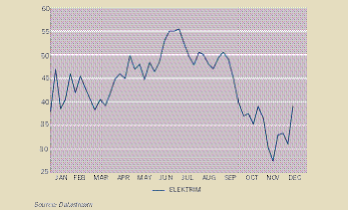 |
Related

Corporate banking
Americas’ transaction banking banker of the year 2026: Scotiabank’s Chad Wallace

Transaction Banking Awards

Corporate banking
Chile’s best sustainable deal 2026: Santander for Patagoniafresh (Empresas Iansa)
Transaction Banking Awards