Back at the beginning of this decade, the future looked promising for Bank Handlowy, the Polish foreign trade bank which then enjoyed a virtual monopoly in corporate banking. Now it is looking rather less so, thanks to the increased foreign competition and Handlowy’s failure to purchase any of the Polish banks including Bank Polska Kasa Opieki (Pekao) and Bank Zachodni which were recently up for sale.
According to Darius Gorski, analyst with Robert Fleming, the bank has lost more than half of its share of the corporate banking market since 1991. “In the early 1990s Handlowy was the flagship bank here with an 80% market share in corporate banking,” he says. “They now have approximately 23% and are losing this to rivals.”
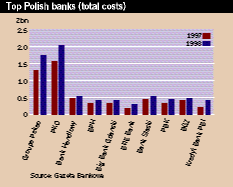
Gorski says that Handlowy also has the slowest-growing balance sheet in Poland. Figures calculated using Polish accounting standards show it has gross profits for 1998 of Z465 million ($119 million) representing a fall of 46% on the previous year, while costs have crept up by 14% over the same period to reach Z532 million.
Its situation used to be very different. Until 1989 the bank had an enviable monopoly in foreign trade financing. Its staff were members of a social élite, whose close links to the communist party meant they were allowed to learn foreign languages and travel abroad.
A decade of independence has changed all that. Foreign competitors such as Citibank, Bank of America and ING Barings have set up shop in Poland, where they frequently undercut Handlowy in corporate lending. Handlowy is now squaring up to foreign heavyweights as well as increasing competition from the fast-improving local banks such as BRE, Pekao and Big Bank Gdanski.
Citibank’s Albert May, director of corporate finance and capital markets in Warsaw says: “We still regard Handlowy as one of our largest competitors on the domestic capital markets and in investment banking. However things are already changing and BRE is becoming a lot better. Commerzbank is a strong equity shareholder and the bank has good management and strategy. Handlowy is already becoming noticeably less aggressive on the domestic debt syndication market.”
“We are concerned with our performance,” admits Artur Nieradko, member of the Handlowy management board, “and I am not expecting any growth in our share of corporate lending for the next two years because of our funding problems. Another problem was our Russian and other emerging market exposures…but you can’t plan for that.”
Handlowy’s management, headed by Cezary Stypulkowski, is aware that to remain competitive in an industry undergoing consolidation, the bank needs to make at least one big acquisition. Ideally, this will be one which gives access to a large retail network, something that Handlowy lacks at present. That may not sound like much to ask, but the goal is proving frustratingly elusive.
In May Handlowy learned it had not made the shortlist to buy Bank Zachodni, the last of nine regional banks to be privatized. Bank Zachodni is a retail-orientated bank based in Wroclaw, with a balance sheet total of Z8.2 billion. At the end of May, Allied Irish Banks, already owner of a 60% stake in Wielkopolski Bank Kredytowy, secured exclusive negotiating rights to buy the bank.
“Ideal” partner
A more serious disappointment occurred earlier this year. In Pekao, the country’s largest bank in terms of assets, Handlowy thought that it had found its ideal partner. But this January the Polish treasury refused even to put Bank Handlowy on to the shortlist of potential bidders for a 52% stake in the bank. That put an end to Handlowy’s cherished dream of combining the two institutions to create the largest universal bank on the Polish market and cast uncertainty over where the bank goes from here.
Last month news emerged that the treasury has chosen instead to enter into exclusive negotiations with a consortium of Unicredito of Italy and German insurance company Allianz. The final shortlist included Deutsche Bank and Citigroup.
Although Handlowy was angling for Pekao as far back as 1992, the latter was always an ambitious target, as some simple arithmetic reveals. A 52% stake in Pekao, based on the mid-May share price, is worth approximately Z3.5 billion). The estimated cost of the stake is expected to be significantly more than that, possibly as much as Z5 billion.
By contrast, Handlowy’s total market capitalization is only Z3 billion, less than half that of Pekao. Even if Handlowy had got the green light for the acquisition, it would have needed to embark on one of the largest ever capital-raisings in the region to pull it off.
 |
|
|
The loss of Pekao is a major blow to Bank Handlowy which had not been shy of publicizing its desire to acquire the bank. Stanislaw Berkieta, vice president responsible for strategic projects at Citibank in Poland says: “Cezary Stypulkowski [president of Bank Handlowy] knows exactly what he wants. He wants to head the number one bank in Poland and he would have achieved that with Pekao. He can only do it now through other acquisitions.” Seven years ago Handlowy’s management publicly informed the government that it wanted to get its hands on Pekao. The team was also convinced, in what with retrospect appears hubristic over-confidence, that it would get it. Nieradko says: “We thought that we were the best choice and so were confident of success.”
Nieradko explains: “The two institutions make a perfect match. Their weakness is our strength and vice versa. Pekao’s weakness is in the corporate sector and its lack of asset-placing capability. Our weakness is a lack of access to retail deposits which causes funding restrictions. A combination of the two banks would provide the best synergies possible for the banks, the shareholders and the country.”
Pekao takes a different view, as Igor Chalupec, member of the bank’s management board with responsibility for the privatization process, explains: “When we received the initial bids [in September] last year, four out of the five potential investors fulfilled the necessary criteria and one did not. That was clearly Bank Handlowy.”
The exact criteria used to assess the bidders remains uncertain. A spokesperson for the Polish treasury, which is handling the privatization, says: “There are hundreds of criteria. The potential investor has to have a very good image in the international markets, a good rating by a credit agency, up-to-date technology, a strong capital base, know-how, experience in all banking products and knowledge of restructuring and consolidation.”
Chalupec says: “We were lucky enough to be able to transfer our thinking to the treasury. They accepted most of our principles.”
The politician in charge of banking privatization is the controversial Alicja Kornasiewicz, deputy treasury minister, who has responsibility for the privatization of telecoms and banks, two of the most high profile sectors to be sold in Poland. Known for her drive and ruthlessness, Kornasiewicz is not forthcoming with the press. “Secrets, secrets, secrets. She is always like that,” says one of the ministry’s public relations staff.
Kornasiewicz declines to discuss details of the Pekao bids, but reveals that price was not the key factor. “Market rumour is that the price that Handlowy were prepared to pay was the second highest after Deutsche Bank,” says one local banker. “The Germans were prepared to pay a 30% premium over market price and Handlowy’s estimated offer was still significantly higher than the other three banks bidding.
In both cases politics had a part to play in the decision,” says one local banker, as is always the case when privatizing state-owned banks.
Handlowy’s Nieradko says: “The price would not have been a problem because we included in our bid letters from all three core shareholders [These are JP Morgan with 14.8% of the bank, Zurich Insurance with 5.2% and Swedbank also with 5%] saying that they would participate in any necessary capital-raising.”
Back-door attempt
Last June, Bank Handlowy proved how keen it was to get hold of Pekao by taking advantage of a legal loophole to buy 4.6% of the bank in an initial public offering of 15% of Pekao aimed at foreign and local private investors. The move may have backfired on Handlowy since by doing so, it angered both Pekao and the treasury.
Artur Szeski, deputy head of research at CDM Pekao Securities says: “If this desperate measure was aiming to show that they were really interested in the bank and should be taken seriously as a potential investor then it had the opposite effect. The treasury were very disappointed in Handlowy because of this.”
Nieradko puts forward a curious defence. He says: “We realized that there was a loophole in the prospectus allowing for the possibility of multiple orders in the two domestic tranches of the issue. We decided that the risk of someone else spotting this was too great so we decided to participate to the fullest extent possible by placing multiple orders. We wanted the full 15% because there was a clear intention to merge the banks.”
Nieradko also says that Handlowy warned the treasury of the technical problem ahead of the issue. “We had a reply from the treasury saying that the mechanics of the deal were perfect,” he says, although he declines to produce the letter.
The event still rankles at Pekao, where Chalupec says: “I have never encountered or heard of such behaviour by a serious investor. I think that Bank Handlowy wanted to prove that they were financially prepared to buy the bank and put a certain amount of pressure on the decision makers. Handlowy was disruptive at several stages of the sale process and I think that they wanted to spoil our privatization.”
Much of the acrimony between the two banks’ managements has taken place in the press rather than in person. Nieradko says: “We were the only bidder of the original five short-listed for the deal to be refused a meeting with the Pekao management. The official reason was that we were a competitor to Pekao on the Polish market but this could equally be said of the other four bidders.”
Chalupec confirms that the two management boards have not met to officially discuss the privatization. “We never officially met Handlowy’s management but what we learned unofficially was that they had prepared a very one-sided concept for the future of the banks. Essentially they had developed a strategy centred around the acquisition of a deposit-rich bank. Pekao would have solved their funding problem but left no room for the needs of our bank.”
Having failed in their main goal the next blow for Handlowy was its removal from the bidding process for an 80% stake in Bank Zachodni. But even if Handlowy had been successful, Nieradko concedes, a bank which is only a fifth the size of Pekao would not have ended Handlowy’s uncertainties. He says: “Zachodni would not have solved the structural problems of Handlowy but the supervisory board had already taken the decision last year to try and acquire both it and Pekao. You win some, you lose some.”
Handlowy has yet to win anything. Easier acquisition targets might be some of the smaller banks in Poland but Nieradko does not seem interested: “People ask me why we are not chasing after some of the smaller banks in Poland. There are about 20 of these but even their combined assets would be smaller than those of Zachodni, and that is a small regional bank.”
So what can Handlowy do now? One hope may lie in the sale of the state savings bank, PKO. Berkieta says: “Anyone who wants to be a major player in the Polish banking market would be silly to exclude a bank like that from its acquisition plans.”
Handlowy and PKO at least enjoy cordial relations and they have an existing joint pension fund initiative. Jacek Dzierwa, Polish analyst at Salomon Smith Barney says: “Everyone realizes that they [Handlowy] now have a problem. I advised them to wait and buy PKO. This bank, with its large retail deposits, would be very well suited to them.” Robert Fleming’s Gorski agrees that the two would make a good match: “A merger between Handlowy and PKO is a sellable story,” he says. “They would not have a problem arranging the funding for this acquisition.”
But many obstacles remain before the bank can be privatized. Critical is the removal of PKO’s accumulation of non-performing housing loans. Another is that the bank must be converted to a joint stock company before it can be sold. Most analysts estimate that it will take at least two years before the bank is ready to be privatized. Marek Juras, analyst at Erste Securities in Warsaw says, “I would be very surprised if Handlowy did not have a strategic partner by then and this would change everything.”
Gorski says: “Another problem in delaying the privatization is that PKO is already losing its market share in retail banking. It is a state-owned bank that is not restructuring. The market is becoming increasingly competitive and consumers increasingly demanding.”
Nieradko remains non-committal on the topic of PKO. “We may be interested but we will have to wait and see what exactly is being offered for sale.
The government is in the process of sorting out the old housing loans and this is a massive problem that is going to cost billions of zloty to sort out. Put it this way we are not altering any plans in waiting for the privatization of PKO. There are just too many question marks surrounding this bank.” When pressed to describe alternative options Nieradko says: “Well, ideally we should be buying Pekao right now.”
Last chance for a flagship
News that may not be music to Handlowy’s ears is that Kornasiewicz is determined to sell PKO during her term in office. She says: “The treasury will sell this bank before 2001. We are currently working on a comprehensive plan for its privatization with the assistance of Schroders and Arthur Andersen. This should be prepared by the end of the year.”
Further worrying news for Handlowy is that Kornasiewicz is not convinced that the bank should be sold to a strategic investor at all. “I have not decided on the form that this sale will take. It is not necessarily going to be to a strategic investor. It could be done well via a large IPO [initial public offering].”
At BRE Bank, president Wojciech Kostrzewa says Handlowy should be allowed to acquire PKO. He says: “PKO offers the government the last chance to create a national flagship bank, and one without a strategic foreign shareholder. Even as a competitor of Handlowy I can see the rationale for the economy to have one major bank not dominated by foreigners.”
He adds: “If Handlowy do not get PKO they have a real problem on their hands.”
Handlowy’s immediate solution to its cripplingly expensive interbank funding one analyst estimates the bank borrows Z6 billion a year – appears to lie in Handlobank, the retail arm of the bank which set up its first outlet at the end of last year. To date the bank has established six outlets. Nieradko says that this retail operation has always been part of the bank’s long-term strategy.
But failure to acquire Pekao has lent added urgency to the scheme. After failing to make the shortlist the bank has increased the number of outlets it plans to set up from 60 in four years to 75 in two years. The cost of the set-up is estimated to remain the same, in the region of between $60 million and $70 million. Nieradko says: “So far we have had twice the number of customers joining us that we expected but half the volume of deposits. We need time and customers.”
The latter are two things in short supply in Polish retail banking. Says Gorski: “If you want to win market share in retail banking you have to do it soon. Lots of banks are expanding aggressively into this market.” Juras says: “Handlowy has ambitious plans and wants 4% of the retail market. I will be surprised if they manage it. You can’t steal clients without an efficient network.”
The concept is high-technology, including products such as telephone banking and 24-hour internet access. Citibank’s Berkieta says: “This banking concept is about cutting down on the bricks and mortar and introducing very modern products.”
He reports that Citibank is planning to open up to 30 outlets in the next three years. Austrian rival Raiffeisen has recently announced plans to spend $200 million on expanding into the retail market.
BIG Bank Gdanski, the splendidly named Gdansk-based universal bank with assets of approximately Z14 billion, has set up a retail arm known as Millennium Bank. This has the highest reproduction rate of outlets, with 50 already in existence and a further 150 planned in the next 18 months. BRE has just unveiled the name of its retail operation, Multibank, which is due to be launched later this year or early next.
BRE’s Kostrzewa declines to offer further details saying only: “The level of investment will not be significantly lower than our competitors. Our market research shows that there is still room in the retail market and although we are entering late we hope that it will not be too late. In some respects it will be good for the front-runners to start the education process of the consumers.”
BRE Bank, 49%-owned by German Commerzbank, is embroiled in what looks set to be the first-ever market-driven bank consolidation battle in the Polish market. The target is BIG Bank Gdanski and both BRE and Deutsche Bank have requested permission from the central bank to acquire up to 25% in the bank.
Both banks currently hold approximately 10% in BIG Bank Gdanski. In a crucial development at the bank’s extraordinary general meeting in mid-May shareholders voted to allow the bank’s management to sell its 24% share in the bank. At the time of going to press the battle lines remain drawn.
There are a number of implications of this for Bank Handlowy. Analysts estimate that if BRE is successful in its bid for BIG Bank Gdanski then the combination of the two banks would create the third largest bank in Poland in terms of assets after Pekao and PKO. “This would clearly be a bid for the big time and provide some unpleasant competition for Handlowy and many other banks,” says one local analyst.
The other significance is pin-pointed by Chalupec. “One conclusion to be drawn from this situation is that the fragile shareholder structure of BIG Bank Gdanski did not prevent it from being the object of a hostile takeover battle,” he says.
At present Handlowy, BIG Bank Gdanski and Kredyt Bank remain among the few banks in Poland without a single majority foreign shareholder. Gorski says: “This is one disadvantage for Bank Handlowy and may have played a part in the treasury dismissing them from the Pekao bid.” Nieradko says: “We are the best, so we do not need a majority foreign shareholder.”
Surprise stock transfer
Whether they feel the need for one or not, at the beginning of this year Handlowy became more vulnerable to a takeover following the treasury’s surprise transfer of 22.5 million of Handlowy convertible bonds (equal to 22.4% of the bank) to the state-owned insurance company Powszechny Zaklad Ubezpieczen (PZU).
Juras says: “The official explanation is that the bonds were transferred in order to recapitalize the company in preparation for its privatization.” Nieradko says he has heard the official explanation but is unhappy with the conduct of the treasury. The bank claims that it was given no prior warning of the transaction. He says: “It is courtesy if nothing else to inform the company and their shareholders of a move like this.”
Evidently Kornasiewicz does not agree. “Why should I have to announce to the world what I am planning to do with my shares… They [PZU] can keep them, convert them or sell them. They are free to make the best use of them that they can.” A PZU spokesperson says: “We are a passive investor in Handlowy. I am not prepared to say anything more than that. What I can confirm is that the treasury is now accelerating our privatization and 30% will be sold to a strategic investor.”
It is unclear how useful these bonds will be to a potential strategic investor. A single investor is restricted to converting 1.12 million shares per year but crucially there is no limit on the total number of bonds that can be converted in only one year. The other factor is that the three core shareholders in Handlowy will, from June next year, be free to sell their shares in the bank, which together amount to 24%. BRE’s Kostrzewa says: “The PZU shares could have a lot of value for a potential strategic investor. I think that there will be some fantasies arising over this next year.”
Chalupec says: “I think that this transfer of convertible bonds into PZU has changed the landscape considerably. PZU has suddenly become an important player in the scramble of bank consolidation.”
Wladyslaw Bartoszewski, director of JP Morgan’s representative office in Warsaw says. “In the short term there are no plans for Morgan Capital to get out of Handlowy and in the longer term who knows?” For now, Bartoszewski emphasises JP Morgan’s commitment to the bank. “Our $100 million investment into Handlowy for the 14.8% stake represents the largest single investment by the bank outside of the US market.
Bartoszewski also quashes suggestions that Handlowy may become the object of a hostile takeover. “Handlowy is normally the predator not the hunted. If the three core shareholders do not want Handlowy to be taken over then it would be hell to do it. Hostile takeovers are very difficult in Poland and there are lots of ways to stop it if the shareholders, like us, have deep pockets.”
Other analysts dismiss notions of a takeover battle on different grounds. Says Robert Fleming’s Gorski: “Why would a foreign bank be interested in buying Handlowy? It is easy enough to establish a corporate banking arm in the country. It is establishing retail that is a hell of a job.” Hell of a job or not, Handlowy badly needs a retail deposit base to balance and grow its traditional banking business.
It is a dangerous time to have stagnant growth prospects in any part of the Polish banking market, with banks gobbling up market share as well as each other with almost equal ferocity. Gorski says: “It is difficult to say where Polish banking is going. It is a bit like backing a horse.”
Handlowy has stumbled at the first and second furlong and the odds are stacking up against it. But it’s still in the race.