Europe’s new currency might have had a stinking debut on the foreign exchange markets, falling by nearly 10% against the dollar in the first two months, but participants in the Eurobond market couldn’t care less. For Eurobond market firms, life has rarely been sweeter. The launch of the euro has brought in its wake a bull market: a boom in new issues and an opening up of the market both to new borrowers and new investors.
In the first two months of this year, the euro rose to prominence, accounting for 49% of international market new issues, compared with 41% for the Emu 11 currencies during 1998. Meanwhile dollar deals accounted for 35% of new issues in the first two months, compared with 38% in 1998. There were some €15 billion of corporate deals in the first two months of 1999, compared with under €4 billion in the same period in 1998. And deals are getting larger. Almost 23% of new issues in the first two months were for amounts of €2billion equivalent or more, compared with 7% in 1997. “Dm1 billion [$550 million] deals used to be considered large. Now €1 billion deals are run of the mill. It just has the feeling of being a bigger, more developed market,” says Guillaume Bonpun, head of fixed income syndication at Dresdner Kleinwort Benson, summing up a confident mood.
Confronted by record low yields on government bonds, European investors have been buying corporate bonds with unprecedented enthusiasm. Not only are deals bigger than ever before, they are generally selling well and showing decent aftermarket performance. Many issues have been priced inside initial price-talk and then increased in size. Market practice for new issues is evolving away from hard underwriting towards the sort of techniques used in the primary equity market, such as book-building and price-discovery. That makes deals less risky for arrangers. Even more enticing: in a new issue market that now breaks down broadly into a dollar bloc and a euro bloc, the leading positions in the arranger bulge bracket are, for the first time following more than half a decade of domination by US firms, up for grabs.
Some of this excitement may ultimately prove short-lived. Following the emerging-market and Long-Term Credit Management crisis last year, spreads on credit bonds widened far beyond fair value. It has been easy to sell credit bonds so far this year, when spreads have had so much room to tighten and European institutional investors have been pouring into the market new cash, flowing from government bond redemptions and interest payments. Spreads on single A rated corporate Eurobonds were around 35 basis points last June. They rose to around 60bp last October and were back to 40bp by this February. Spreads for double A rated financial issuers were also around 35bp last June, peaked at 95bp in October and had come in to under 60bp this February.
And there has been precious little competition for corporate issuers so far this year from that other traditional source of credit spread: emerging markets. “Russia broke the taboo on defaulting: something we haven’t seen for many years,” says Cyrus Ardalan, global head of fixed income marketing at Paribas, “and that has had an important psychological impact. For essentially emerged countries, the markets are receptive. Hungary is trading at 87bp which is 10bp tighter than we thought investors would accept. But many other emerging-market countries are simply beyond the pale. Ukraine, to take an extreme is above 5,000bp over.” The toughest deals this year have been emerging-market issues: BBB- rated Colombia abandoned its attempts to sell a deal of between €400 million and €500 million after failing to attract much demand on price talk of a 675bp spread; BB+ rated Philippines cut its hoped for €500 million 10-year deal to a €350 million five-year deal, and having hoped to price at a spread of under 400bp, eventually paid 425bp. Croatia did a little better, increasing a €250 million five-year deal to eventually launch a €300 seven-year deal at 375bp over Bunds. But the borrower nearly overreached itself. Market sources say lead manager Credit Suisse First Boston had to hold a large portion of the deal and when it eventually sold, the spread widened. Turkey provided a rare bright spot with a Dm750 million four-year deal at 630bp over Bunds sold to German retail and increased from Dm500 million.
European investors have turned away from emerging-market sovereigns in their search for yield towards single A corporates. “Certain Dutch funds which one year ago wouldn’t touch anything but government paper, will now go as low as triple B,” says Andrew Pisker, global head of bonds at Paribas. “But it has to be for something that is analyzable for them and that offers transparent accounting, clear bankruptcy laws and no convertibility risk.” For corporate borrowers this has opened up a world of possibilities. “Deals are getting done for borrowers that couldn’t access this market last year and certainly not in large size,” says Simon Meadows, managing director at CSFB. He mentions a €300 million 10-year deal for Principal Financial, the fourth-largest US insurer, but a little known credit in Europe, which CSFB brought to market in January. “We sold one-third of that deal to French investors. There is no way that could have been done two months earlier.”
By mid-March, the first signs were appearing that demand for such corporate bonds, which easily outstripped supply in January and February, was beginning to be satisfied. Spreads on keynote deals: a €500 million 10-year deal from Telefónica de España and a €1 billion five-year issue from Fiat, both widened after launch. So what happens when all the new cash has been put to work and credit spreads have returned to normal levels? Is it possible to detect amid the short-term exuberance what are the significant long-term structural changes in the Eurobond market? And what are the key ingredients for arrangers to succeed in this fast-changing environment?
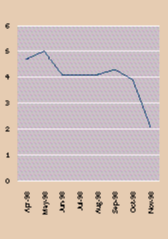 |
| Source: Capital Data Bondware |
Most bond market participants are pushing such thoughts to the back of their minds and just enjoying the good times. Following the horrors of last year’s third quarter, the Eurobond market has had a real bull-market feel to it in the first three months of this year. “Distribution has been broad and it has all been to real-money accounts,” says Eamonn McConnell, head of debt syndicate at Deutsche Bank in London “It is core European investors, allocating new money to the international bond markets, not just switching between issues.” He adds: “In the euro-currency sector, sales people are hungry for paper because they know they can sell it. As a result, traders are positive on markets.” And that translates to great opportunities for borrowers. “Investors want large size for liquidity and they also want corporate bonds for spread. So when deals offer both – like Alcatel, BAT, Olivetti, – investors are all over them,” says McConnell. “We are having real battles over allocations, because investors are having to be scaled back. That’s a quality problem to have.” Last year’s favourite bond market theory – that European investors would respond to the single currency by buying credit as never before – has become this year’s reality. But the scale and the speed at which institutions, hitherto restricted to buying domestic government debt, have turned to international corporate bonds has surprised even experienced traders and salesmen. Mark Watson, head of European fixed income syndicate at Salomon Smith Barney, recalls selling a €300 million 10-year deal for Travelers Insurance, not a particularly well known credit in Europe, in late February. “For a day or two it was a little slow, then suddenly the orders starting coming in thick and fast. Towards the end, a northern European insurance company, put in a single order for €30 million of bonds.” Two things surprised Watson: the size of the order – until this year dealers regarded single orders of €5 million to €10 million equivalent as big tickets – and the identity of the buyer. Salomon Smith Barney had done very little business with this investor, which, though large, had until this year mainly bought domestic debt. Now it is a valued customer, having done several large follow-up trades and switches.
Other firms report similar experiences. “Some investors, following private meetings with borrowers during roadshows, if they are convinced by the credit story, will put in orders for €100 million of bonds at a time,” says Bonpun at Dresdner Kleinwort Benson.
Just as large, once-domestic investors are assuming new-found importance for sales desks, so new corporate issuers are all the fashion for origination teams. In early February, Dresdner Kleinwort Benson sold a €1.7 billion 10-year bond for BAT International Finance, offering a 125bp spread over Bunds. That huge deal has shown the way for corporate borrowers in Europe. Other well-known corporate names have followed: Elf, Carrefour, Alcatel, Deutsche Telecom, KPN, Fiat, Repsol, Telefónica. It seems that certain key European bond investors, such as German insurance companies, are keen to buy bonds issued by companies whose stocks are included in the new euro-zone large-cap equity indices, such as the DJ Stoxx Euro 50. Equity analysts at those investing institutions are already researching these companies and conducting some due diligence as a basis for bond fund managers to buy their debt. Fund managers are drawn to benchmark bond issues for such leading corporate names, typically at 10-years maturity, as building blocks for credit portfolios that broadly mimic the same institutions’ new euro-zone equity portfolios. European companies that used to raise most of their finance from banks are plunging into the new corporate bond market, raising longer-term debt with easier covenants.
It’s not just the continent’s leading corporates that are embracing the capital markets. Almost as significant as the BAT transaction, according to many bankers, is a very different deal led by Dresdner Kleinwort Benson in March: a €100 million seven-year bond for Claas. This is a German tractor-maker, still privately owned by three branches of the Claas family which founded it before World War I. It has no public equity listing, never mind a debt rating from any of the major agencies.
The entry of a financially conservative, family-owned German manufacturer into the bond markets may be a pointer of more deals to come. “It’s quite visionary for Claas,” says Bonpun. “It is trying to position itself in the European capital markets and acknowledging that, as a leading European company in its field, it needs to meet and become known by European investors.”
Appetite for credit
Meanwhile, the old frequent borrowers, the mainstays of the Eurobond market for many years that occupied the ground just below sovereign issuers – the European Investment Bank, KfW, Cades, the German Landesbanks – no longer dominate the new-issue market. That’s partly because tight swap spreads have made it difficult for such arbitrage-driven borrowers to meet their sub-Libor floating rate funding targets. Partly it is because they no longer quite fit the bill for European investors. “Last year the gravitational point on the credit rating spectrum for European investors was from AA+ to AA-,” says Niall Cameron, director at Merrill Lynch. “Now it is from AA- down to A+. That’s an amazing turnround in appetite for credit. The main access point for issuers is between Libor plus 25bp to Libor plus 60bp. For investors which have decided they want yield, there’s not much point buying at OATs plus 5bp.”
Few banks are shedding tears at this change. Most think they can make more money from bringing new corporate issuers. These borrowers tend to price deals generously so as to ensure success with debut euro offerings; they go on roadshows and pre-market deals; they allow for price discovery. Top-rated frequent issuers, by contrast, have traditionally expected banks to underwrite tightly priced deals. So it was with mixed feelings that one leading Eurobond firm reacted to being left out of the top dealer group on the EIB’s new euro area reference notes (Earns) programme. While finding room within its top 10 primary dealers for IMI and Santander, EIB has left out some of the most active bookrunners from the group of banks that will now regularly share lead management of its benchmark deals. “In the past we’ve led some very big deals for the EIB,” says one head of syndicate. “What the EIB are saying now is that we’ll have to do a massive amount of work just to be given the chance to compete in a beauty contest to do a deal for them in one year’s time. Is it worth the effort of pursuing them? I’d rather go out and look for the next single-A corporate. It’s more interesting and there’s more money in it.”
“The days when frequent borrowers could snap their fingers and have 15 banks biting their hands off for a deal are over,” says another banker.
Pricing discrepancies
While most bond firms agree that the key structural change in the market has been the growth of corporate issues, firms agree about little else: pricing for example. There is precious little common ground on what level different issuers should be priced at. When CSFB and Paribas won the mandate for an €500 million 10-year deal for BBB rated state-owned Public Power Corp of Greece in February it provided another example of the new openness of the bond markets to previously unfamiliar credits. “Public Power Corp had mainly relied on syndicated loans and we had done one five-year floating rate note for them last year, mainly sold to Italian banks,” recalls Meadows at CSFB. Greek assets were in demand as that country shaped up as every traders’ favourite convergence play and the leads priced the bonds at 87bp over Bunds. “What surprised us was the wide discrepancy on bids for that deal. Some firms had bid as high as 110bp over,” adds Jonathan Fox, managing director at CSFB.
Says Cameron at Merrill: “There simply aren’t enough credit analysts at the banks and investing institutions. Also corporate borrowers have very few comparable securities to price off. So borrowers are being given dramatically different suggestions on price.”
One reason why there remains such uncertainty over pricing is that a truly efficient single-currency capital market is still some way off. European companies can choose two routes when pricing deals: they can target placement to domestic investors that are familiar with the name and may well buy bonds at tighter levels, or they can try to achieve large-size deals and broad placement with institutions across Europe, a tactic that usually requires borrowers to pay up.
“Local markets have their own unique views on local credits,” says Michael Lindsay, head of European syndicate at JP Morgan, “and so for the moment bonds of telecom companies, as an example, aren’t really being priced in terms of relative value to each other, because they are often being sold as domestic credits into domestic markets. Firms and issuers have to be careful with certain credits and certain types and sizes of deals. The market isn’t efficient or sophisticated enough for firms to say precisely that certain bonds should trade at an exact level and be confident positioning them at 5bp cheaper than that. If you price bonds to the domestic bid, the danger is, especially if domestic buyers are full up on a name, that the next bid outside the home market might be 15bp away.”
This raises dangers for banks, at a time when they are all keenly competing for business. Although firms are generally more reluctant than in the past to buy whole deals, and many corporates when seeking broad European placement have roadshowed deals and book-built orders at market clearing prices, some mandates are still awarded on banks’ willingness to underwrite at a competitive price. There have been deals recently where banks are certain that bonds have been mispriced. “Short dated FRNs are becoming a pure league table business – those with the biggest cheque books win consistently,” says Michael Weston, head of debt capital markets in Europe at Morgan Stanley. “This is the year of the bulge bracket in Europe. But that coinciding with the introduction of the euro and rapid consolidation means that competition is fierce to the point of being suicidal.”
Though some firms may be underpricing to establish market share, there is another reason that deals are being mispriced. “Institutional investors in Europe are still price-takers, not price-makers,” says Roman Schmidt, global head of debt syndicate at Barclays Capital. “In the US market a lead manager can ask an account like Pimco at what level it will buy a credit and get a precise answer. If Pimco says it will buy a credit at 150bp over, the lead manager has his pricing. If he prices the deal two days later at 150bp it will sell. It probably won’t sell at 149bp. But in Europe, institutional investors cannot tell you with confidence that Carrefour should come at 41bp. Investors want to see the research, go to the roadshows, meet management and above all get a sense of the momentum behind a deal. Often the success of deals comes down to the confidence of the lead managers and the sense of momentum.”
Another layer of complexity in pricing deals is adding to the confusion for some market participants: that is choosing which benchmark government bond to price deals off. Some borrowers price off French OATs, some off Bunds. Barclays Capital takes care to express pricing in spreads both to OATs and Bunds. But Belgian investors are used to comparing spreads to OLOs and Italian investors to BTPs. “Not only is it hard to price credit correctly, but with no government curve out there, there is no consensus on which securities to price off,” says Charles Berman, head of European debt capital markets at Salomon Smith Barney.
Floating-rate calculations
Firms are increasingly looking at the interest-rate swap curve, deducting the absolute fixed rate that borrowers are paying – the benchmark government bond rate plus the spread – from the prevailing fixed rate that swaps dealers will pay in return for Euribor, so calculating a floating-rate margin. Increasingly fixed-rate bonds are being compared on the basis of their after-swap margin to Euribor. Thus Telefónica’s €500 million deal may look expensive at Euribor plus 18bp, when compared with other European telecom bonds trading at more than 20bp over Euribor.
Looking at bonds on a floating-rate basis, it is clear that DaimlerChrysler scored a success with its €600 million five year deal through ABN Amro and Deutsche Bank. The 33bp spread over Bobls, translates to Euribor plus 7bp. That’s particularly impressive, given that the company is rated a A1/A+ and Deutsche Bank paid Euribor plus 6.25bp on a €250 million FRN sold in the same week. Deutsche Bank is rated AA+. The success of the DaimlerChrysler deal, which was increased from €300 million, partly reflects strong demand for the company’s name in Germany.
The advantage of using the swap curve is that it is highly liquid and efficient. There is a tightly traded deep market in the fixed rates that swap dealers will pay in exchange for receiving Euribor. And dealers themselves increasingly use the swap curve for risk-management purposes, hedging the interest rate risk on fixed-rate bond underwriting positions by paying fixed and receiving Euribor. Borrowers are paying more attention to their rates to Euribor and less to their spread to government benchmarks. Fox says: “Take a top-rated triple A borrower, which over time expects to fund at Euribor less 15bp. It doesn’t really matter whether that translates back to a fixed-rate spread of 4bp over government bonds or 40bp over or 400bp over. What matters to the borrower is that its value remains Euribor less 15bp.”
It remains to be seen whether Euromarket borrowers will continue to book-build deals and accept market-led pricing. For the moment there is almost a traffic jam of roadshows across Europe with no coordinated scheduling of issuer presentations. “There is a battle for attention. There may be as many as two or three roadshows a day in Edinburgh,” says Schmidt at Barclays Capital. Many banks hope this trend will persist after the first rush of debut euro benchmark deals is completed. Banks themselves remain traumatized by the losses they suffered on bond positions last year and will embrace almost any market development that reduces their risk. “Most people recognize that is the right way to do business,” says Cameron. “It’s more transparent: it creates a more stable market for investors and borrowers should benefit from that.”
Berman at Salomon Smith Barney predicts: “The next change in market practice will be broader acceptance of pot [central order book] systems and name give-up. Firms will argue against name give-up on the grounds that the investor base is fragmented and firms have proprietary accounts. But the truth is that the pot system provides a more orderly way of allocating bonds and greater transparency for all concerned on who is buying. Protection of proprietary accounts is often cited as an argument against the pot, but quite often it is resisted because it exposes a lack of real distribution.” Berman is right. Many firms do dislike the idea of giving up the names of investors to a lead bookrunner, submitting orders to a central pot and hoping to be rewarded with commission allocations once a deal is closed. It’s a debate that pits the European firms against the Americans. “The problem with the pot system is that within about two months it will be totally abused,” says Schmidt. “Lead managers will take the pot lists and start calling accounts they had no previous relationship with and let it be known that investors subscribing for bonds through the lead manager will get a favourable allocation.”
Still underwriting… cautiously
Although the European firms are attracted to the lower risks of fully negotiated deals, they have not abandoned the idea of underwriting. “A deal doesn’t have to be all pre-placed for us to take it on,” says Pisker at Paribas. “We will underwrite bonds, at a price.” Competitors suggest that Deutsche Bank, which had led 140 deals by the end of March, compared with roughly 75 each for the other top five underwriters this year, may not have sold every single bond. ABN Amro has also been aggressive.
The attitude of lead managers towards underwriting deals may vary, depending on whether they are targeted at retail buyers or institutional investors. Meadows says that CSFB is mindful both of the number and size of deals it takes on, in relation to market demand. “When there is strong Swiss retail demand for euros or dollars, we make sure that we have one or two deals that we have led available to sell into that. What we won’t do is underwrite three or four similar retail deals at the same time.” Many recent corporate deals have been sold predominantly to institutions placing large orders. But if the lead does not sell out of bonds on day one in such deals, it will almost certainly face difficulties in clearing its books. “Everyone will know that you are stuck with those securities and you will have to sell bonds at cheaper levels to get deals completed, absent any retail bid,” says Meadows. The ability of lead managers to judge the market price at which significant new demand will appear for bonds on their books is crucial to their risk management. “If a deal doesn’t work at the launch price, you have to know the next level at which there will be buyers, be it 5bp cheaper or 15bp cheaper,” says Meadows. “You have to have a clear idea of that.”
Competition in the bond market has reached a new intensity. The Europeans know that the launch of the euro is their last chance to establish themselves as leading international investment banks. If they fail, there’s no home market in francs, Deutschmarks or guilders to fall back on. So they are keen to press their advantage. “The important thing for us is that we’ve been able also to sell bonds to second- and third-tier investors across Europe,” claims McConnell at Deutsche Bank. “It’s those investors that are driving issues, not just the top 100 accounts which everybody knows. And firms that don’t have penetration like that will end up on the periphery of the European bond markets, rather like some European firms in the yankee sector of the US market.”
Surprise leaders
In the first 75 days of 1999, leadership in the bookrunner rankings for international bonds changed hands between two surprise leaders: Deutsche Bank and Salomon Smith Barney. Its competitors have been quick to point out that, before the much trumpeted deal for AT&T, Salomon owed 50% of its volume to two American issuers: Federal Home Loan Banks and Freddie Mac. Salomon has sole-led two short-dated $3 billion deals for Federal Home Loan Banks. Its competitors argue that these and other agency dollar global deals are predominantly sold into the US and only dressed up as global deals for league-table advantage. Berman at Salomon responds: “Investors were very nervous about US interest rates at that time; they wanted defensive short-dated instruments and we had some very big lead orders out of Asia. Those deals grew out of real secondary demand that we saw inside and outside the US.” But he admits: “From a league-table point of view, it was a dream.”
Certainly, federal agencies with a combined annual borrowing programme of some $120 billion have a massive impact on the league tables. For the moment, that borrowing is almost entirely in dollars and split between the top six US firms, giving them a $20 billion start in the league table race. The federal agencies swap their fixed-rate borrowings into floating rate. Although absolute rates are lower in euros than in dollars, the swap market is not conducive to the agencies borrowing in euros, although they have all looked at the market and will eventually want to broaden their investor base. The fixed rates that swap dealers will pay in return for Euribor are very close to benchmark government bond yields, leaving no room to swap out of fixed-rate liabilities at sub Euribor rates. For that to change, government bond spreads will have to fall, but that is not likely when European investors are more keen on buying corporate debt than government debt.
The US firms have their own gripes about the league tables. They dislike the inclusion of more and more jumbo Pfandbrief deals, a European counterweight to the US firms’ dominance of the federal agency borrowers. Also the American are frustrated that borrowers of euros have flocked to European banks. “We feel very strongly that we should be getting more euro deals and it’s frustrating to see them being given to European banks which don’t know how to price and handle credit,” says the head of syndicate at one US firm. “We had one European bank recently selling bonds at Euribor plus 55bp to 60bp to asset swappers. That was far too cheap and there were any number of real-money accounts which would have bought the credit. But the lead didn’t know how to sell it and didn’t feel comfortable holding it.”
It remains to be seen how comfortable investors will be holding credit. So far, it has been an easy ride. Credit spreads widened so far last year that there has been ample room for credit spread-tightening. One worrying development is the number of M&A dealmakers now scouring the continent suggesting leveraged acquisitions in the wake of Olivetti’s audacious bid for Telecom Italia. It’s a fair bet that while investors have pored over well-prepared credit research analyzing cashflow, interest cover and debt-to-operating-earnings ratios for companies selling new euro bonds, few buyers or banks have considered event risk – the sudden change in a company’s capital structure or operating business often associated with mergers or acquisitions. In recent years, event risk has generally been positive. Big companies have taken over smaller companies, improving the credit rating of the smaller company’s bonds without hurting the acquirer’s rating.
Piecemeal-purchase risk
We will be hearing more about event risk, if large leveraged takeovers become popular in Europe. The risk for European investors is that they have been building credit portfolios piecemeal. Given the dearth of investments to chose from, investors have looked at new issues one at a time, reading the credit research, gaining approvals and then buying large tickets of individual deals. The obvious danger is that investors might find themselves holding a few large positions in bonds all of which widen, because of event risk.
Sensing this fear of the unknown among European investors, many of whom are still mindful of emerging market losses last year, Warburg Dillon Read has been adapting its sales effort towards a portfolio advisory approach. It has come up with a database tool for optimizing credit portfolios. The idea is to take account of an institution’s return goals, its investment criteria – what bonds it can and cannot buy – and then to advise it on the creation of an optimum portfolio that will meet those returns in a risk-controlled way, for example by achieving a proper diversity while eliminating bonds that may meet an institution’s investment criteria but have shown excessive historical volatility.
“Institutional pension funds and insurance companies in Europe now having to move into the credit sector are showing impressive openness in working with institutions like ourselves and accepting the need to work together on developing credit models,” says Kevin Regan, head of rates distribution for Europe at WDR. They also want a credible, systematized investment process. That won’t necessarily save them if credit spreads widen because of a systemic crisis, but at least it might prove to the boards and trustees to whom fund managers are accountable that they made initial investment decisions in a sensible way.
Regan hopes that WDR’s product, trademarked Credit Delta, and starting from a huge database of available corporate bonds, is an improvement on existing products. “Other credit management tools take a great account of ratings,” says Regan. “However rating agencies often disagree about the appropriate rating for certain credits. And in the market you can have a triple B rated corporate and a triple B rated emerging-market sovereign whose bonds trade 800bp apart.” WDR has been testing the system with large institutional investors in Germany, the Netherlands, France and the UK. Regan hopes, if the system become accepted, it may be the precursor to an internet-based trading system. It’s not a service the firm intends to give away freely. “We will expect from clients business in return and it is yet to be determined whether this is fee advisory or trade volume.”
Fund managers themselves are being equally hard-headed. Many have been calling in Eurobond firms, going through their research and sales coverage, quality of trade execution and, in some cases, pruning counterparty lists. It’s smart when competing for client money, for fund managers to show they are wringing the best service from firms.
But to some bankers, while demand for corporate bonds remains strong, covering the potential issuers is a bigger challenge than covering the buyers. “There are more investors than there are mandates,” says Pisker. “We could do €1 billion a day of single A rated corporates for weeks at a time. It’s a question of finding the issuers.”
Historically a small number of relationship managers covered the frequent borrowers that provided most of the Euromarket’s supply of new issues. Corporates don’t borrow as frequently and require a different kind of coverage. Again European banks hope this will work to their advantage and that their corporate loan officers, who used to negotiate bank credits with European companies, can help in originating deals for their capital markets desks – bank borrowing costs have risen to the point where they cannot lend in great volume to corporates – and provide a starting point for credit research to sell to bond investors. Banks like Deutsche Bank are trying to politely tell long-standing corporate customers that the bank won’t be rolling over credit lines, while at the same time introducing their capital markets teams.
While Eurobond firms are flushed with excitement at the emergence of a thriving new corporate bond market, they are working under extreme pressure. Bank bosses want market share, but won’t tolerate the kinds of losses suffered last year. Serving new borrowers and new investors is quite a challenge. Firms that flunk it could be out of the race for good by the end of the year. It’s always been a tough, competitive business. But there’s never been so much at stake.


