 |
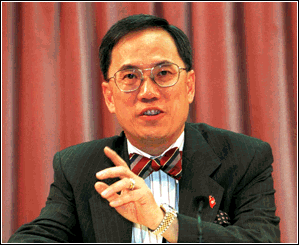
| Tsang: greater transparency among governments should be matched by the hedge funds |
Hong Kong withstood handover from Britain to the UK with scarcely a tremor, withstood the onset of the Asian financial crisis in 1997 far better than its neighbours, has shrugged off plunging property prices despite a disproportionate amount of its wealth and economic activity being tied to property, and today remains a world-class city despite pollution from mainland China that, were it any other regional centre, might be sufficient to dissuade companies and employees from locating to it. Two things might destroy Hong Kong: an increase in the tax rate or a collapse of the Hong Kong dollar. As an article of faith Hong Kong has maintained full convertibility of its currency while pegging the exchange rate to the dollar.
Tsang acted in extraordinary circumstances when he intervened in the equity market. A popular story in Hong Kong has it that his office had received intelligence that speculators were spreading rumours designed to cause runs on the local banks. There was a sense that real civil disorder might follow.
Since the crisis, the Hong Kong stock market has appreciated massively making Tsang look like one of the smartest investors in Asia, a label that makes him squirm. He has looked for ways to trade out of the position, the first being the tracker fund, an index fund of Hang Seng constituent stock owned by the government, which was about to be priced days after Euromoney met Tsang. It was massively oversubscribed, with HK$33 billion ($4.25 billion) of orders for a HK$10 billion offer. Perhaps wavering Hong Kong investors had their confidence boosted by announcement of news that Disney would open a theme park in Hong Kong, its third outside the US after Tokyo and Paris. Tsang was a mastermind behind the Disney deal, which requires a huge investment by the Hong Kong government.
The Hong Kong government will own a 57% stake in the joint-venture theme park company and Disney 43%. The government will inject HK$3.25 billion in equity, HK$6.1 billion in loans to the joint-venture company and spend HK$13.6 billion on infrastructure development and site formation. Disney, which didn’t invest any equity in Tokyo, will inject HK$2.45 billion of equity in Hong Kong. The joint venture will raise HK$2.3 billion in commercial loans. It looks as if Disney got the best of that negotiation, but the Hong Kong government claims that there will be a huge positive impact on the local economy far beyond the park itself.
The government hopes to attract three million extra tourists a year to Hong Kong and projects a net present value of HK$148 billion in economic benefits spread over 40 years.
News of the Disney deal broke while Tsang was in the UK and he was up in the early hours of the morning for a video press conference beamed back to Hong Kong. Tsang spoke to Euromoney in his suite at the Mandarin Oriental in Knightsbridge still wearing a bow tie – his trademark – covered in Donald Ducks. He apologized for being late. He had just come from a meeting with UK chancellor Gordon Brown, having earlier lunched with Bank of England governor Eddie George. The day before, he had hit the headlines by using an address to a Confederation of British Industry conference in Birmingham to call for closer monitoring by financial authorities of hedge funds.
Isn’t it a bit too easy to blame hedge funds for Asia’s woes?
Please don’t make me sound paranoid. I am only saying what I truly believe. Hedge funds cover a broad spectrum, including those that do genuine hedging and that is OK. And if anyone wants to conduct direct foreign investment in a country and wants to hedge by shorting the currency, by shorting the Hong Kong dollar, then that’s OK too. But if you decide to descend on a country where you have no actual investment and devalue its currency in a very short time frame – as happened to sterling in 1992 – I have to ask is this the way the game should be played.
Now since the events of 1992 in the UK and 1994 in Mexico, the world has moved on in terms of transparency. Governments are increasingly open about their current accounts, their balance of payments, their reserves, potentially exposing their weaknesses. Should there not be similar disclosure requirements on hedge funds? I am not asking to control them. Coming from Hong Kong, we believe in free markets. I would never advocate controlling them or regulating them. But I believe in greater transparency as a way to prevent a recurrence of what happened [in Hong Kong] in 1998.
But hasn’t the market solved the hedge fund issue? Many of them have deleveraged and after LTCM investors are less inclined to put money into hedge funds that won’t disclose how they intend to manage it.
No. It’s greed, still greed. If you put your money on deposit at HSBC you get 5%. These guys offer you 20% or more and the super-rich will park some of their money with hedge funds. The hedge fund community is getting larger, though there are also a lot of decent guys among hedge funds.
What forum are you suggesting might take up this challenge of monitoring hedge funds?
There is the G20 and the financial stability forum, which is due to report next spring. That I believe, is a major opportunity. Travelling in Asia in recent weeks I sense some euphoria, a notion that we can go back to the party. But we should not. We should think hard about what still needs to be done in the reform process.
Unless something is done, unless there is some agreement among the governors of central banks in the world’s major financial centres on how to monitor hedge funds and financial flows through them, then there will be less coordinated regional responses. The Asians will do one thing, the Latins another and it will be pretty chaotic.
And whether or not the hedge funds really were to blame for the Asian crisis, what do you do if there is broad agreement across the region from Korea to Australia that there is a problem? How do you convince governments that their increased disclosure won’t hurt them? How can we persuade China to open up its markets and make its currency freely convertible, if it is scared of the consequences of such openness?
Has your experience of the Asian crisis changed your thinking about free convertibility of the currency and managing a fixed exchange rate to the dollar?
This is a system that suits us. It is supported by our own people even to the point of accepting the pain sometimes associated with it. They have not dumped the Hong Kong dollar. The savings ratio has increased irrespective of the crisis, which suggests we have got a good system. It imposes discipline. It means we have to balance our books and our external accounts. We can’t borrow too much. We must regulate the banks well and have strong foreign exchange reserve coverage. We can’t spend too much or entertain popular politics.
There is no perfect monetary system. But with a floating currency, when it comes under stress it can quickly devalue, scaring your own people into dumping the currency until it becomes broken. After the 1998 crisis I am even more convinced that a free-floating fully convertible currency in a free market is inappropriate for a medium-size economy. You need an anchor and for us the anchor is the US dollar. I do believe in it and I won’t change it.
Can you clarify recent statements attributed to you concerning a possible link with the Singapore dollar?
Yes, please help me clarify that. When I was in Singapore recently I was asked to imagine the financial landscape 50 years from now – let me repeat five zero, not fifteen but 50 years down the road. So I said that for a start there might be fewer currencies than now, perhaps starting with combinations of the now most freely convertible currencies such as the Hong Kong dollar and the Singapore dollar. But it was all looking a long way into the future.
So what are the long-term prospects for a single Asian currency bloc one day?
It would be very difficult to share one sovereign currency as the Europeans have. We are much more dispersed geographically, economically, politically and culturally. But I do see the vulnerability of small currencies in a free market. The US dollar and the euro are very big markets. You can’t mess with them. Smaller currencies may, in extreme circumstances, need some measure of security.
Yes, tell us about the reasons for your intervention in the stock market last year.
I emphasize that in extremis we did some unorthodox things, so that the people who were attacking us got hurt, though it was not my prime aim simply to hurt them.
And what progress are you making in unwinding the huge holdings you accumulated in the Hong Kong stock market?
I accounted to the whole world for each stock we bought and set up a company, Efil, to hold those at arm’s length. Efil has employed some very expensive fund managers – Goldman Sachs, ING Barings and Flemings – to advise them and they came up with this idea of the tracker fund, an open-ended mutual fund to be listed on the stock market. To me it helps liquidate the portfolio without actually selling stock and driving the market down and creates a new commodity to trade. What could be better?
It’s important to remember, we’re unloading 5% of the portfolio and then we’ll do more tap issues, depending on the capacity of the market to absorb them. I think this instrument will appeal as something of a hybrid between fixed income and individual equity. In the past Hong Kong people didn’t like fixed income because of its lack of volatility. They liked more of a betting game. Now after the crisis they might like something with greater stability. We’re trying to develop a deeper and more liquid debt market in Hong Kong and this might contribute to that.
Meanwhile the fund managers are still being retained and may come up with other ideas. The tracker fund is just a start.
What’s your reading of the extent of the recovery in Asia?
What I think is most relevant is to look back at the golden time for the Asian tigers, which was late 1996 and early 1997, look at GDP then and now and see how far Asian countries have come in regaining lost ground. What you will find is that few of us have recovered all our past glory. Taiwan is the best performer so far. Next is Hong Kong with GDP just 2% to 3% below the peak. Then a poor third is Singapore at 9% below its peak GDP, then the Philippines and Korea and Thailand and Indonesia at the bottom, with its economy still 70% below the level in prime time.
My point is yes, we’re all recovering. But don’t boast about it, don’t get complacent. In Hong Kong we still suffer from high unemployment but there is no sign of going into a depressive downward spiral. If there’s no major problem on Wall Street and the Japanese economy continues to grow, the Asian economic recovery might be largely complete next year.
At the IMF/World Bank meetings in Washington, Federal Reserve chairman Alan Greenspan said that the lesson of financial crises is that the countries that get through best are ones where users of capital can turn to two sources, the banking system and capital markets, so if one seized up the other is open. The truth is that most Asian companies have neither functioning banking systems nor capital markets. Where does that leave you?
Muddling through. We’re just muddling through. The financial stability forum is doing some things. But there hasn’t been much progress on capital flows. The capital markets are still deficient. After the crisis, we’ve striven for reform in Hong Kong. We’ve looked at the securities markets, privatization and the banking system.
So what can we expect?
Among the banks in Hong Kong, there may be some more consolidation, though there is nothing I can do to force them. The Singaporeans might, but I can’t force it. But I think the banks see the writing on the wall.
We’re introducing legislation for the mandatory provident fund, which may put more stress on some of the smaller banks, though recently we saw 10 smaller family-run banks band together and put capital into a joint venture to use state-of-the-art technology to try to give the big boys a run for their money in the pension and insurance market.
How happy are you with the development of the mortgage market?
The Hong Kong Mortgage Corporation is designed to remove a mismatch at the banks between long-term assets and short-term liabilities. That’s useful and also creates new products in the securities market though unfortunately these are property related. I think people realize there is no hurry to buy property now and the market will become more stable. The government has a land bank and can release property when the market gets too hot, so that the previous experience of a property bubble creating wealth at a rapid pace then bursting and destroying wealth just as rapidly, will not develop so quickly.
What about privatization policy? Many people say the MTRC is functioning so well there’s no need to privatize it.
One reason I’m floating the MTRC is to balance out the Hang Seng index, which is overweighted to property. The MTRC is run as a public corporation and over time I know it will become inefficient.
Politicians will poke their dirty fingers into fare determination. So if we put it into the public market, it will be subject to market discipline. Also if they need more money in future to build new infrastructure, they won’t have to come cap in hand to me, they can sell more shares. And of course by selling it, I will get some money to balance the budget next year.
Tell me about the background to the Disney deal.
We felt that we were lacking in tourism and we talked to Disney for a year. We believe this is a very important step in elevating tourism in Hong Kong to a new level. As to the returns on the deal, our figures suggest that the return at present prices will be HK$148 billion. The benefits will be eight times the costs and the internal rate of return will be 25% per annum. That’s using rather conservative base case assumptions.
But isn’t Disney getting more of that return for a much smaller investment?
It looks as if we’re putting in a lot of money and getting less return and Disney puts in not very much and gets a big return. But Disney didn’t put a cent into Tokyo. We wanted Disney to show a commitment, to be more committed than if they were just managing a franchise. I think it will make them much less likely to shoot us in the foot, for example by opening another park anywhere nearby.
Disney’s return is totally from earnings generated within the park. My investment is different. I get some return from income within the park, but I’m also looking at returns to the economy as a whole: to hoteliers and retailers and transport operators benefiting from a larger flow of visitors. I’ve got a good deal and so has Disney but we’re looking at very different return streams.



