
The debate continues as experts give their counterarguments:
Bernard Connolly, executive director of AIG international.
Graham Bishop, advisor on European financial affairs at Salomon Smith Barney.
Supporters of Economic Monetary Union in Europe cannot ignore the fact that after much fanfare and predictions of rivalry with the US dollar, the euro still fell 13% against its rival over the first six months of its life. Euro weakness has been seized upon by euro-detractors as a sign of the impending failure of the EMU project. But this conclusion falls prey to a common confusion between a successful currency and a strong one. Seven months into its life, all the signs are that the euro has already been a success and is likely to be so in the future, despite early weakness on the foreign exchanges.
We can shed some light on the difference between success and strength in a currency through a cursory examination of the US dollar and the Japanese yen. The US dollar is a successful currency. It is the world’s premier reserve currency and its guardian, Chairman of the Federal Reserve Board, Alan Greenspan, has won Euromoney’s Central Banker of the Year award more often than any other. But over the past thirty years the dollar has not been a consistently strong currency. Today, after four years of appreciation and backed by a record-breaking economy, it is only now above the level regarded as competitive.
It is harder to find “unsuccessful” currencies which have been strong and the Japanese yen does not fit neatly into this description. However, its international role certainly lies far behind Japan’s role in the international economy and for most of the past ten years overseas investors have been underweight Japanese assets. Yet for much of the past thirty years it has appreciated strongly. While this strength has recently reversed, the yen remains overvalued on a price-competitive basis. Success and strength may be related, but they are not synonymous.
So is the euro a success or a failure? The primary attributes of a successful currency are credibility, liquidity and a facilitator of trade. Stability is often added to this short list. But by stability, we often mean exchange rate movements which are not so discontinuous and volatile as to threaten credibility, liquidity or trade.
Euro credibility
If all you knew came from newsprint, you would imagine that the euro and the European Central Bank sorely lacked credibility. At the very least, it would appear that the ECB has much to do to earn credibility – and there is no shortage of advice. Earlier in the year the ECB was routinely attacked for a lack of transparency in its decision not to reveal who-said-what at its policy meetings. More recently, and somewhat inconsistently, it has been criticized for allowing too many people to venture an opinion on the value of the currency. A semi-public debate by officials over the merits of the Stability&Growth Pact designed to limit European budget deficits may not have helped the euro’s credibility either. But anecdotes and newsprint can be misleading as well as inconsistent. In financial markets, credibility is something than can largely be observed and measured and those measures suggest the euro does not lack anti-inflation credibility.
A credible currency is one which is expected to appreciate in the long-run against other currencies, where inflationary expectations are low and where there is not a substantial gap between policy today and what is expected in the future. Credible currencies have low interest rates and flat yield curves. This is an apt description of the euro yield curve which is anchored by policy close to 2.5% at the short end (3-month interest rates) and rises to around 4.5% at the long end (10 year interest rates). The yield curve is lower and flatter than has traditionally been the case in Italy, Spain, Portugal, Ireland and Finland. On this basis the euro has added substantial credibility to the monetary policies of Euroland’s periphery without taking it away from Euroland’s core – Germany, Austria, Netherlands, France, Belgium and Luxembourg. Indeed long-term rates are today just a touch above 50 year historic lows and German-like inflationary expectations have become the norm across Euroland.
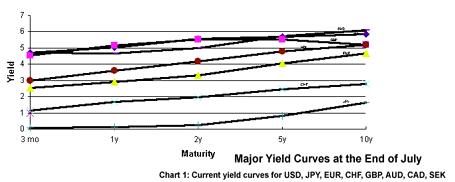
It is striking that long-term interest rates in Euroland are more than 100 basis points below those in the United States. And this is despite similar inflation rates in both economies, growing budget surpluses in the United States, and concern that the Stability&Growth Pact may be put into abeyance. The market is saying that despite all this, it expects the euro to appreciate versus the dollar in the long-term. While the euro yield curve is not steep by historical standards, it is steeper than the US yield curve. However, more so than the level of long-term yields, yield curves relate to the different positions economies occupy on the economic cycle. A better comparison may be between the euro and Swiss yield curves given that the Swiss economy is very tied to the fortunes of Euroland. In this regard it is interesting that the euro yield curve is flatter than the Swiss yield curve, despite the Swiss National Bank’s long pedigree in central bank credibility.
In short, and somewhat surprisingly given the difficulty and the bad press the ECB has received, the market expects the euro to exhibit low inflation and to appreciate versus the dollar in the long-run. It would appear that the anti-inflation credibility of the Bundesbank and deutschemark has been successfully extended to the whole euro-area. This partly explains why despite weakness in the euro, overseas investors, especially those in the US and Japan, remain fully invested in euro-denominated assets (according to an analysis of State Street Bank’s $5.2 trillion of portfolio holdings data). Indeed, it is only the relatively steeper euro yield curve which questions whether the ECB has more credibility than the US Federal Reserve.
Euro liquidity
A liquid currency is one where transactions costs are low, which in turn leads to the development of deep markets. While there are a number of interesting attempts to measure transaction costs, it is still hard to find meaningful data. Our best proxy for whether the euro is adding to liquidity is evidence that new issuance of euro-denominated paper is greater than issuance in the legacy currencies over a comparable period and that we are seeing increased market sophistication. Although the euro is just half a year old this evidence is plentiful.
Total issuance of debt in euros is substantially higher than issuance in the legacy currencies over a comparable period and running neck and neck with the dollar. In the first quarter of 1999, euro-denominated issuance in the international bond and note market rose to $147.3bn compared with $101.3bn in Q1, 1998. Euro-denominated issuance as a percent of US dollar issuance rose from 61% to 74%. While official figures are only now being compiled, it would appear that the second quarter saw a further acceleration in euro issuance.
| International bond market issuance | |||||||
| Billions of US dollars | |||||||
| 1997 | 1998 | 1998 | 1999 | ||||
| Q1 | Q2 | Q3 | Q4 | Q1 | |||
| US dollar | 516.1 | 605.6 | 167.1 | 174.8 | 134.9 | 128.9 | 199.9 |
| Euro-area | 219.7 | 320.1 | 101.3 | 83.2 | 69.6 | 66 | 147.3 |
| % of dollar | 42.6 | 52.9 | 60.6 | 47.6 | 51.5 | 51.2 | 73.7 |
Interestingly, within the total figure, issuance by emerging market governments is evenly split between euros and dollars suggesting the euro is quickly gaining a vehicle currency and international role. The corporate story is also interesting. More than $80bn of euro-denominated bonds have been issued by companies and utilities in the first six months of 1999, more than double the volume for 1998 as a whole. It would appear that liquidity in the legacy-currency markets was held back by size, especially outside the more liquid government bond markets. Pooling these markets together under one currency has not only created a critical mass of liquidity, it is revitalizing non-government markets.
Over the past couple of months three companies – Repsol, the Spanish oil company, Mannesmann, the German engineering and telecoms company and Tecnost, the funding vehicle for Olivetti, the new majority owner of Telecom Italia – have all issued euro-denominated bonds of $3bn or more. Tecnost broke global records with an offering of e9.4bn on June 3rd. Just two years ago no European company had issued a bond greater than e1bn in size.
Microeconomic benefits
While the corporate bond story has been much heralded, its significance is often underestimated. When all is said and done about culture and the legal environment, a key aspect of the entrepreneurism in the United States has been the better access small companies have to the securities markets due to the superior liquidity of dollar markets. The bias in Europe towards large companies in part reflects the extra premium small companies have to pay to get access to securities markets in relatively illiquid markets. By bringing liquidity, depth and sophistication, the euro will give a needed boost to innovation and entrepreneurism in Europe.
By improving the transparency of prices across the eurozone, the euro is also helping to cement the single market. No longer can car companies sell the same car in one country at a large premium to its price in another. Across Euroland prices are being forced down to the lowest levels and efficient producers are being able to expand their distribution. Better transparency, competition and distribution will support trade and economic activity and is proving a strong force for corporate restructuring and mergers. Along with the development of deeper financial markets this is one of the most significant implications of the euro’s arrival.
It is a development which will be amplified by the simultaneous development of e-commerce. When a small design company in Dinard, France can market to a retailer in Dusseldorf, Germany through the internet, with all prices in euros, it will have a much better chances of success. The irony is that while big European distribution companies are championing the euro and many small companies have been associated with currency patriotism, it is the small company sector that may experience the greatest support from the arrival of the euro.
Euro weakness or euro credibility
While corporate and foreign government issuance in the euro is sign of current and future success for the euro, it is a force for weakness in the exchange rate today. As a result of economic weakness in Europe and the resulting unwillingness of European corporates to borrow, a substantial amount of euro demand by European residents is being met by the issuance of debt by foreign companies and governments. The new liquidity of the euro denominated market, the uncertainty in the US dollar market over monetary tightening in the US, and strong retail demand for euro issues has meant that it is cheap to borrow in euros and swap back into dollars.
If the Brazilian e700mn, three-year euro denominated bond had been swapped into dollars it would yield 650 basis points over the relevant US Treasury compared with a current spread of over 750 basis points for the five year $3bn, dollar denominated Brazilian bond. In so far as foreign borrowers are meeting European demand by issuing in euros and then swapping a proportion of the euros into dollars, this is having a negative impact on the euro. Of course one day this effect will be reversed as central banks around the world respond to the market’s adoption of the euro as a major vehicle currency for investment and debt by raising euro holdings on foreign exchange reserves.
The main cause of euro weakness in the first half of 1999 has been unexpected weakness in the Euroland economy, juxtaposed with unexpected strength in the US economy. The strong bounce in the euro from $1.014 on July 14 to over $1.07 on July 23 following upbeat business surveys in Germany and France is evidence that the euro had been previously tracking an underperforming economy, not a loss in euro credibility. A weak euro in response to a weak economy is not a bad development. Indeed, given a single monetary policy to fit all eleven member states, the rigidities of European labour markets and inflexible fiscal policies, many Euro-area policy makers will be relieved that the euro did weaken. If it had strengthened, worsening Europe’s economic woes, there would have been some serious questions over the euro’s long-term viability. The lack of policy flexibility in Europe will mean that the euro will often be a key economic lever, overshooting on the downside at times of economic weakness and overshooting on the upside during periods of strength.
Redesign the pact
It is this policy inflexibility and the resulting exchange rate instability that are abiding challenges for Euroland. But it is a challenge for which there are a number of solutions. One solution would be to rewrite the Stability&Growth pact to allow for greater fiscal flexibility while at the same time maintaining a downward force on government budget deficits. If fiscal policy can respond more flexibly to economic shocks there will be less need for sharp exchange rate changes. The problem with the current pact is that limiting budget deficits to 3% except during a severe recession is too limiting and fining recalcitrant countries already in fiscal deficit is just not credible.
Both problems can be addressed by a redesigned pact where countries automatically forfeit the right to inward transfers from the European Union if deficits rise above 3.0%. If the central government deficit holds below 3.0% and economic growth slows in areas, countries are eligible for expanded regional development funds. There are many appealing aspects of this plan. First, forfeitures are easier and more credible than fines. Second those vulnerable to a cut off of European transfers will become an effective domestic lobby for low deficits. Third a government can restrict the deficit amid economic slowdown comfortable in the knowledge that the country will be eligible for increased resources from Europe.
The euro is already a success
The weakness of the euro on the foreign exchanges in the first half of 1999, tells us more about the relative state of the Euroland economy than it does about the future success of the single currency. In foreign exchange, success and strength are not the same thing. Successful currencies are those which are credible and liquid and facilitate trade and economic activity. On this basis the euro is already a success.
The euro yield curve is low and flat signifying anti-inflation credibility. Euro issuance is ballooning and there is new liquidity in the euro-denominated corporate bond market. More depth and cheaper financing in euro-denominated markets and greater transparency in the goods markets will bring substantial economic rewards. These microeconomic benefits of the euro have often been neglected in favour of the more modest macroeconomic advantages. Indeed, many macroeconomic challenges remain, not least how to reintroduce some policy flexibility following the arrival of a single monetary policy and the adoption of the current Growth&Stability Pact on fiscal deficits. As the Euroland economy recovers, so will the euro but euro volatility will remain unless the Pact is rewritten to introduce a greater stabilizing role for fiscal policy. Avinash Persaud, Global Head of Research for State Street
The debate continues as experts give their counterarguments:
Bernard Connolly, executive director of AIG international.
Graham Bishop, advisor on European financial affairs at Salomon Smith Barney.


