by David Roche
The European economy is headed for recovery. The consumer is spending again and exporters will do better from synchronized global growth. What’s more, the state is gradually loosening its icy grip on free enterprise. Above all, the European Central Bank won’t raise interest rates, while the Federal Reserve will hike them by another 50 to 75 basis points before the year-end. So I reckon European financial assets will outperform those in the US over the rest of this year.
In the eyes of many investors, the long-run underperformance of European financial assets has been richly deserved. EU wages are too high, labour legislation is horribly rigid and unions still hold sway. Europe’s welfare-state mentality is largely to blame. The public sector spends too much, taxes too much and has too much debt. And European industrialists make the wrong products in the wrong places at the wrong price. So they sell their wares to the only people that can afford them – overpaid European consumers. The euro’s disappointing debut has confirmed the worst fears of those doomers and gloomers.
But beneath the surface, there are signs that the outlook for Europe is improving – and rapidly. First, over the past six years, Emu-11 governments have improved their finances radically. A smaller public sector makes room for bigger corporate profits and faster economic growth. Euroland real unit labour costs have been falling while those in the US have trended higher. That’s been a major boon to Emu-11 competitiveness – especially as the dollar has been strong over much of this period.
Second, it seems at last that the state in Europe is taking a back-seat role. Everybody knows that lower tax regimes attract more capital. But Germany’s former finance supremo, Oskar Lafontaine, argued that this was damaging to the national interest. So his remedy was to harmonize everyone’s tax rates at a high level. This might have kept the pressure off Germany, but it would have hurt Europe.
Thankfully, Hans Eichel, Lafontaine’s successor at the finance ministry, has a different view. His recent tax reform has helped to shred the ribbons of red tape and unnecessary bureaucracy. Although the impact on the corporate sector is relatively modest – it will boost profits by just Dm15 billion ($8 billion), less than 0.5% of GDP, over two years – it’s certainly a step in the right direction.
In France, the notoriously dirigiste government has modified (if not dropped) its plans for curtailing the working week, after vehement opposition from the corporate sector. Nobody’s arguing that this is a transformation in French attitudes. Unit labour costs will still jump 2% to 3% from January 2000 onwards. But it’s encouraging that the authorities are at least paying heed to the corporate sector’s concerns about profitability.
Finally, in Italy, there’s been an important move away from a copy-cat 35-hour week. The metalworkers’ union, for example, recently agreed to a negligible reduction in the working week for around a third of industrial employees. What’s more, there was no accompanying increase in real wages.
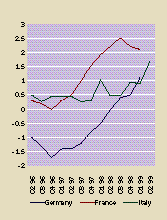
But it’s not simply these glimmerings of structural reform that make me more bullish about European recovery and profitability. Europe’s business cycle has turned too. Employment in the biggest Emu countries is growing again.
That will continue to boost consumer confidence, which is already close to historical peaks. And it should enhance the outlook for labour earnings growth, allowing retail sales to pick up.
Consumers in Europe’s higher-cost countries, such as Germany, will also benefit from the price convergence that is engendered by Emu. The implicit pressure on corporate profit margins will force companies (and countries) to change the way they do business. For example, a recently enacted law in Germany’s eastern state of Saxony allows retailers to extend weekend shopping hours into previously sacrosanct Sundays.
What’s more, with the global economy on a clear path to more synchronized growth, the outlook for industrial production is also improving. That should contribute positively to overall expansion. So I expect a 3% growth clip for core Europe over the next 12 months.
And behind all this is what happens in the US. It’s difficult to gauge the precise impact on the US consumer of a sudden rise in interest rates. But I’m pretty sure it will cause a significant retrenchment of private-sector demand. For a start, over a quarter of US household financial assets are in equities. These holdings are worth more than 100% of annual GDP. And there’s a clear linkage between the performance of the S&P500 and the buoyancy of US retail sales.
I’m convinced that continued strong credit-led growth in the US is going to force the Fed to raise rates throughout the second half of this year. Even if I’m wrong and the Fed doesn’t raise rates any further (because Alan Greenspan has been converted to the ranks of the New Paradigmers), the US current-account deficit will continue to expand and US treasury yields will rise further to reflect the difficulty of financing that deficit. So the dollar will weaken.
Earlier this year, I predicted that the euro would slump to one-to-one against the dollar. But now, contrary to the current consensus, and on the evidence of the structural and cyclical signs in Europe, I reckon the euro is set to strengthen against the dollar. From today’s levels of $1.01 (and possibly below $1 dollar for a moment) the euro will be back at $1.15 to 1.20 within the year. It’s time to switch from US to European financial assets.
Employment year-on-year
David Roche is president of Independent Strategy, a research firm based in London. www.instrategy.com