European high-yield debt: the ties that bind
Europe’s high-yield bond market has had a roller-coaster ride this year. Hardly had it recovered from last year’s Russian crisis when jitters in the equity market and fears of rising US interest rates pushed volatilities to spectacular levels.
To add to these uncertainties, US Federal Reserve chairman Alan Greenspan has made moves – essentially through issuing cryptic statements of his intentions – to stop the markets from overheating. “Greenspan’s strategy is to continue to inject into the market some uncertainty about his own actions,” says John Wotowicz, European head of high yield at Morgan Stanley.
The result has been that issuers and investors alike have been hanging on his every word in an attempt to second-guess him. And this in turn has led to a stop-start issuance of high-yield bonds.
“The behaviour of the market has been influenced by the Fed’s timing of its meetings,” says Malcolm Stewart, co-head of European leveraged finance at Salomon Smith Barney. “Since the August Fed meeting, the secondary high-yield market has firmed up, and the European market has been performing better than the US.”
Because the European high-yield market continues to rely on US investors, and sometimes US issuers to provide its base, it has been subject to all the vagaries of US interest-rate speculation.
However, James Amine, head of European high yield at Credit Suisse First Boston, thinks that in time European deals will not have to depend as much on US investors. “The European market is becoming more independent in the sense that deals can be sold nearly entirely into Europe,” he says. Amine also considers that what happens in the US economy and the US high-yield market will have less direct influence on the market in Europe.
“Over the last year as new investors have entered the market, and those involved have committed more capital and expertise, the European high-yield market has become stronger, deeper and more sophisticated,” says Alasdair McPherson, director of high-yield research at Paribas. “The market is no longer nascent, it is now recognized as an important asset class – albeit one that is in the awkward stages of adolescence.”
The problems in the US stem from the fact that many investors are switching into markets that are less interest-rate sensitive. Because the US high yield market is a mature one, there are fewer new investors to replace them.
At the start of the year there were large inflows of cash into the sector, but since interest rates have become a concern, money has been pouring out. In May, for example, $903.5 million (1.2% of total assets) left US high-yield mutual funds. The funds’ buying capacity is down.
In addition, the CBO (collateralized bond obligation) market – where high-yield debt is securitized by a third party and re-sold with a range of risk profiles – has begun to dry up. CBOs had accounted for 20% of all US high-yield investment, as they appeal to investors with a wide range of risk appetites.
So in July when a flood of new supply in the US arrived – mostly single-B rated – the market could not absorb it. The number of pulled deals increased and many were repriced and restructured to cope with the growing volatility. “Single-B CBOs had to give coupons of 13%, and the structures began to become onerous for borrowers,” says Carolyn Aitchison, head of European high yield at DLJ. “It was the first time since 1994 that we have seen warrants on industrial deals become commonplace.”
Spreads widened dramatically as issuers rushed to get deals done before the much-anticipated 25bp interest-rate hike in the US at the end of August. However, after the summer lull the flow of deals in the primary market has picked up considerably. At the end of August mutual funds again recorded positive inflows of cash.
The anxiety of US high-yield investors has been heightened by the growing level of defaults in the market, which Standard & Poor’s, the US ratings agency, claims are at an all-time high.
The most high-profile failure was by telecoms company Iridium, which defaulted on its high-yield debt in mid-August. So far there have been few defaults directly affecting European investors, though there have been worries over chemicals company Brunner Mond which has already violated covenants on its bank debt.
How a high-profile default would affect investor sentiment in Europe depends in part on how much can be recovered. Most – but not all – investors understand that a certain number of defaults is the price paid for greater yield. “European high yield hasn’t experienced a recession yet, so you can’t call it a seasoned market,” says Jean-François Astier, head of leveraged finance in Europe, at Lehman Brothers.
Predicting the improvement and decline of high-yield credits is becoming a major part of investors’ strategy. “As the European high-yield market matures, credit events, both positive and negative, will become much more common,” says McPherson at Paribas.
For example: Derby Cycles has had to reset the covenants on its debt due to poor sales; magazine group IPC has reset debt repayments and has requested a new injection of equity from its sponsors; and television channel Central European Media has been hit by political problems in the Czech Republic. More positively, German toilet manufacturer Geberit has launched a successful IPO and its bonds have been called, while Dolphin Telecoms also looks set to launch an IPO next year.
The foundations of a stable high-yield market in Europe – a consistent supply of deals and reliable investor demand – are gradually falling into place again after the disruption at the end of 1998.
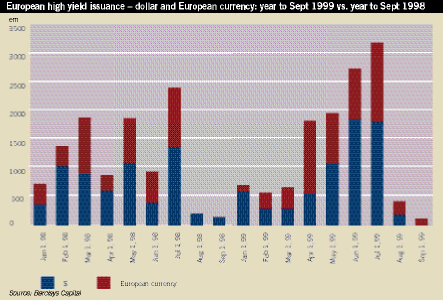
Issuance of dollar and non-dollar paper by European high-yield borrowers for the first half of the year was up 6% on the previous year to e9.5 billion ($10 billion). Issuance volumes for 1999 should match, if not exceed, last year despite a quiet first quarter. Some are predicting a total of e20 billion ($21 billion) issuance this year.
One noticeable change in this year’s market is the increase in euro-denominated new issues compared to dollar deals, which have declined. In the first six months of 1999, 48% of high-yield issuance was denominated in European currencies, compared to 39% in 1998.
The euro has become a mainstream currency for issuers and investors all over the world. American corporate borrowers, usually those with major operations in Europe such as American Standard and PSINet, have been keen to borrow in euros so that they can match their debt to their revenues. American high-yield bond investors have also been happy to buy euros, to help diversify their portfolios.
The high-yield market volatility of the last six months has created market opportunities for those clever enough or lucky enough to get their timing right. It has allowed relatively unknown European companies to do blow-out deals while seasoned borrowers have suffered because of the overcrowded issuing calendar. Several deals for strong issuers have fallen by the wayside.
Increasingly, sophisticated investors have picked up yield as spreads in the European secondary market tightened. The rapid flow of deals, particularly between June and August, created a buyer’s market and investors had the luxury of being more selective. As issuers tried to attract investors’ attention, coupons on deals rose higher and higher. “Investors now have the upper hand in setting interest rates on bonds,” says Wotowicz at Morgan Stanley.
Difficult market conditions caused the number of banks underwriting successful deals to shrink. A small band of mainly American banks monopolized the business, much to the alarm of rivals that had failed to establish themselves before the market turbulence.
The first quarter of 1999 was a twilight zone for the European high-yield market. “People were concerned about market receptivity at the start of the year,” says Robin Doumar, co-head of European leveraged finance at Goldman Sachs. The market was still suffering the ill-effects of 1998’s Russian crisis, although there was considerable optimism that the euro would kick start new issuance again. After a few deals – Coral, Tokheim, and @entertainment – the market went quiet again.
Confidence of issuers and investors was not helped by the poor reception of the deal for telecoms start-up group Completel by Salomon Smith Barney, launched on February 8. What had been intended as a deal worth $300 million with a considerable euro component was reduced to $75 million, without the euro tranche.
“The initial transaction was too aggressive,” says one banker. “They were trying to raise too much money for a start-up company which only had $50 million in equity and no operating licenses.”
Completel needed to do a bond deal quickly to fund the building of its operations. And, despite the unfavourable market conditions, the management decided it could not afford to postpone the deal. “We thought investors would be persuaded by our business plan,” says Bill Pearson, founder of Completel. “We were disappointed by the portfolio managers’ reaction. Had we done the deal a year before we wouldn’t have had problems at all.”
On April 1, the first Spanish high-yield deal was launched by CSFB and Merrill Lynch for telecoms firm Jazztel, rated CCC. The deal’s execution ran into difficulties, and to place the paper the borrower had to settle for a high coupon of 14%, including equity warrants.
The fact that comparable deals secured lower pricing led to criticism of the underwriters. In the secondary market, however, Jazztel has emerged as one of the best performing bonds in the market, and is trading at 120% of its issue price. This is largely because Jazztel’s business plan has proved to be solid. The company is now planning an IPO.
Jazztel’s experience contrasted with another Spanish start-up telecoms deal, by ONO, launched on April 29. “We sold the bonds just off the business plan, as there were no subscribers,” says Stewart at Salomon Smith Barney, the underwriting bank.
The deal went well and managed to secure an aggressive pricing and offered a coupon of 13% with warrants. Jazztel and ONO were in direct competition at the pre-marketing stage, and many investors held back from Jazztel to buy ONO, favouring its mix of telephony and cable businesses.
In May, issuance picked up and peaked at the end of the month with a $800 million (including a euro tranche of e340 million) deal from telecoms network provider KPN Qwest, led by Goldman Sachs. The borrower, which is a joint venture between Dutch telecom firm KPN and US internet company Qwest, is a well known name in the market. The strength of its reputation meant that such a large deal, with the largest euro tranche at that point, was placed easily.
After months of preparation, several large deals from major issuers were launched in June, giving the market momentum. Mobile telephone company Orange completed a $740 million deal, including a large sterling tranche, lead managed by Goldman Sachs. The deal sold well on the back of the strong Orange brand name, but the pricing was wider than many had hoped.
Goldman Sachs followed the deal a week later with a dollar/sterling issue for $400 million equivalent from Energis, another UK telecom company.
On June 3, DLJ and Chase launched a $200 million deal – including a euro tranche of e100 million – for Netia, one of the first east European corporates back into the bond market after the Russian crisis. The local telephone operator from Poland is a joint venture between Telia of Sweden and a group of Israeli investors. Its business has been thriving since the start of telecoms deregulation in Poland last year.
Netia had previously come to the high-yield market with a Deutschmark deal in October 1997, so many investors were familiar with the company. However, the lead managers realized that they needed to explain the credit to new investors. “We knew that a Polish, early-stage telecoms company would have to be properly marketed, and the credit explained to investors,” says Jonathan Ezrow, head of high yield capital markets at DLJ. “It is not the sort of deal that sells itself.”
Meanwhile, concerns about the likelihood of interest-rate rises started to creep into the market. Despite growing turbulence and wider secondary market spreads, demand for new issues held up, buoyed up by the sentiment that the European high-yield market was recovering at last.
Interest-rate speculation was soon to become a market obsession. “June was a very difficult month while investors waited for Greenspan to make a decision,” agrees Astier at Lehman Brothers. Rates went up at the end of the month, but the Fed’s strategy changed from a tightening stance to neutral, giving the market a brief spurt of vitality.
Two corporate deals that managed to take advantage of this issuing window were Kappa and PSINet, both launched on July 16.
Kappa, a Dutch paper and packaging company, had planned a deal in the third quarter of 1998 to refinance its LBO. The deal was postponed indefinitely after the Russian crisis, leaving underwriter of the bridge loan Barclays Capital on tenterhooks.
In the end Barclays’ patience was rewarded, as its first deal in the European high-yield market caught the rising wave of investor demand. The three-tranche deal was increased to $626 million with euro tranches worth e415 million, making it the largest euro deal in the market.
“We secured a very tight pricing of the credit,” says Frank Sekula, head of high yield capital markets at Barclays Capital. Half the deal was sold to US investors, which are familiar with the paper and packaging industry. Most market players agree that the Kappa deal was well timed.
“Barclays hit a three-week hot issuing window,” says one banker. US internet company PSINet also took advantage of the benevolent borrowing conditions and brought a deal, lead-managed by DLJ, that was increased from $400 million to $1.2 billion, including a euro tranche of e150 million.
These conditions soon led to oversupply during July and several deals, such as Corral Petroleum’s $600 million transaction, were pulled. Leading fruit company Chiquita abandoned the euro component of its $200 million deal, led by Lehman Brothers and Salomon Smith Barney, and retreated to the US market. US beverages firm Conandaigua Brands also pulled its European tranche, and borrowed domestically.
The deluge of new issues during July included deals by telecoms firms Versatel and Pannon GSM, as well as BSN, a glass company newly spun-off from French conglomerate Danone.
On July 27 Goldman and DLJ braved the over-crowded market to launch a jumbo high-yield facility for Dutch communications group UPC. The $1.5 billion deal, with a euro tranche of e300 million broke new records for deal size in the European high-yield market.
Although it sold well, the pricing was wider than initial talk. “Given the strength of the company’s story, UPC should have been a much more robust transaction and a larger deal,” says one rival banker.
After the traditionally quiet August, when the market restarted in September investors and issuers found a very light forward issuing calendar. The initial signs are not good for the market’s prospects in the rest of the year.
Morgan Stanley unsuccessfully attempted to be the first into the market after the summer lull with a planned $1.1 billion deal for German pay-TV provider Kirch. Roadshows were completed in the first week in September and pricing had been expected by September 6.
But two weeks later, lacklustre investor interest caused the deal to be pulled in favour of a syndicated loan. Kirch plans to re-visit the bond markets in the first quarter of 2000, and has retained Morgan Stanley as its main underwriter.
Other than the difficult market conditions, Kirch’s main problem is a perceived weakness in its credit story. The highly leveraged company, headed by entrepreneur Leo Kirch, has been operating with mixed success for six years. Germans already have access to many free television channels, and few have been convinced by Kirch to pay for more. Investors are wary about the firm’s ability to boost its subscription levels with new programme packages and better management.
Weightwatchers squeezes through
In the last week of September US diet firm Weightwatchers succeeded in completing a $250 million deal, with a euro tranche of e100 million. The only other deal now being marketed is for telephone directories publisher Thomson, and is not expected to be worth more than $250 million.
A major issue for the high-yield market is the Y2K problem which bankers expect to reduce the flow of deals considerably towards the end of the year.
Most deals will try to squeeze into the period before US Thanksgiving in November. “The entire fourth quarter forward calendar will be compressed into a period that ends November 21 rather than December 31,” says Stewart at Salomon Smith Barney, pointing to the risk of oversupply during this time.
However, others see December as a good time to issue because of the lack of competition for investor attention. Investors are likely to be more cautious about lower credits, favouring seasoned issuers and companies with reliable cashflows rather than start-up firms. “If you are bringing the right deal for the right company, investors will buy it,” says Astier at Lehman Brothers.
Although this year’s problems have arguably been caused by factors such as interest rates and Y2K anxieties, people are starting to learn that volatility is an inevitable and fundamental part of buying non-investment grade debt. The US market, which represents a grown-up model to the fledgling European market, has shown that volatility is not something that disappears with maturity.
DLJ’s Ezrow says that the way European high-yield investors have reacted to difficult conditions this year is in marked contrast to the problems of late 1998. “One of the nice things about this year is that there has been less hand-wringing about what has been going on. In the Russian crisis few investors had seen volatility before, but now they are more used to it. There is a clearly identifiable cause – oversupply and volatile interest rates.”
The basic premise for investors to buy high-yield debt – extra returns – has proven true this year. High-yield returns have far outperformed the rest of the bond market. “The number of new investors in the market has grown threefold since autumn 1997,” says Aitchison at DLJ. “Through this period of volatility we have seen spread compression between dollar and non-dollar instruments. Europeans have been accumulating paper,” agrees Ezrow.
Geoffrey Sherry, head of high yield capital markets at Chase Manhattan, estimates that there are now up to 75 major investor accounts buying non-dollar high-yield debt – up from just 15 accounts in 1998. “The change in the depth and breadth of the investor base has been very real,” he says.
Investors’ understanding of high-yield instruments and their credit analysis skills have also markedly improved. “European high-yield investors are already sophisticated in their understanding of credit and their use of credit research. Over the last year, however, they have started to focus more on standards of reporting and concerns about structural subordination,” says McPherson at Paribas.
The Russian crisis has purged opportunistic investors from the market, making way for longer-term buyers. This has proven a useful base for some fund managers. M&G Asset Management, for example, started a dedicated high-yield retail fund at the bottom of the market in October 1998 and bought bonds at bargain prices.
M&G and the other UK funds have been some of the main buyers of high-yield paper and about 75% of the market is London-based. French and German investors are starting to enter the market, although several German investors already buy high-yield paper through US and UK funds. There has also been a good response to high yield in Italy, Switzerland and the Netherlands.
Securitizing high-yield debt through instruments such as CBOs is one way of broadening the investor base. In August, Morgan Stanley and Intermediate Capital Group launched a high-yield collateralized debt obligation (CDO) deal, consisting of mezzanine and loan assets as well as bonds, as a step towards a high-yield CBO market in Europe.
The secondary market has so far been weaker than the new issues market, with low volumes of trading. This is because high-yield investors have tended to fall into two types – buy-and-hold, which keep the paper to maturity, or flippers, which sell at the slightest hint of price appreciation.
“Both investor mentalities are part of the traditional European and Eurobond culture,” says Wotowicz at Morgan Stanley. Few investors occupy the middle-ground – to hold a bond for about 12 months, and hope for credit appreciation. Many bankers think that this sort of investor will help the market to mature and gain stability. “It will take time for properly-oriented high-yield players to start to dominate the market,” says Wotowicz.
Embracing diversity
Lack of diversity is one of the remaining weaknesses of the European market which remains dominated by issuers from the media and telecoms sector, accounting for almost 60% of new deals.
This sector is also the biggest issuer in the US, but the rest of the market contains a wider range of companies, allowing investors to build a diversified portfolio in high yield. “The European high-yield debt market is quickly becoming much more mainstream, and will soon go beyond just LBO and media telecoms deals,” says Astier at Lehman Brothers.
The European market may be caught in a dilemma. Investors will not consider buying high-yield paper until there is sufficient diversity, while issuers that are outside the usual high-yield mould won’t risk coming to market until they see a certain level of investor participation.
Issuers from outside the media and telecoms sector should be encouraged by the fact that deals from other sorts of industries usually attract a lot of additional attention when they come to market, and are well received by investors.
In time corporates will use the market as a source of regular financing, as happens in the oil and gas sectors in the US, rather than for event-driven deals such as LBOs and acquisitions. This will help widen the range of names in the market.
Next year will be pivotal for the high-yield market in Europe. Heavy issuance is expected, with a wider range of European investors and issuers exploring the asset class. This may let the market develop its own distinct style. And that in turn may allow the leading European banks gradually to catch up with their US rivals.




