How bad can things get in Brazil? January’s devaluation of the real was the government’s nightmare outcome. Its success in beating inflation since 1994 depended on the strength of the currency. Take that away and you open the floodgates to inflation and recession.
Both are now firmly on the agenda. The government accepts inflation this year could be as high as 10%. It could be much worse. If the currency continues to slide, some analysts say, inflation will reach 50%. As for recession, many expect the economy to shrink by as much as 6% in the next 12 months.
And the government’s ability to act could be severely curtailed if a new nightmare situation also comes true. One result of deflation, and of the sky-high interest rates the government is using to ward off further slides in the currency, is that the size of the public debt stock has swollen near to bursting point. Foreign portfolio investors abandoned Brazil risk long ago. If local investors were to follow suit, what then? Capital controls? Default? Both bring back memories of the “lost” 1980s, when Brazil spent a decade in the wilderness after defaulting on its foreign debt. Most in the government believe either option would wipe out all the achievements of the past five years.
But the government believes it has a solution. Last November the IMF agreed to provide $41.5 billion to help defend the currency, provided the government tackled a budget deficit of about 9% of GDP. It also encouraged the government’s policy of raising interest rates to attract buyers for the real.
Budget cuts were slow to materialize, however, and neither an overnight rate of 29% a year nor Brazil’s huge armoury of foreign reserves was enough to see off a speculative attack on the real. Soon after the first IMF payment (of about $9.3 billion, in December), and having spent about $40 billion defending the real since the Russian crisis, the government was forced to let the currency float.
 |
|
|
The IMF is now preparing to release a second tranche, of about $9.2 billion, on a promise of more fiscal tightening and with the support of interest rates now pushing 40%. Supporters of the policy argue that such punitive rates are a temporary necessity and that they will start to fall once the real stabilizes. Devaluation has lessened pressure on the currency, they say – since it was the fear of devaluation that undermined confidence in the real – and it will give exporters the boost they have long demanded. Meanwhile, impending recession will keep inflation within manageable limits. And as interest rates fall, investors will have greater confidence in the government’s ability to pay its debts, allowing rates to fall further. But even the policy’s supporters accept its execution will not be easy. To succeed, it requires the government to implement the fiscal reforms that have been at the top of president Fernando Henrique Cardoso’s political agenda since before the start of his first term of office in 1995. But there is little sign that the political system that has thwarted his progress so far is about to roll over and make things easy.
Unfinished business
Fiscal reform is the great piece of unfinished business of Cardoso’s presidency. He was swept into power on the back of his success in combating inflation as finance minister in 1994.
Following his election as president, the government convinced Brazilians that it was serious about tackling the underlying causes of instability. Privatization would be stepped up, trade barriers would fall to allow the entry of cheap foreign goods and, above all, reforms would be enacted to remove the excesses of the populist 1988 constitution, specifically to trim the bloated public sector and overhaul the near bankrupt pensions system.
But there was a problem. “When inflation fell, the whole dynamic of public expenditure changed,” says Raul Velloso, an economics consultant in Brasília. What had once been false spending promises by federal and state government – to be diluted by inflation over time – suddenly became very real commitments.
With the Asian crisis in 1997 and the Russian default last year, many politicians woke up to the country’s vulnerability to sudden shifts in international capital flows. This brought a flurry of activity, and civil service and pension reforms eventually made it through congress. But such long-term reforms will be slow to be felt in public accounts. In the meantime, the government needs quick fixes.
Velloso thinks it will get them. He points to the approval in January of a measure to raise extra pension contributions from public employees, and to tax pensioners. If implemented by the state as well as federal governments, Velloso expects it to produce annual savings equal to 1.5% of GDP. The measure was passed – after four previous attempts had failed – days after the currency was allowed to float in mid-January.
But recent history shows that such spurts of reforming zeal can run out of steam. In the middle of last year the government thought it had congress on its side as the real came under speculative attack in the wake of the Asian crisis. But as the winter recess approached, government managers began to run out of time to secure votes needed for pensions reform. They could have won the vote on the last working day – but congressmen preferred to stay away to watch the football World Cup, and the reform was set back by more than six months.
No to new taxes
The new congress in place since January remains largely untested. David Fleischer, a political scientist in Brasília, says the government will be pushed to win any new tax concessions out of congress. “The mood in congress with regard to the government’s fiscal demands is cautious,” he says. “Politicians are worried about the effect of high interest rates on unemployment. The line these days is no new taxes. There’s a feeling that congressmen have done enough. Now it’s up to the executive to come up with budget cuts.”
One new tax, however, does seem likely: a state tax on exports, removed during the last mandate as part of a drive to modernization, but now mooted as a solution to a new impasse, this time with the new intake of state governors.
The states are yet another thorn in the side of the government’s fiscal managers. Indeed finance ministry officials argue that if Brazil excluded the states from its national accounts, as other federal counties do, the national budget deficit would be much smaller, and less alarming to investors. But there is no other federal country comparable with Brazil that allows its states to run up deficits.
During the last mandate, the federal government renegotiated the states’ debts, rescheduling them over 30 years at bargain-basement interest rates of between 6% and 7.5%. But some incoming governors, their revenues all but consumed by pay and pensions, say they cannot pay. It was when Itamar Franco – Cardoso’s predecessor as president and now governor of the state of Minas Gerais – threatened default that confidence finally collapsed, forcing the government to float the real. The government says further rescheduling is impossible. Any relaxation would go down as badly with markets as it would with the IMF. So exporters may find themselves paying part of the bill.
Fleischer believes the states will eventually come into line and “bite the bullet”; but he also thinks they will continue to be a stumbling block for the government, which may end up having to absorb part of their debts. That will only add to the intractability of the country’s long-term restructuring problem, to which no easy solution is in sight.
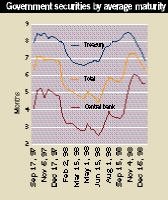
But the government now faces a much more pressing short-term problem. Although Brazil’s net public debt to GDP ratio, at about 52%, is much lower than that of many countries, the cost of servicing its debt is swelling under the double pressure of high interest rates and the devaluation of the real. Last year the government spent about 8% of GDP to service its debts; this year the cost could go as high as 12% or more.
The government hopes that it can handle this situation through a combination of foreign reserves – currently about $36bn, with more cash to come from the IMF – plus high interest rates to attract enough lenders, and the promise of fiscal cuts to come. Its target is to “stabilize” the net public debt to GDP ratio at 46.5% by 2001.
“This is just not realistic,” says Felipe García at the New York office of Idea, a financial markets consultancy. “Just to hold the ratio steady, interest rates would have to come down to between 15% and 20% a year. To stabilize the ratio will be difficult enough, to say it will come down doesn’t make sense.”
There is no suggestion as yet that Brazil will encounter difficulties servicing its external debt. But there are signs that it may run into problems rolling over domestic debt. At one auction last month, the central bank refused market bids, saying it was not prepared to pay the (undisclosed) interest rates demanded. Days later, it sold paper at 39.3% a year, to five bidders, each for 20% of the offer.
To García, this “looks funny”. It is no problem that the central bank should reject bids it regards as too high, although repeated refusals would have an unsettling psychological effect. But the successful auction suggests either that bidders were working together, accepting interest rates lower than they would like in order to stave off damaging turmoil, or that the government had stepped in through intermediaries to engineer a successful auction. The former explanation would be a positive sign of markets keeping the greater good in sight; the latter would be altogether more worrying.
Either way, markets are not ready to see interest rates fall. With confidence already on a knife-edge, that would lead to capital flight. But the policy of high interest rates may have done as much as it can. Very few foreign investors are prepared to accept Brazil risk even at the rates now on offer – they hold only about 1% of Brazil’s domestic debt stock. What amazes some observers is that Brazilian institutions are still prepared to accept the growing risk of default or, at best, restructuring. Any further increase in rates is sure to undermine even the confidence of local investors in the government’s ability to pay.
Drastic measures
Debt restructuring is one of the few options open to the government if it is to break the relationship between interest rates and exchange rates that has driven its debt servicing costs higher and higher. The IMF seems likely to push for such an arrangement, although the government will be deeply unwilling to risk undermining its credibility and its future ability to borrow.
One possibility would be to offer to convert domestic debt into external debt in the form of sovereign bonds. Institutions such as local mutual funds would have little option but to go along with it. But banks and corporations, which together hold an estimated 60% of domestic debt, would be free to look elsewhere.
Free, that is, unless the government shuts the doors and locks them in. It has repeatedly ruled out the possibility of capital controls, for the same reasons – the threat to credibility – that it rules out restructuring and previously ruled out devaluation. Paul Krugman, professor of economics at the Massachusetts Institute of Technology, argues in a recent article that to accept the need for temporary capital controls would be “a shame, but not shameful” and that they would cause far less suffering than the alternatives of inflation and recession.
García at Idea says that the adoption of capital controls would prompt many senior government to resign, unleashing administrative instability. However, he believes that provided it got on with the business of fiscal reform, Brazil could recover from the shock in a year or two.
If the present course is unsustainable what alternatives remain? One would be to absorb part of the debt burden by allowing inflation to return. Some inflation is now inevitable, but any government complicity in its generation would risk too much. Armínio Fraga, the new central bank governor, has said that to offer inflation to Brazil would be like offering a drink to a reformed alcoholic. Prices are already rising for some goods entirely unconnected with the exchange rate. A return to indexation would spell the end of the stability of the past five years.
A more radical solution would be to abandon the real altogether and dollarize. Argentina is in talks on such a plan and has already suggested the formation of a Mercosur currency bloc. Many argue that the loss of sovereignty would be a small price to pay for the stability of an unassailable currency.
But such a move, in the world of Brazilian politics, is perhaps beyond the realms of possibility.
There is only one real solution to Brazil’s problems, and that is to tackle its indebtedness by enacting far-reaching fiscal reforms.


