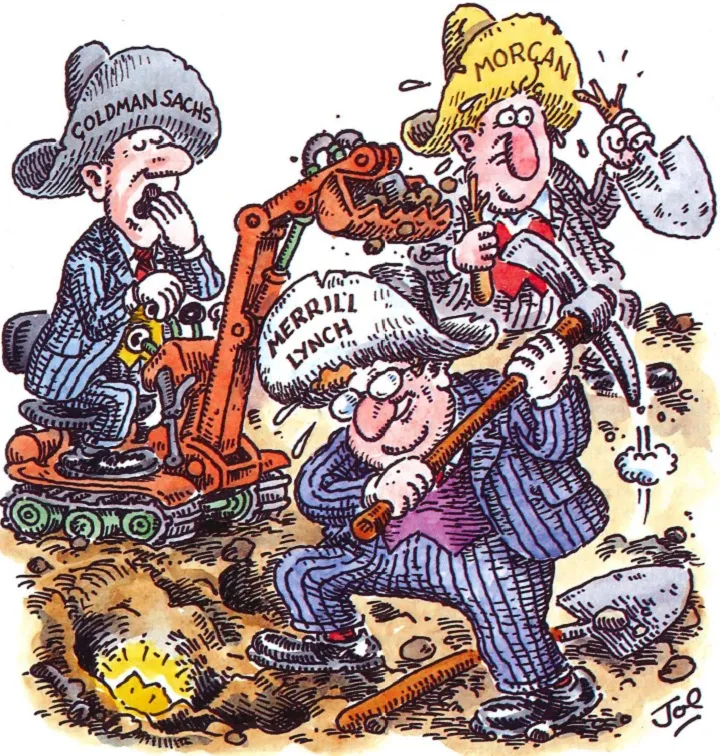
In January, Merrill Lynch won a mandate in Brazil as global coordinator for the privatization of mining conglomerate CVRD. The fee will be just 1.91% of the funds raised. This is bad news for other leading investment banks which regularly compete for the world’s top mandates. Fees are coming down. Rewards for executing large, complex, time-consuming privatization issues are falling, just when the deals are getting tougher to complete, and the cost of maintaining a high-powered privatization team is still rising.
The drop in fees is especially pronounced in emerging markets. Goldman Sachs took 4.5% on the first offering of shares in Mexican telephone company Telmex in 1991. In 1993, CS First Boston earned 4% for the privatization sale of Argentine oil company YPF. Already fees were under pressure. When Goldman came to do a second Telmex tranche in 1992, the fee was 3%.
The bad news for the banks is that the slide will probably continue. Competition is still strong from firms desperate to establish their credentials in the international equity market. In emerging markets, even though mandates can become a curse – last year’s plum Asian deal, Indonesia’s PT Telkom, turned out an embarrassing failure – the desire to win them is still fierce.
By contrast, in the developed markets, the hierarchy of equity firms is clearer. An extreme example is the corporate new issue market in the US. Three or four firms dominate. And within that group, a firm knows that unless it boasts the top-ranked analyst on a stock or the leading secondary trading market share for that sector, it won’t win the deal. The result is a well-established fee schedule – ranging from 7% for small IPOs to 2% or less for large secondary-block trades – that is the envy of non-American firms.
In emerging countries, equity market leaders are less well established. Because many finance ministries have appointed home-country banks to prominent roles in privatizations, the pool of contenders claiming privatization experience is ever-widening. The global American firms find themselves competing with UK, continental European and local banks to win mandates. They are facing three or four times the competition they used to.
But so far that doesn’t seem to be dampening their interest in winning privatizations. Not many firms have followed Goldman Sachs, which appeared to rule itself out of the running on CVRD by bidding 3.125% on fees. Some competitors suggest the firm is more interested in chasing corporate equity deals.
For all their disappointment over CVRD, the losers were soon fighting hard for this year’s big mandate in Latin America – Telefonica del Peru. “That’s the only large deal due to come out of Peru and it may be one of the most interesting in Latin America,” says Michael Ryan, managing director at Merrill Lynch. “Several firms may see it as an opportunity to build a track record in the telecoms sector and bolster their league table position and decide, for these strategic reasons, to bid low.” At the end of January, Merrill Lynch and JP Morgan secured the mandate.
“It is already ridiculous to be running emerging market deals for less than 3%,” complains a banker at another American firm. Apparently, not all his peers agree. Strong rumour says that Morgan Stanley was prepared to bid even lower than Merrill – a mere 1.5% – on CVRD.
The trend will not be confined to Latin America. The long-awaited privatization of Turk Telekom may finally be mandated this year. Partly because there is no established market leader selling Turkish equity internationally, many bankers fancy their chances of winning a lead role. Says one: “The so-called short-list of finalists for that deal is very long. You can bet that someone ambitious to build their reputation in privatizations, or telecoms, or fringe European equities, will bid low.” Appointing the lowest bidder is a way of demonstrating to critics at home that the government is driving a hard bargain with foreign bankers.
Cutting to win
Many bankers now worry that they will suffer similar cuts in fees in developed market privatizations. “How can Merrill Lynch now ask any European government for 3% for a privatization when it accepts such low fees in Brazil?” asks one banker. To date, there have been no spectacular declines. The rule of thumb for European deals is that fees are steady at around 3%. But there have been exceptions. The all-in cost to the Spanish government on the last offering of Telefonica stock was 2.95% plus expenses. The Dutch government paid 2.5% on the second sale of KPN stock last year. “We are now at a crucial juncture on fees,” says Jerker Johansson, executive director at Morgan Stanley. “It will go one of two ways: either to a clear differentiated fee structure as in the US; or it will be like the Eurobond market, with firms cutting fees to win business.”
In European corporate equity deals, bankers see encouraging signs, with chief financial officers ready to pay over 5% for initial public offerings (IPOs). But the signs are less hopeful on privatizations. Behind the scenes, strong pressure is being applied. One banker says: “In the later stages of mandating the ENI deal, the Italian authorities were pressing all the time, calling the banks to say they had not made up their minds who to mandate and asking how low firms would bid on fees.” Another banker says: “Firms have already quietly breached 3%. On one forthcoming Italian transaction, a UK bank has promised to pay back a portion of its fees to the government.”
Many global coordinators blame specialist advisory firms for their woes. They are especially bitter at firms with no capital markets expertise which interfere with the process of selling equity and justify themselves to the governments by cutting back on fees paid to banks. At the same time, advisers tend to push for larger-sized deals and higher valuations. They also bring confusion. Syndicate members on the second KPN sale last year say that the Dutch government’s adviser, NM Rothschild, and the global coordinator, ABN Amro, tried to upstage each other throughout. Junior banks weren’t sure who was running the deal or who to ask for guidance on myriad issues.
It’s a typical example, bankers say, of advisers stepping beyond giving advice and trying to police and run deals, which they are not qualified to do. “They’re creating an adversarial climate, pushing investment banks more into the role of advocate for investors,” complains one banker. That shouldn’t happen, unless a bank is taking on a hard underwriting and has a vested interest in securing stock at a low price. The overwhelming majority of privatizations incorporate book-building, whereby the selling government and the banks share the common goal of maximizing proceeds.
Global coordinators also blame each other for cutting fees. “European banks are biased towards lower fees,” complains one American banker. “Those firms from countries used to fixed-price equity offers are accustomed to selling stock at a discount to the market and charging a low fee of under 2%. The total cost to the issuer is higher because it includes the discount and the fee.” He argues that European banks have applied low fees to book-building deals, not realizing that fees ought to be richer because, in the process of maximizing proceeds, an arranger has to motivate its sales force as well as paying research and corporate finance staff.
European bankers deny they are leading fees down. They point out that it was Merrill Lynch and Morgan Stanley which squeezed the CVRD bid below 2%. But European firms agree that inexperienced lead managers, having won a toe-hold in their own market perhaps by under-bidding, are likely to miscalculate the revenues and costs of the privatization business. The head of equity capital markets at one UK firm says: “It’s easy for some of these banks to say that if you earn 3% on a multi-billion dollar deal it must be profitable. But bear in mind the cost of the research, sales and corporate finance infrastructure required.”
Equity firms claim that the costs of employing hundreds of salesmen and analysts have to be met partly from fees for arranging privatization deals. These might take years to complete from early pitches, through winning the mandate, to executing the deal. They add that even when fees appear healthy, these are often spread among a large syndicate of banks, many of which perform little useful work and are only included at the whim of the host government.
Opportunity cost
A co-lead management is not much consolation these days for a firm which has failed to win the lead mandate after months of work. “On deals where we used to earn $1.5 million as a co-lead we are now lucky to bring in $500,000,” says one banker. Even for successful bidders, returns are thin in what is supposed to be one of the most profitable segments of investment banking. “The return on effort in privatizations is low,” insists Merrill’s Ryan. Last year – a good year for stock markets – Morgan Stanley’s return on equity was 16%: good but hardly excessive. It has a lot of fixed costs. Investors must worry if it has to compete in future with firms pricing IPOs on the margin.
Comparing costs against revenues accurately in the privatization business is difficult because you need to gauge the opportunity costs. What could a firm’s staff be earning if they were freed from the endless bureaucracy of privatization deals? Nevertheless some firms try to keep track, by filling in time sheets rather like lawyers and accountants, to measure how much time privatizations take up. The results are disquieting. Many bankers now suggest that privatizing governments should, wherever possible, speed up the whole process of selling off companies.
Another European banker compares his firm’s return on two deals executed last year. One was a privatization for which it initially pitched in 1993. It won the mandate and executed the deal last summer. Total revenues for 18 months’ work, involving eight managing directors working near full-time for six months assisted by many more salesmen and support staff, was $2.5 million. Later in the year, the firm executed a bought deal on which it earned $5 million in 24 hours. The bought deal was not even particularly risky, the banker says. “This should scare governments,” he adds. “Some firms will stop tendering for conventional business. Today, the French government might get 15 pitches on a deal and those 15 firms will do anything to win the mandate But two or three years ago, 50 banks might have put themselves forward.”
Most banks warn about other dire consequences for governments which squeeze too hard on fees. “Because the economics available to banks are being reduced, many syndicate banks just don’t perform.,” says Michael Evans, partner and managing director at Goldman Sachs. Governments don’t seem to realize this. A particular danger is that firms will commit fewer resources to researching and making markets in privatization stocks, potentially putting investors off future privatization sales. Eventually, they may stop competing for anything but the easiest-to-sell blue-chip companies.
More immediately, firms will be less inclined to commit their capital to stabilizing prices when share prices fall in the immediate after-market. In recent months that has been the common fate of many privatization stocks. One banker admits: “Firms make all sorts of promises about committing capital when they are pitching for deals. But it is very difficult to argue internally that we should devote more of our capital to supporting an aggressively-priced new issue in a volatile market, when this business already consumes substantial resources at a moderate return.”
Even on book-built deals, firms take some risk-capital positions in trading new issues. On most deals firms are given a notional underwriting amount. If a firm encounters strong demand and sells stock way beyond its notional underwriting allocation plus its share of the green-shoe option [the syndicate’s option to take more stock from the selling government] , it is short of the stock. If it only sells up to the green-shoe limit, it may find itself long of stock. Some recent privatization deals, notably Pechiney, have been almost impossible for syndicate members to sell. And in many deals, firms have to take on hard underwriting commitments during open fixed-price offers to domestic retail investors. “Banks were on the hook for nine days in Telefonica while the European stock markets were highly volatile,” says one syndicate head. If firms feel they have been short-changed on fees they will be even more inclined to let difficult deals like Pechiney plummet in after-market trading.
Firms can suffer a capital hit long after completing a privatization offer. Some firms which made rich fees from Latin American privatizations in the early 1990s took heavy losses in falling markets following the peso crisis of 1994. They suffered because they were by far the leading market-makers in stocks they had taken public. When markets turned sour, investors dumped stock to traders at the firm which had led the deal. Some argue that their 4% and 5% fees should be measured against those losses.
Asset quality
Global coordinators are growing increasingly uneasy about privatizations in general, not just about fees. Privatizations have lost their scarcity value, they say. Most European and many emerging countries are pursuing programmes. Investors can afford to pick and choose as never before. Many recent offerings have been marked by stock price falls in secondary market trading. Investors have less incentive to snap up shares in the primary market. The British government built up goodwill among domestic retail investors in the 1980s by privatizing companies at prices which allowed for share price appreciation in the after-market. Only later did they tighten up on pricing. Other governments have tried to jump into privatization further along in the process, without building up enthusiasm among retail investors over a series of deals.
Another growing problem for global coordinators is the doubtful quality of the assets they are being asked to privatize. In the successful early UK privatizations of utilities operating as near monopolies, it was usually easy to identify cost savings which might boost profits and share prices. In recent European deals, this has been harder to do. Some countries are selling off companies that have long operated as quasi-independent corporates, reporting a recognizable P&L, such as KPN. Easy cost savings are less readily achievable. Other countries have tried to sell off the wrong companies at the wrong time in the stock market cycle. The French stand accused of this on several recent deals, including aluminium company Pechiney, which was sold late last year. The deal bombed in the after-market and many firms now express surprise that it went ahead at all. “It was nearly a BP,” says one American banker, recalling the infamous UK issue with which underwriters were stuck following the 1987 world stock market crash.
Some governments seem to be ignoring today’s tough market conditions. Final pricing meetings are difficult. In most book-building deals, banks produce a chart of the amount of demand against the price investors will pay. Initially sellers are always tempted to take the highest price that will allow them to fully subscribe the offer. But that may be a mistake. If markets are volatile, investors may dump shares quickly. That will sour the reception for future sales. “It’s difficult to persuade governments to leave anything on the table for investors. Understandably, they have to maximize proceeds for the taxpayer.” says Lucinda Riches, executive director at SBC Warburg. Another banker complains: “Government officials are saying: ‘I don’t care what my bankers tell me, I won’t let them talk the price down.’ But we have to allow the markets to set pricing, not politicians. Some governments have pushed too far.”
The French and Italian privatization programmes are the ones most likely to struggle this year. One banker says: “In pricing French deals, the notion of leaving something on the table for investors doesn’t even rate consideration.” In recent deals, domestic retail investors have been much less enthusiastic and share prices have fallen sharply from the IPO price. If those trends continue, deals will be impossible to complete. The disappearance of domestic retail buyers is particularly worrying.
“In the UK,” says Riches at Warburg, “domestic institutional fund managers almost have to buy privatizations because of their weight in the indices, so retail support is not as vital, at least on the smaller offerings. But in Spain and Italy, where domestic institutions are not as large, the retail response is more important.” International investors like to see strong signs of domestic support before committing to buy privatization stocks. Bankers blame the weak Italian domestic demand on ENI for pricing that deal at the bottom of the indicated range and failing to secure a larger deal. The weak domestic response worried other investors. American institutions sold considerable amounts soon after the deal closed.
The hardest thing for governments to control is the combined scale of their privatization programmes. Together they have a lot of stock to sell. And while they may regulate their own privatization calendars, they rely on occasional compromise and common sense to clear the way for deals that will obviously compete for the same investor dollars. The sale of Deutsche Telekom is set for November. That may prove to be a bad time to sell telecom stocks, but no other sensible government would schedule a telecom privatization to compete with it. Unfortunately, such good sense is not guaranteed.
An easy solution for governments is to price issues so low that investors snap them up. But that is hard to justify to political opponents. What advice would lead managers offer? Simple, they reply. Look at the portfolio of companies for sale, choose a good one for which there is a realistic prospect of strong demand; put together a syndicate of banks which is not skewed in favour of domestic firms and do a transparent, well-marketed deal priced to perform reasonably well.
“A number of governments are now at the crossroads on privatization,” says Amir Eilon, managing director at BZW. “They must decide that they are not just shovelling out any old thing that’s to hand but are trying to sell off quality assets for which they need to develop some appetite, starting at home.” Tough sectors to sell this year will be telecoms, metals and chemicals. Easier sells may be energy utilities, oil and gas, and airports.
Quick deals
If governments could quicken up the privatization process, they might find it easier to match company sales to cyclical peaks in demand for a particular sector. The ultimate quick deal is the block trade. Late last year, the British government disposed of its remaining 1.8% holding in BP, through a block trade worth £513 million. SBC Warburg won the deal against competing bids from a handful of other firms. It bought 101 million shares at 508p, representing a 4.3% discount to the prevailing market price for BP shares of 531p. It quickly placed shares with over 100 accounts, over half in the UK, the rest in Europe and America.
Bankers expect the UK government to use bought deals to dispose of several of its 28 small residual stakes in other privatized companies. Some European governments may follow suit. Following its next marketed sale of Repsol stock, the Spanish government will retain under 10% of the company which it might sell through a bought deal. The Dutch government also holds several small residual blocks.
The advantage of the technique for governments is that it offers speed and certainty of proceeds. The drawback is that there is no absolute guarantee that bought deals bring the highest possible price. They are of limited use in IPOs, or even second- and third-tranche sales. Most rival firms applauded the BP deal. But another UK banker points out: “Bought deals are all about banks managing their risk and reward. Banks will calculate where they can sell the stock, subtract a discount of around 1% and make their bid. But just because four or five banks bid in the same range, that doesn’t prove it’s the best price. You find the best price by sounding out as many potential investors as possible.”
Unorthodox approach
A compromise between the traditional, protracted privatization and the bought deal is the quick book-building. Last December, UBS and Dresdner Bank-Kleinwort Benson sold $376 million of shares in the National Grid, held by North West Water and Scottish Power, through what they called a global accelerated tender. The firms built a book of orders over two days, rewarding institutions for bidding early and aggressively. They priced shares after securing a heavy oversubscription. Bankers who worked on the deal argue that the fees were probably lower than the discount that would have been required on a bought deal. The vendors also avoided the expenses of a lengthy roadshow. “And investors don’t have to listen to dozens of brokers selling the same story,” says Connor Killeen, head of equity capital markets at UBS.
Quick book-building could be used for some second- or third-tranche privatization sales, where domestic institutional support is likely to be so strong that a cumbersome retail offer is unnecessary. But pushing out quick deals remains an unorthodox approach. BZW advised the UK government against using a bought deal for its BP stake. The firm’s message to privatizing governments is to be wary of innovation and instead to return to the basics of privatization. “Plan carefully, avoid glitzy, glamorous deals, explain the investment story, don’t rush the process,” says Amir Eilon. “If you do all that, you can extract enough information to allocate stock to quality buyers and price dispassionately.”
Last year’s privatization of Pechiney highlights the dangers of the quick and dirty route, he says: “As well as being a cyclical stock, this company had just gone through six months of aggressive asset disposals. As well as the privatization there was a simultaneous rights issue, a take-out of non-voting shares and of a minority international subsidiary. With deals this complicated it’s dangerous to skimp on investor education.”
BZW still hails the process it and Kleinwort Benson used in last year’s second offering of shares in the UK power generators (GenCos) as the deluxe privatization model.
The GenCos deal was flagged months in advance. The global coordinators monitored dealing in outstanding GenCos shares for the best part of a year to ensure institutions did not drive the stock price down in expectation of covering their short positions in the new offer. The global coordinators, together with the rest of the syndicate, spent two months pre-qualifying institutions, grading them for favourable allocation depending on several criteria including how long they had held their existing investments in the GenCos.
But many firms are tired of such elaborate procedures. “We have to crush these secondary sales down to two or three weeks,” argues Killeen. He also expects greater volume of privatizations to be completed through bought deals. Other bankers are coming round to the same view. “On certain deals we have changed our view on the ideal structure for a marketed offer,” says Johansson. “We now believe in a much more truncated timetable from announcement to pricing, simply because investors are becoming more expert at evaluating whether or not to buy offerings.” He adds that governments should prevent deals becoming too bureaucratic.
Accommodating retail investors limits governments’ ability to speed up deals. Retail support is an important aspect of many privatizations, especially IPOs, for two reasons. Many governments wish to build up their local capital markets and encourage wider share ownership. International investors, which in the early days of cross-border equity investing sought values in stock which domestic buyers had not seen, now take a different approach. They prefer the comfort of knowing that local investors are buying. Stock market regulations may require fixed-price offers for retail to be held open for two or more weeks. The process of gearing up share shops and other retail outlets can take longer, even many months.
Although compelled to follow long timetables, governments could be more innovative on retail offers. Eilon says: “I’m staggered that more governments haven’t followed the UK government’s example and used the partly paid structure.” Experience in the UK suggests that the risk of non-payment of second and third instalments on privatizations is very low: around 2% to 3%. The advantage for share buyers is that they can put some of their purchase capital into money market investments for several months. Investment banks also feel a benefit. Eilon adds: “Say banks earn 1% on total proceeds on an offer paid over three equal instalments. It’s as if they’re earning 3% on initial proceeds.”
Other innovations may be useful on retail-driven deals. Goldman Sachs and BBV offered Spanish retail investors a refund against the first 10% of any capital losses on last year’ sale of stock in Repsol. It addressed their chief fear: that the price of a privatization stock might fall soon after the initial offer.
Bells and whistles
Other wrinkles can be introduced: such as offering bonus shares for retail investors that hold privatization stocks for a year or longer after launch. But it doesn’t always work. A similar formula was adopted in the ENI sale. The head of capital markets at one syndicate member says: “Italian retail investors were already worried by political turmoil and stock market volatility. They interpreted the offer of down-side protection as an admission that the deal was likely to bomb out.”
No amount of tweaking deal structures for domestic retail investors will allow a government to sell a huge amount of stock at an aggressive price following a string of poor deals. Institutions are even less likely to be impressed by gimmicks.
“Institutions will figure out very quickly the net present value of a part-pay option, or any other option,” says Johannsson. “So by using a lot of fine-tuning you won’t necessarily add much demand. If a stock is worth 100p and you add bells and whistles worth 10p to try to sell it, you might just as well sell it at 90p.”
Yet bankers are racking their brains to devise new structures, even for privatizations aimed mainly at institutional investors. At least one European government is expected to use a convertible-bond offering in its privatization programme this year. That makes sense for investors. The bond component of convertibles provides substantial protection against capital loss. The drawback for governments is that a full equity sale is not assured. Governments also take on higher public sector indebtedness until the bonds are converted into equity.
Some practitioners argue that tinkering with structures can confuse the economic issue. Says Eilon: “In debt markets, it’s worth trying any nuance to squeeze out one or two basis points of value. In equity markets, you’re not dealing with basis points but with stocks that can rise or fall by 20% very quickly. By playing with a structure here or there, you can take your eye off the fundamentally important thing, which is to sell the stock properly.”
But other bankers reply that governments must be opportunistic and look at alternatives. “You can’t trust the markets to bail out every deal,” says Merrill’s Ryan.



