BAKER’S BIG WORRY IS PROTECTIONISM
It seems a long time ago that James Baker III returned in triumph from the summit in Tokyo, an international economic coordination agreement in one pocket, and cheerful forecasts for world growth in another.
The growth envisioned in May has not materialized. Coordination of economic policy appears to have evaporated. The US trade deficit still gapes open, despite the Treasury Secretary’s earnest efforts, producing a fearsome imbalance in the world’s economic structure.
In an exclusive interview with Euromoney editor Neil Osborn last month, Baker confessed to being a worried man. His fear is protectionism–a theme he returned to repeatedly during the conversation. The world comprehends neither the strength of protectionist sentiment in the US, he said, nor the imminence of the danger that Congress might pass protectionist legislation that would snarl world trade patterns. The trouble is, he added, everybody is bored to tears with pious talk about the virtues of free trade, which makes defending it that much harder.
Nevertheless, Baker remains optimistic that the coordination mechanism he is attempting to build will eventually be fully functional. There are clearly some grounds for this optimism. Even Baker’s sternest critics cannot deny his achievement in reducing the value of the dollar so sharply after the Plaza meeting of September 1985. Nor on the coordinated cuts in interest rates that followed the Tokyo confab.
(Baker likes to compare his coordinated and unilateral cuts in terms of a baseball batting average. It was a very respectable .667 at the time of the interview, but dropped when the Fed lowered the discount rate in late August without response from Germany or Japan.)
Elsewhere in the interview, Baker spoke in upbeat tones of his negotiations with the Inter-American Development Bank over the Baker Plan. He also hinted that Japan may soon be persuaded to channel more of its funds into Latin America. Here are the highlights.
Your critics say the Tokyo accord was hollow. How do you respond?
We said from the very beginning that it’s only as good as its implementation. It is, after all, an agreement of heads of state to pursue a certain process. It’s an agreement that depends on consensus and its implementation will depend on consensus. We never represented it to be anything but that.
There is a great deal of room for enhanced international economic cooperation and coordination. The very survival of our system– the world’s free trading system–depends on it. We’ve all got to start and continue thinking about the international aspects of our domestic policies and this exercise is certainly a very worthwhile step in that direction. It isn’t hollow if the various countries will do what their heads of state said they wanted done in Tokyo.
Are you less optimistic now than you were in Tokyo? You have been quite critical of the Germans and the Japanese.
No, I haven’t been critical of the Germans and the Japanese with respect to the Tokyo communique. I have not. I have done nothing other than simply say that we would like to see additional growth, if possible, in Germany and Japan. I frankly liken that to other countries telling the United States, which we accept, that we must deal with our fiscal deficit. We are simply saying we need more growth worldwide. The United States has grown now on a reasonably sustained basis for 43 or 44 months, and we hope that we can see some additional growth elsewhere. That’s not being critical.
How would you characterize your progress towards building the mechanism to implement the Tokyo agreement?
I think the progress has been done quietly, but there have been several meetings of the G5 deputies. We will engage in the exercise at or around the World Bank annual meeting. There has been tentative agreement at least with respect to the indicators to be used, and there’s been discussion with the IMF with respect to the role that they will play. I think I would say that there’s been reasonably good progress, albeit private.
Is there any of that progress that you can make public now?
No, not if I hope it to continue.
Alan Greenspan argues that the potential benefits of coordination are limited because the large volume of financial assets denominated in dollars outside the United States can overwhelm the purely economic indicators. Do you accept that there is a limitation?
I think that there is a limitation but I still think that there is a great deal of room, and I would bet you Alan agrees, that there is a lot of room for improved coordination. I’ve had people say: “Haven’t we seen the end of international economic policy coordination?’ Because the last attempt at coordinated interest rate reductions failed. My answer to that is by all means no. You should not be ashamed of batting 667. We’ve tried for three, and two of them have been coordinated to various degrees. One of them was coordinated among the United States, Japan and Germany. The second one was coordinated between the United States and Japan. And of course there was the last one which ended up being unilateral on our part. But still I think that’s pretty good progress.
In the long term, can you foresee a day when there would be some form of target zones to bolster your accord?
I would hate to say that, because then people would say the United States is in favour of target zones. We basically say we are not for them or against them right now. We’d like to see some improvements in the system, we’d like to see more stability, we’d like to see less volatility. I’m still under a charge from the President to make a recommendation to him before the end of the year with respect to the possibility of a major conference [on exchange rates]. I still have that obligation as a result of the State of the Union message. So I wouldn’t want to say right now.
Are you an admirer of the European Monetary System?
I can see some utility in it, but there are probably some problems there as well. I really don’t want to be pitching ball right there right now. Let me say one other thing about Tokyo and the changes in the system. I think it’s really important that we do whatever we can to save the world’s free trading system. In my view we are perilously close to losing it. We have legislation pending up here as a consequence of the intolerable trade deficit that the United States has run. There is more than simply a strong mood in favour of protectionism in the United States. The mood is absolutely rampant. Frankly, our view is that if the United States goes protectionist we will lose the world’s free trading system. And the assault here is very, very real. When we say we would like to see more growth abroad it’s because we are engaged in a life or death struggle here–at least as we see it–to maintain an open trading system. We do not suggest to others how they should run their economies. We don’t lecture. We do say– please help us, grow more.
In May you said that you thought the trade deficit in 1987 could be $100 billion. Do you still think that?
I would revise that and I would say– perhaps $110 billion. So there’s been a little change in our view on that.
That will fan the protectionist fires. What do you propose to do now?
We’re doing everying we know how to do. We are self-initiating unfair trading cases. We have asked the Congress for funds to fight the predatory practice of mixed credits. We have done what we’ve done on the exchange rate side: the Plaza and everything else. We are going to talk to a couple of the NICs [newly industrialized countries] although we don’t expect that to have a major impact on the trade deficit. We made it clear to the EEC we were not just going to sit back and have quotas and tariffs laid on us. So we’ve adopted an approach of aggressively enforcing our own unfair trade laws. We are dealing with the exchange rate problem. We are trying to deal with the Third World debt problem, and we are trying to encourage the other major economies of the world to grow a little more, consistent with maintaining constant vigilance against inflation. We know how hard it is to get inflation down, and we think that it is one of the most fundamental significant accomplishments of this presidency that we have been able to get it down and keep it under 4% for four years. We don’t want to lose that, and we don’t want the world to lose what they have gained by fighting against inflation. At the same time we want to preserve the world’s free trading system and we’ve got to find a way of using all of these means to stave off this very, very virulent protectionist sentiment.
You mention the NICs. Korea gave a distinctly negative response to your approach. What can you do now? That’s a very small part of it and we will talk to those countries. We don’t expect that to have overly major impact with the trade deficit, but at the same time the practices that are being followed [by NICs] in light of the imbalances could stand a little adjustment.
Speaking of protectionism, Sam Nakagama has suggested an import levy an oil, to raise the price. Do you see any element of merit in that?
Yes, I do. And we discussed that here internally within the administration about 90 to 120 days ago, before the oil price dropped quite as far as it has now. There is some merit, but there is some demerit. In the first place it would require the creation of a bureaucracy to enforce it, because you would have to have an exception for [such things as] home heating. But, yes, it would have some benefit on the trade deficit side. The President said no to it. It came up in the context of the debate on the budget as a mechanism for raising revenues. It did not come up in the context of what can we do to reduce the trade deficit and to assist a severely impacted domestic energy industry. I’m not suggesting that the President’s answer would be any different, I’m just saying that he considered it in a different context.
The new Mexico agreement. The Mexicans have made promises and undertakings concerning their economy before and not kept them. What’s different this time?
The programme is different for one thing. That is, there are more elements of privatization and economic reform than there have been before, and secondly the IMF agreement is considerably different. It does not impose upon them austerity-type performance requirements that are impossible politically to meet. I think that’s one reason we can expect perhaps a different result this time. I think there’s also some difference in atmosphere in Mexico, or they wouldn’t be moving in this direction. Some of the things that are in the programme are things that they have already done, for which they have not sought nor received any credit. They were [already] moving in the direction of privatization and making some changes in their foreign direct investment rules and regulations.
Now, just like I can’t promise you that the banks will come up with new money, I can’t be guarantor of the performance by a sovereign country.
Speaking of the banks, Senator [Bill] Bradley’s new debt plan would involve the Banks taking a little hit–some write-offs. Do you see any merit in that particular suggestion?
No. What that would do would be to cut countries off from access to the financial markets. No private financial organization is going to continue to lend when they have been somehow forced to take a loss with respect to prior loans. You might also say how in the world is that proposal supposed to operate? Is this the role of government– to step in and say you will take a 3% loss on these loans? It is also to some extent naive to say this will be the debt relief you will get, debtor country, and then we’ll talk about your reforms. It seems to me the better way is to say: if you reform there will be some capital flows at the end of the line which you need to sustain that reform.
The Washington Post reported the Mexicans were threatening to place debt payments into an escrow account during the negotiations prior to the agreement. Is that true?
There was an escrow account suggestion during the course of the negotiations leading up to the IMF programme. I don’t think it was, anyway, nearly as dramatic or timely as the Post suggests. The idea of an escrow account has come up before.
Yes, it has come up many times before. This time it’s said the Mexicans were serious about it. Did you believe that they were serious?
Well, I think we pretty well took them at their word. I must say we made the point that we thought it would be a terrible mistake, and it’s interesting to note that they didn’t do it.
How would you characterize the response of the World Bank, the IMF and the Inter-American Development Bank to your Seoul initiative?
I think they have been absolutely superb– very responsive. In terms of the IADB, they’ve likewise been responsive. We are seeking, as you know, certain policy changes with respect to the IADB and we haven’t resolved all these yet. We’re still in the process of negotiating.
How confident are you that the IADB can be persuaded to accept conditionality and other parts of your initiative?
We’re very optimistic that we will ultimately reach agreement with the IADB with respect to the policy reform we’re talking about. We’ve been at it a while and we really believe it’s beginning to go in the right direction.
Do you think we need a new mechanism to take up some of Japan’s great surplus of funds and channel them into Latin America?
I don’t think we need any new mechanism. We have plenty of multilaterial institutions that can work with countries to accomplish that kind of result, the World Bank being a major one.
So what more can be done to encourage use of those mechanisms? There’s a lot of money in Japan, and Latin America needs investment, but the two are miles apart.
There’s progress being made, there are discussions that I can’t get into because I don’t want to violate any confidences. I think the Japanese are fully cognizant of their responsibilities as the major surplus country in this area. I’ll leave it at that.
Some commentators fear that the fragility of the world’s financial system may be increasing. Henry Kaufmann worries about leverage, as you know, and the BIS talks about the dangers of financial innovation. Do you share those fears?
I’m really not too concerned that the financial system is in imminent danger of any sort of collapse. We’ve got some strains in this country on some of our banks, but many of our banks are stronger today than they were when the Third World debt crisis first erupted in 1982, and I’m really disinclined to be pessimistic right now about the financial system. I realize what these people are saying, but its just not where I am; I don’t feel that.
Let me put one caveat in there, and that is the trading system. Finance and trade are all tied up together and if something happens to the trading system and you end up with a series of international trade wars, that would be a horse of a different colour. I’m very worried–I don’t think people really understand the extent and the degree to which protectionism is felt out there in the hinterland of the United States. We are beginning to see protectionist sentiment translated into action here in the Congress. In my view we are actually fighting a life and death struggle for the survival of the world’s free trading system.
What are your chances?
This year, hopefully, we’ll be able to hold the line. But there must be some progress on our trade deficit problem. It is economically unsustainable and it is politically unsustainable. That’s why it’s important from our standpoint that our trading partners do what they can to grow, that they do what they can to help us implement the Tokyo agreements so we have a political mechanism for dealing with these imbalances, so we sit down and actually talk about it and take action from time to time or, as we said in the Tokyo communique, use our best efforts to take remedial action. It’s a very difficult situation.
Are you growing less optimistic?
It’s become a lot worse over the course of the past two months or so in the United States. It may just be that we are in that critical period, but it’s become a fair amount worse in the last month.
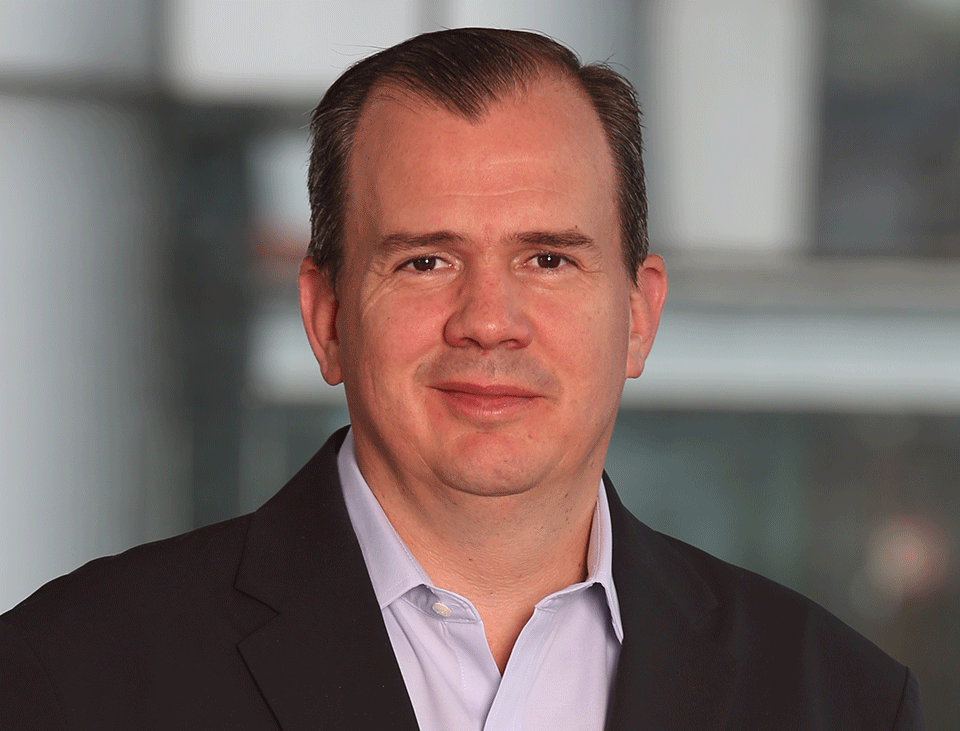
Photo: James Baker, the US Treasury Secretary (right) puts a point forcefully during his interview with Neil Osborn, Euromoney editor.