Cross-border capital and lending flows are declining, albeit from previously unsustainable and dangerous highs. Trade is lagging even anaemic global expansion. Protectionism and nationalism are the rising political forces.
And yet away from war zones and populations suffering from the worst extremes of poverty, the digital economy makes most of us feel more inter-connected than ever before.
Is it to be our redemption?
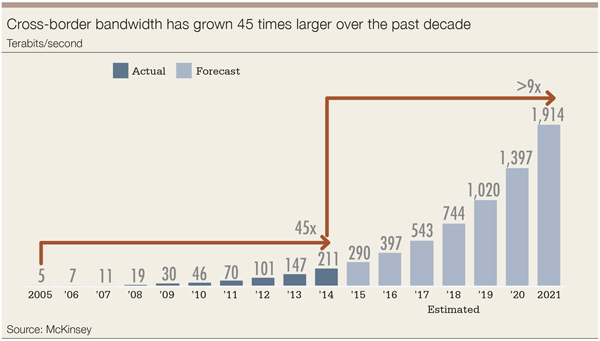
A McKinsey report, Digital globalization: new era of global flows, attempts to measure the growth of cross-border flows in data, which it estimates have increased 45 times in the 10 years from 2005, even as trade and financial flows have flattened.

|
McKinsey contends that the cross-border bandwidth of data flows will grow by another nine times in the next five years as digital flows of commerce, information, searches, video, communication and intra-company traffic continue to surge. It suggests that data flows are already contributing more to GDP growth than cross-border flows of manufactured goods, and that data flows account for $2.8 trillion out of the total of $7.8 trillion of global GDP contributed by the combined cross-border flows of traded goods, FDI and data in 2014.
McKinsey posits that globalization has not stopped, as might seem the case from the slowing of trade and the retreat to home markets of once globalizing enterprises like the world’s largest banks. Rather, small businesses and individuals are becoming the drivers of globalization.
It points out that small businesses worldwide are becoming “micro-multinationals” by using digital platforms such as eBay, Amazon, Facebook and Alibaba to connect with customers and suppliers in other countries. Even the smallest enterprises can be born global: 86% of tech-based start-ups McKinsey surveyed report some type of cross-border activity.
Once dominated by multinational corporates funded by the largest banks, globalization is increasingly the preserve of individuals participating in it directly, using digital platforms to learn, find work, showcase their talent and build networks. Some 900 million people have international connections on social media and 360 million take part in cross-border e-commerce.
Approximately 12% of the global goods trade is now conducted via international e-commerce, with much of it driven by open platforms such as Alibaba, Amazon, eBay, Flipkart and Rakuten.
Taobao example
McKinsey runs through the example of Taobao, the Chinese consumer-to-consumer marketplace that Alibaba set up in 2003 that grew to be one of the world’s top-10 visited sites within a decade after starting, as familiar to Chinese language shoppers as eBay.
“Consider all of the tools and platforms that a small Chinese manufacturer has at its disposal when it becomes a Taobao merchant,” the report asks. “The company can open and customize a Taobao ‘storefront’ for free using a mobile app and upload its merchandise for sale. It can communicate with customers using an instant messaging service, handle payments through Alipay, choose an Alibaba-affiliated logistics company for shipping, place targeted digital ad buys through Alimama, and get a small loan instantly from an Alibaba microfinance subsidiary that can evaluate the merchant’s credit based on data about its business performance on the platform.
“Finally, the company can use Alibaba itself to buy supplies and professional services.”
In 2010, The World Bank estimated there were around 125 million small and medium-sized enterprises in the world. By 2013 some 25 million of these were active on Facebook. Today Facebook reports 50 million SME users. In the US, the share of exports by large multinational corporations dropped from 84% in 1977 to 50% in 2013. Among SMEs that export, the smallest – those with fewer than 50 employees – are gaining share the fastest, McKinsey finds.
|

|
In the past era of globalization led by developed-market multinational corporations most of the benefits fell to countries that were the central hubs in flows of physical goods and of finance. In the era of digital globalization, more of the benefit passes to countries even at the fringe of such flows, as long as they participate at all.
McKinsey argues: “The near-zero marginal costs of digital communications and transactions open new possibilities for conducting business across borders on a massive scale.”
And what of the retreating banks? Business, experience suggests, just like nature, abhors a vacuum. As McKinsey points out for the small merchants on Taobao, if they need finance, some business will provide it, whether the lending arm of their digital shop-front host, an unregulated lender or a recognized bank perhaps backing the line of credit to a peer-to-peer lending platform.
Similarly, if conventional banks will not service the world’s largest remittance corridors, new start-ups with better technology will. Euromoney has written about TransferWise, Azimo and others. New digital banks like Safello and Wirex will use blockchain to ease the flow of low-value, cross-border payments at high speed and low cost for individuals and small businesses. Corporations will look to fintech companies for new payment services if the established banks won’t help them.
And if banks can’t adapt to the new digital world, then so be it. They are simply self-selecting for extinction.


