Awards for Excellence 2016

|
The past 12 months have been a tipping point in the banking industry and its relationship with technology. It was the time that every bank chief executive began not just to talk about the digital challenge, but started to do something about it. Every strategic conversation now touches on and is sometimes dominated by issues such as the challenge posed by disruptors, the need to provide better services to clients, the use of big data, or how technology can help banks improve returns by increasing efficiency or boosting revenues.
So it seems fitting that Euromoney’s banker of the year award for 2016 should go to a bank leader who has not only been talking about these issues for a decade or more, but has actively been positioning his bank not just to survive in the new era, but to thrive in it.
Francisco González, the executive chairman of BBVA, has done just that. He is seen by his peers as the go-to man for any advice on digital banking. Some other CEOs even make a joke of it now. Tell them something intelligent that you have heard about banking and technology and they are likely to smile and ask: “Did Paco say that?” It is a sincere form of flattery.
They will praise Paco, as González’s friends know him, and BBVA in public as well. At the bank’s 2016 annual general meeting, for example, a number of financial leaders took part in a video praising BBVA’s digital transformation. These included Nobuyuki Hirano, group chairman of Mitsubishi UFJ; John Stumpf, the chairman and CEO of Wells Fargo; Oliver Bäte, the CEO of Allianz; and Nobel Prize-winner Myron Scholes. It is not a bad endorsement.
What they praise and what Euromoney recognizes with this award is that González has gone further than any other bank chief in changing his business from being a purely financial institution to one that is also, at its core, a technology company.
This is more impressive still given the size and scale of BBVA’s business. This is no small, nimble startup. It is a bank with a near €800 billion balance sheet, operating in multiple jurisdictions that include both developed markets, such as Spain and the US, and developing markets in Latin America and emerging Europe.
|

|
|
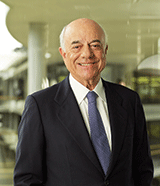
Francisco González, executive chairman of BBVA |
The digital transformation began nine years ago. As a former computer programmer, González quickly recognized the potential for technology to disrupt the banking industry. He began by making sure that BBVA had state-of-the-art systems in place – González is known to describe many banks’ IT systems as like a tangled bowl of spaghetti – and at the same time enfranchising tech and business leaders to bring real change to the institution. But those inside BBVA say 2015 was a key year in the transformation process. A new business organization was implemented under the banner: ‘To bring the age of opportunity to everyone’. This new drive builds from some already impressive numbers. In 2006 BBVA processed 90 million transactions a day. That jumped to over 500 million in 2015 and González expects the bank to be able to manage 1 billion real-time transactions a day in 2017. By the end of 2015 in Mexico, BBVA was selling almost 30% of new consumer credits through digital channels, compared with just 2.4% at the start of that year.
González has not been afraid to look beyond organic growth; over the past 12 months BBVA bought stakes in online banks in the UK and Finland. It also invests in disruptive startups.
González’s successes are not confined to technology. He has built a diversified global business, with a particularly strong presence in high-growth markets such as Mexico, through Bancomer; and Turkey, through its recent consolidation of Garanti Bank. BBVA also remains a leader in the competitive Spanish markets.
González is not only a leader in technology. At the G20 meetings in Turkey last year, it was BBVA’s chairman who led a working group on the financial markets that presented to political leaders on the issue of bank regulation. His conclusions: take a pause to reflect on how regulation is impacting economies and ensure greater coordination between countries.
González still sees technology as the core answer to the industry’s earnings woes. Yes, technology is there for customers, but it is also there to improve returns on capital to shareholders. And if banks do not do that, as González says: “Banks that are not prepared for new competitors face certain death.”