|
|
“If people start to associate all types of daily transactions with Google, Apple or Alibaba or Alipay or whatever instead of banks, you run the risk of becoming a background player” |
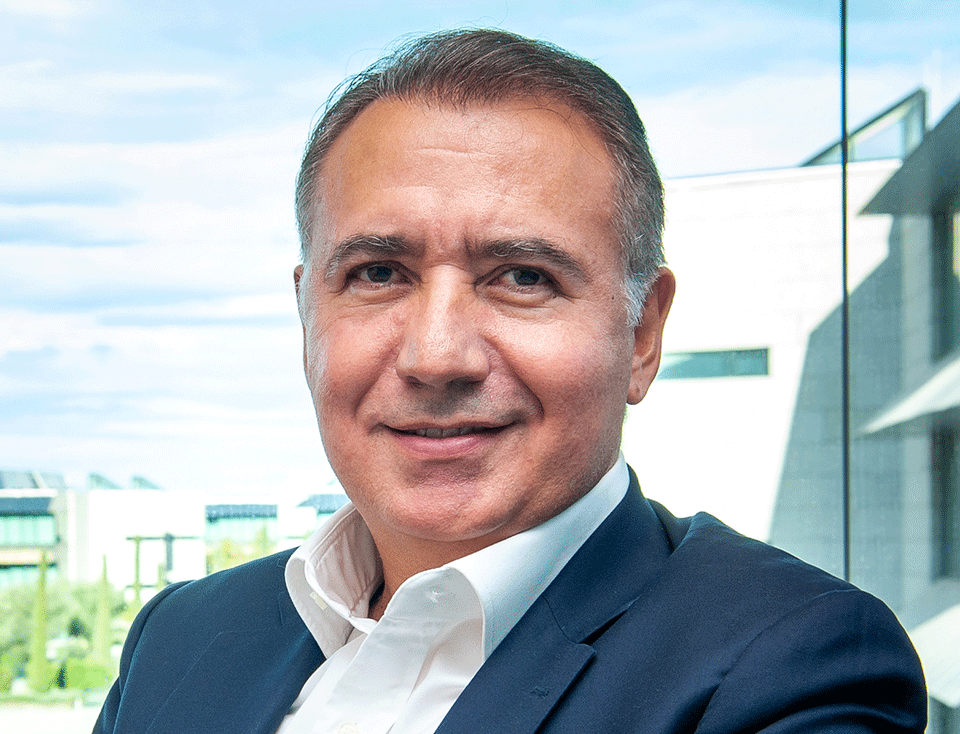
A conversation with Dr Tom Dahlström of Finland’s OP Group, the ubiquitous financial services firm, is like having one’s own TED talk about banking.
Firstly there’s his ‘doctor’ thing. Not many banking executives can claim to be one – Dahlström’s doctorate is for economics, which he got in Helsinki after post-graduate studies at London’s LSE.
Then there’s his title: chief strategy officer. Such deal-spotting jobs are increasingly commonplace at banks but, after 15 years at the decidedly Nordic OP Group, Dahlström functions more as an in-house boffin, with a mandate to research, think and divine trends as to where and how OP can extend its reach.
Then, his reading list. Notably: ‘The art of cryptocurrency – How Bitcoin and digital money are challenging the global economic order,’ which he describes as “an inspirational account of an emerging technology that has the potential to fundamentally alter the very foundations of the global financial system.
“There are progressive thinkers in this industry,” says Dahlström, “but it’s usually difficult to come across them. The number of questions is growing faster than the number of answers.”
Indeed, to the academic Dahlström, banking seems rather less the mundane matter of managing and making money than it is a global laboratory to map out his vision for OP.
And Dahlström’s thoughtful take on the industry is stark; the traditional banking model needs to be, well, destroyed.
“In my opinion, the time for buying traditional banks and their networks is approaching its end,” Dahlström says. “They need to be blown up basically.”
It’s a view that’s all the more intriguing given that the OP Group, the corporate umbrella for some 180 cooperative banks of 450 branches, with their obligation of ‘sharing the fruits of success with everyone,’ has done rather well doing traditional banking in conservative Finland, where it dominates.
In 2015 the OP Group posted record pre-tax profits of €627 million, 30% up on 2014. It was recently ranked by Bloomberg Markets as Europe’s strongest financial institution, and the eighth strongest in the world.
The rural-based OP Group boasts 1.4 million customer-owners, which is about half the banking-age population of Finland. OP also has 650,000 wealth management clients, with €100 billion in deposits. With a 34% market share in loans and 36% in deposits, as well as dominant positions in insurance and health services. Group treasury head Elina Ronkanen-Minogue boasts that almost 90% of Finnish households are connected in some way to an OP product.
In a post-crisis Europe burdened by struggling banks, OP would seem poised to exploit banking opportunities beyond Finland.
“I would not use my money to buy a traditional bank,” Dahlström tells Euromoney. “Of course, if you get an amazingly good price, then why not look at it? But even in terms of price, banking assets have become overvalued at the moment.
“We get approached by sellers, by investment bankers putting deals all the time, at the moment in central and eastern Europe in particular, with the restructuring going on there. But it’s not our preferred mode of operating.”
That’s because he sees OP’s competitive future not solely as jostling with the Scandinavian Nordeas and Danske Banks in Finland’s narrow financial space of just 5.5 million people. Dahlström is watching the Apples, Googles, Alibabas and for some Uber-esque, as-yet-unlaunched app that will capture the euros of tech-sophisticated Finns with their near-200Mbps internet speeds, among the world’s fastest.
Disruption
“I don’t think the industry has realised what type of disruption we are looking at in the future,” Dahlström says. “There’s digital, the new types of business models, tech companies are getting into the banking sector as well, Apple and Alibaba extending their value chains… who build their business on the data generated.
“That will force the banking industry itself to change; and not all the current players in the market will have the capacity to do that,” he adds.
“They are sitting on top of old IT legacy systems going back to the 1970s and 1980s that basically cannot be altered. And they are sitting on top of huge branch networks. So if you buy one of those players, you’ll spend the first five years doing all the nasty things.”
Traditional banks, he says, will not be able “to take the hits from all directions. You are bound to lose, you have to come up with new avenues, you have to rethink your business model, do some of the things that the new entrants, these disrupters, are doing before they do it to you. And do it without disrupting your own business at the same time.”
He sees electronic payments, a banking staple, as the most vulnerable to plunder by non-bank upstarts. “It’s really important for the banks to remain relevant, because if you lose payments, you lose a big chunk of your customer relationship, the daily experience.
“If people start to associate all types of daily transactions with Google, Apple or Alibaba or Alipay or whatever instead of banks, you run the risk of becoming a background player.”
Regardless of size, Dahlström says that to compete against disrupters, traditional banks have to develop “globally good business models, globally good digital services” even for local banking.
“You do have to be involved in the everyday realities of people, you have to provide solutions that are relevant for them. The challenge is to build scalable digital business models. You have to build those anyway to protect yourself against the new entrants,” he says.
He cites the “revolutionary” taxi app, Uber. “It’s not just the taxi service, there is a whole stack of things that they’ve built there. We have to continually think of what can we do to help customers manage their finances better, enhance their feeling of security and well-being.”
The humble credit card is a start, he says. It’s “a dead product” unless it fits into something that interfaces with another product, like an e-wallet. “That provides you with information about the transaction and helps you manage your economy and helps you make purchases in an easy way.
“Then you energise the credit card and you’ve made it into something else,” like applying it to small business.
“We are more and more thinking what are the major needs of SMEs? What are the problems they face? And can we be a benefit, perhaps building platforms to negotiate contracts, links to other companies, negotiating the labour market more efficiently?” Dahlström asks.
“So we’re talking about various digital platforms that banks and financial services companies can use to build ecosystems. I hope that in a strategic review process in 2016 we will open our eyes and our minds a little bit more towards the opportunities that we have.”
Innovation
Dahlström says he’s not looking for “anything completely transforming. I think it would be unrealistic to think that OP would turn into, you know, an Apple or a Google or completely reinvent itself or become a global powerhouse in banking because, let’s face it, scale does matter, even when you are talking about digital businesses.
“But we can certainly take deliberate steps and even quite low-risk steps that would also benefit our customer-owners. There are some areas, where we are already quite progressive and we are investing, and it doesn’t always take €100 million or €300 million to develop an excellent capability in some area. Finland is a very good base for engineering, there’s a lot of tech savvy people here.”
Scandinavia generally, and Finland in particular, has been an early adopter of banking innovation. The region was one of the first to adopt interbank transfers in place of cheques. Later, the region was an early proponent of online banking. As conservative as a Finn can be, Dahlström says there is a readiness to accept new thinking.
And working for a community-minded cooperative like OP allows him a little more latitude.
“When you are not a listed entity, you can think about things a little more in the longer term,” he says. “We have projects that we know are going to benefit society but will not necessarily pay us back in the next quarter or the one after that.”
He cites OP’s 2013 move into health services, which he chartered, as an example.
“Of course it’s a business and it has to pay back its costs, but core to our discussion at the time as to whether we should go into it or not was whether we thought we could improve the health sector in Finland,” Dahlström says.
“We didn’t just want to become player number X,” he says. “We thought there were problems that needed to be solved, and we would only make the investment decision if we could come up with a business and operational model that improves the health system, for the sake of the nation.
“It only makes minor profits… but it was really about wanting to transform health services.
“Less and less do we define ourselves as a financial service provider, though of course it is our core competence,” Dahlström says. “But I don’t think we’ll be doing many moves into established sectors of the economy. I don’t think we will become an electricity provider or utility or a telco or a huge online retailer.”
Finland’s cooperative banks were hit to a degree by a banking crisis in the 1990s, but the impact was limited compared with other private-sector banks because, Dahlström says, of this inherent distrust of risk “that taught us more about the importance of risk management.”
More recently, Finland has absorbed the eclipse of Nokia, which at its sustained growth peak accounted for a full annual percentage point of GDP growth through the 1990s and 2000s, according to Dahlström.
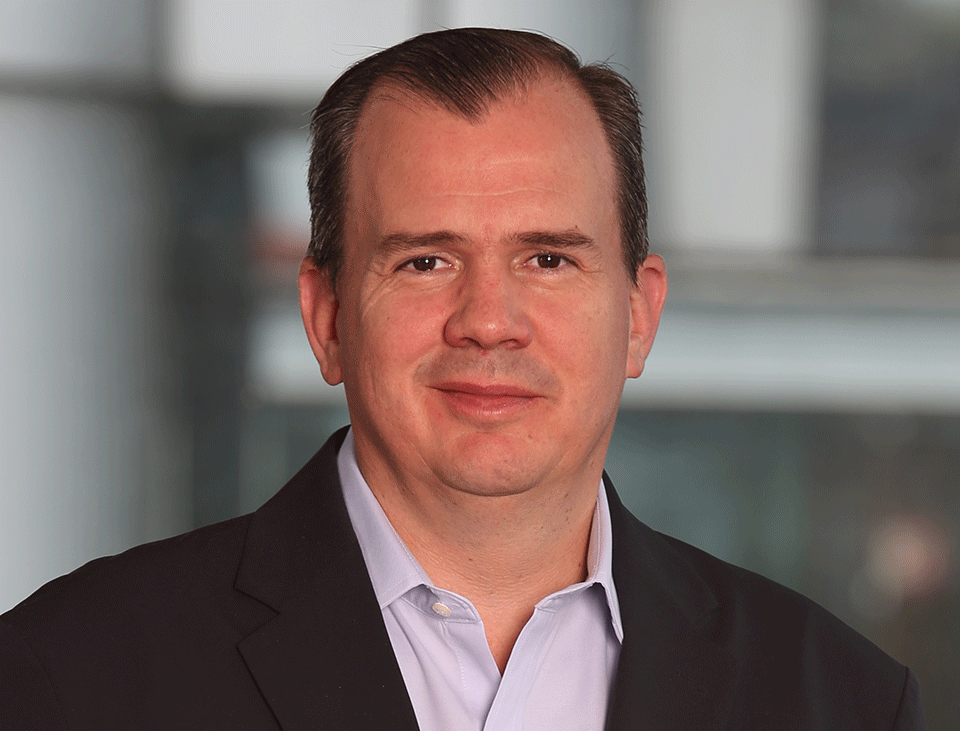
At one point, Finland boasted 15,000-20,000 ‘option millionaires’ minted by the Nokia boom. Banks and investment houses employed specialists whose sole function was to service that community. Says Karri Alameri, executive vice-president of wealth management and a member of OP’s executive board, Nokia’s demise was more psychological than actual. “Our numbers held up, but our clients became more risk-averse. Our inflows have increased during this time.”
Alameri says the recent post-Crimea nervousness over Russian intentions toward its neighbours – EU member Finland shares a common history, a long border and a pragmatic relationship with its giant eastern neighbour – has worried some, but that nervousness has not weighed too heavily on sentiment.
Dahlström ascribes Finland’s community-minded corporate sector – as well as OP, cooperatives dominate Finnish retail, its food industry, the automotive industry, insurance and other services – to a powerful national agenda, derived in part from its independence from Russia in 1917 and a sense of distinction and separation from neighbouring Scandinavia and Europe.
He says: “We realised that we had to rise up, particularly in the capital-poor rural areas that were unbanked, and there was no way of financing that in the traditional banking system then, so you pitched in and we created these local cooperatives, pooling resources and risk too. And this worked.”
The structure has its advantages – OP dominates its home market – but has clear disadvantages in that initiatives to expand elsewhere, such as abroad at a time when opportunity beckons, can be overlooked.
But it’s a model that has also survived Finland’s entry to the EU and the eurozone. As anywhere, Finland has had its financial blowouts but never on the devastating scale that recently overwhelmed economies like Spain, whose caja system was based on community cooperatives until it was let off the leash. Unlike the cajas, there is a decided lack of politics across Finnish cooperatives. Local politicians are forbidden from being involved in the management or decision making of the community financiers gathered under the OP umbrella.
“One of the reasons, which was a strength in the past but not necessarily in the future,” says Dahlström, “is that our cooperative banks have been quite conservative, they haven’t been prone to taking a lot of risks, they felt responsible to the local communities, their stakeholders, because if you mess up things, you mess up things in your local community.
“In the beginning, the people involved in these cooperatives had a personal liability as well,” he notes. “That doesn’t exist anymore, but the culture of being quite cautious has always been there.”
He says it also helped that investment banking doesn’t have the same weight at OP as at other banks elsewhere in Europe and the US. “When the global banking crisis of 2007/08 arrived, we were pretty well off and well capitalised,” he says.
Dahlström says there is a “being Finnish” element that is inherent at OP, which he describes as “renewal”. He says that is what gets staffers coming into work.
“It’s not a civil servant-type role. It’s kind of our mission that we have to do well in our financial role in order to enhance the greater good.”