Best bank transformation:
Lloyds Banking Group
|
|
Also shortlisted: |
Transformation comes in different guises. Spain’s CaixaBank saw an opportunity to become a clear national leader from the wreckage of the country’s savings bank system. It is rightly awarded this year’s title as best bank in Spain.
In 2012/13, RBC Caribbean faced a perfect storm of downgrades in the majority of countries in which it operated, and its business was in disarray. A programme to overhaul its entire business model in the Caribbean saved a 100-year franchise. That story will be told in detail in the August issue of Euromoney.
The speed, scale and context of Bank of Cyprus’s transformation make its recovery story unique. That stunning turnaround is recognised through our banker of the year award, which goes to Bank of Cyprus CEO John Hourican.
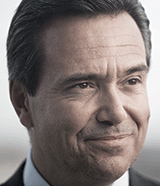
In 2013, Euromoney named António Horta-Osório, chief executive of Lloyds Banking Group, banker of the year. That award reflected how, since becoming CEO in 2011, he had taken the bank from one whose existence was in doubt to one that at least had a chance of a successful future.
This year’s award for best bank transformation recognises that Lloyds now appears not just to have a brighter future than most of its shareholders, not least the UK government, may have expected – it is performing rather well in the present day too.

|
|
The successful completion of our three-year strategy in 2014 has transformed the group
António Horta-Osório, |
As Lloyds chairman Norman Blackwell says: “Last year saw the successful completion of the strategic plan set out in 2011. Under António’s leadership, the group has been strengthened, simplified and reshaped so that it is focused on serving our UK customers. As a result, we are now a simple, low-risk and highly efficient UK focused retail and commercial bank.”
Remember that Horta-Osório said, when launching Lloyds’ new strategy in 2011, it would be up to a five-year process to restore the bank to profitability and return taxpayers’ money. Lloyds’ situation at the time was parlous. In 2011, it reported a statutory loss (before tax) of £3.5 billion, and had not paid a dividend in three years. Three years later, the strategy had been delivered and Lloyds embarked on a new three-year strategic update.
In 2014, underlying profit increased by 26% to £7.8 billion; statutory profit increased by 325% to £1.8 billion, despite a further £2.2 billion provision for PPI, demonstrating that the group is able to deal with legacy issues from a position of strength. Net interest income increased by 8%, driven by the net interest margin rising 33 basis points to 2.45%.
“The successful completion of our three-year strategy in 2014 has transformed the group,” says Horta-Osório. “This is reflected in the significantly improved underlying profitability and capital position. It has also enabled the bank, for the first time in six years, to pay a dividend to shareholders, and has facilitated the further return of money to the taxpayer.”
In the first quarter of 2015, the good news continued: underlying profit increased by 21% year on year.
Those numbers are attractive, but they have been achieved at the same time as Lloyds has built a strong balance sheet, a market-leading capital position, a sustainable funding profile and a cost-to-income ratio well below 50%.
Lloyds also managed to IPO and then sell its remaining stake in TSB to Spain’s Sabadell at a much higher price than the market expected; the UK government’s stake should all be sold within the next 12 months; and a progressive dividend policy is likely to help drive the share price – already one of the best performing financial stocks globally of the past three years – to new heights.
Digital offering
What next for Lloyds? The new strategy seeks to build a better digital offering through £1 billion of investment. But at its heart, Lloyds wants to continue its path to be simpler and more efficient, and hence maintain its cost leadership position.
“We recognise we have more to do,” says Horta-Osório. “We have made a strong start to the next phase of our strategy, in which we will continue to support the UK economy by remaining focused on our customers, embrace the digital age throughout the whole group, and deliver strong and sustainable returns for our shareholders.”
Perhaps the greatest praise for Lloyds comes from its peers. It has shown that seeking national champion status can be a very profitable strategy. To some extent, Lloyds looked to Wells Fargo – one of the world’s most successful banks, with more than 90% of its business in its home market of the US – as its inspiration. Now, banks in Europe and beyond are using Lloyds as an example to follow.