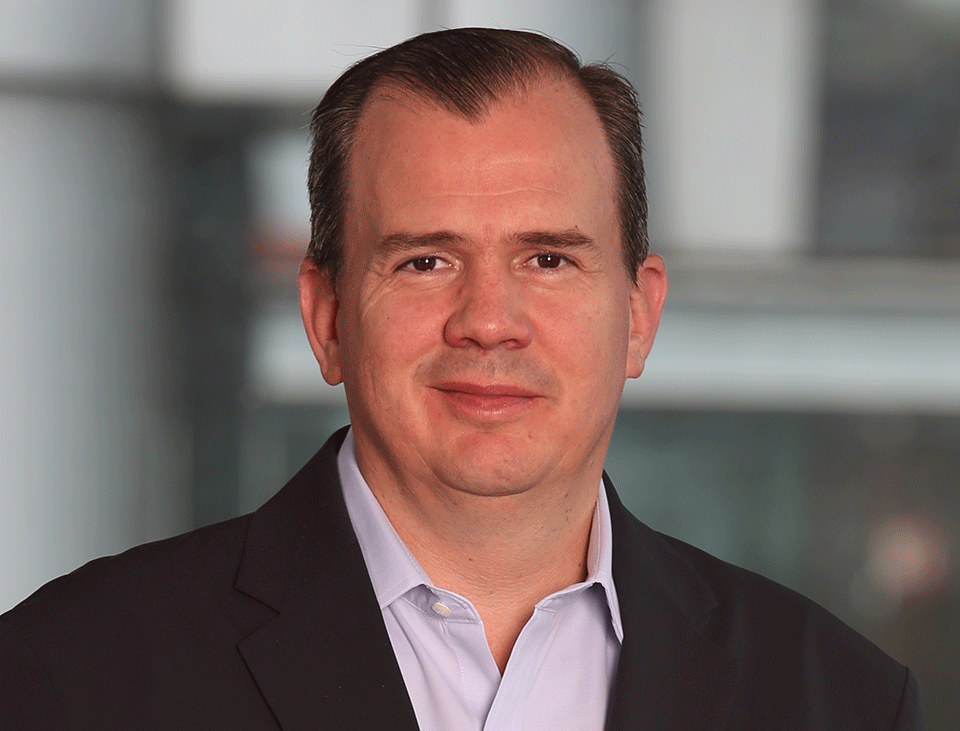
Cristofani prepares Santander Río for better times

It is the biggest and the best bank in a troubled market. The bank almost got an IPO away in 2011 before Argentina’s economy turned. The market hasn’t improved since then. But rather than sit and wait it out, the bank is investing heavily to be in the best possible shape when – if – the political and economic outlook improves.

by Rob Dwyer

EnriqueLarge1-300px-01


Enrique Cristofani

Santander Río

  View more CEOs


Today, when CEOs of banks meet anywhere in the world, the topic of conversation must surely turn swiftly to regulation. Swathes of new regulations are piling onto financial institutions: usually onerous, often conflicting and almost always constricting profitability. 

Yet Enrique Cristofani, president of Santander Río since its formation in 1997, could be forgiven for having a wry smile while listening to his contemporaries’ exasperations. 

For while he could never be got to admit it (the political risk being too high), he must at times think: ‘Try running a bank in a country that mandates banks to lend while capping fees and interest rates and setting floors on deposit rates. Try working with a central bank that changes the rules on dividend payments and capital ratios just to prevent the payment of around $20 million to foreign shareholders. Try working in a banking system without free access to dollars and with an artificial exchange rate. Try to make money from a consumer bank when your customers are facing yet another year of stagnation and your corporate clients have long since stopped investing.’

Welcome to Argentina. The economy hasn’t grown since 2011 and inflation is currently hailed to be under control because it has fallen to about 28% from 40% last year (these are private-sector estimates – the official statistics are usually disregarded). 

Facing a run on foreign reserves, the government and the central bank have increased their already highly interventionist financial model. 

Unable to increase revenues at the pace of costs, profitability has been suppressed so far that losses are now being reported throughout the banking system. 

Maria Valeria Azconegui, banking analyst at Moody’s in Buenos Aries, notes: “Lenders will have a difficult time passing on higher costs to customers in an environment of intense competition and weak economic activity. Consequently, salary adjustments are increasingly weighing on their efficiency metrics. In addition, government mandates that require banks to offer credit to borrowers and small and medium-sized enterprises at below market rates, coupled with new limits on raising bank fees, will constrain their ability to generate real profits.”

Santander Río is the biggest bank in the country. Its hard won position – it has increased its market share from 6% to nearly 9.5% in the last 10 years – gives it competitive advantages that it is relying on to remain profitable. The bank has a 9.5% share in deposits – 62% of which are sight deposits – which provide the cheapest source of funding in the system. 

The bank also has an important payroll accounts base, which not only provides a large client base and cross-selling opportunities but keeps non-performing loans low: the bank’s NPL ratio is about 1%, compared with a 2% system average, and its coverage ratio is 160% compared with a system average of 140%.

The CRM system has helped us learn how to cross-sell – we are the first bank in Argentina to really know our clients and therefore what to sell them according to their behaviour


Enrique Cristofani, Santander Río


NPLs are low anyway because high inflation reduces debt in real terms, but Moody’s Azconegui still thinks delinquencies could become an issue: “This increase has already begun in the consumer loan segment, which may be a leading indicator of generally weaker asset quality in 2015.”

However, Santander Río isn’t immune to the impact of regulation. Cristofani says that the bank’s average interest rate is between 25% and 26% – including mandated segments in the portfolio capped at 19% – which is below the rate of inflation. This inevitably places challenges on profitability, especially when the bank has to apply to the central bank to increase fees. 

Twofold approach

The bank’s approach is broadly twofold: first, to maximize its share of wallet, with the focus for retail banking on the low-risk, high-income segment. To this end, the bank introduced a client relationship management system two years ago. Cristofani says it has been effective.

“We sell new clients a package,” he says. “We sell a credit card, a debit card and a checking account and, hopefully, an insurance product. So that means when you start the relationship you capture the transactional business from day one. The CRM system has helped us learn how to cross-sell – we are the first bank in Argentina to really know our clients and therefore what to sell them according to their behaviour.”

Azconegui says the economic slowdown in the country could lead many banks to shrink their lending portfolios in real terms in the coming year. However, Cristofani believes “loans will grow at a similar rate to inflation – in real terms we will keep the lending portfolio at the same amount.”

Politics being what it is in Argentina – there is a presidential election in October and a potential run-off in November – Cristofani picks his words carefully when responding to questions about the central bank and regulation. No bank wants to attract the attention of the authorities, particularly Santander Río: there were rumours a couple of years ago that the central bank was considering implementing a market share cap of 8%. Santander Río would have just fallen foul of this level. However, Cristofani clearly has pride in his organization’s ability to overcome the last three years of regulatory burden to keep earnings growth in line with inflation. 

Enrique Cristofani-600px-01

Cristofani says Santander’s strategy during this time has been to focus on efficiency. “Efficiency is very important. In the last couple of years we have been approaching our customers through a multichannel distribution network. Around 50% of our clients now interact with the bank through the internet, and now we are trying to increase interaction through mobile telephone platforms.” 

This focus on technology has required investment: for example the bank’s new ATMs cost $40,000 each, compared with $18,500 for the previous model, but the enhanced functionality reduces the burden on un-automated processes. In the last four years the bank has invested $127 million each year in technology.

The investment is paying off: over the last 10 years the bank has reduced the percentage of operations dealt with in-branch to 2% from 9%. The number of operations handled by call centres has also fallen, from 12% to 2%. Meanwhile internet and mobile now accounts for 80% of all operations (up from 29%). Including ATMs, the automated share of operations is 96%.

“Net income in the last couple of years has been increasing close to inflation, but at the same time we have been investing heavily in modernizing and opening new branches – equivalent to between 10% and 15% of net income,” says Cristofani, who adds that since 2010 Santander Río has benefited “hugely” from the development of an internal group called Banco Commercial to share best practices throughout the regions in which the bank operates.

This investment – approved by shareholders in a three-year plan to 2017 – was probably a straightforward decision after the central bank’s rule to increase capital limits for banks before they could make dividend payments after Santander paid $29 million to shareholders in 2013. The government’s response raised eyebrows in a country well accustomed to rule-changes. 

“At the time it led to some serious concerns because it made the government look either petty for responding to such a modest dividend payout amount – or else desperate for dollars,” says a senior manager at another bank in Buenos Aires. 

Guillermo Glasttstein, Santander Río’s manager of strategic planning, outlines the latest capital regulations to which the bank must comply: “We have an 8% capital base over loans and fixed assets, and then we have an operational-risk component that is based on the bank’s average revenue over the past five years – in our case between 2.5 and 3 percentage points. Then you have market-risk component – about 50 basis points depending on volatility – which together makes an 11% capital ratio just to operate.”

There is a very positive view of Argentina if you look at the big picture – we have much more potential than downside. Although clearly you do still have downside


Enrique Cristofani


However, it doesn’t end there. Santander Río also attracts a 1pp charge for being a foreign bank with systemic risk. And then on top of that the bank now needs 75% more capital than the basic just to pay dividends – so in total, in order to pay dividends, the bank would need to have a capital ratio of about 18% – a high threshold. 

Despite this, the bank is almost able to pay dividends, but the chances are the government would then regulate higher in response – the previous limit of 35% excess capital was raised to 75% immediately after Santander Río’s last dividend. Many banks in Argentina – including Santander Río – are therefore opting to invest in new corporate offices and wait for regulatory change.

However, Santander Río’s focus on efficiency amid a complicated operating environment has the benefit of being a cogent strategy anyway. While many CEOs of Argentine banks reportedly scrutinize the regulations for small loopholes in a bid to book some profits, Cristofani has employed a strategic rather than tactical approach to growth. 

Organic growth

So far, since the acquisition of Banco Río it has been purely organic growth. The bank has gone from 150 branches to nearly 400. The number of employees has doubled to 7,250. The number of clients has grown from 900,000 to 2.5 million.

There seems to be plenty of room. Cristofani says: “Argentina’s financial system has a loans-to-GDP ratio of 15% and deposits-to-GDP of 18%. If you compare that to the rest of Latin America, that’s low: about 42% for loans and 39% for deposits, so we are talking about an economy that has very low debt both in terms of individuals and companies.” 

Those low ratios also reflect the low rate of banking penetration in the country: many of the population don’t have access to credit from within the regulated banking system. But Cristofani is cautious about the bank moving away from its core consumer lending strategy that focuses on the safest credits. 

The bank has opened three outreach branches in the poorest parts of the country but, laudable as these efforts are (Cristofani marvels that the latest of this branch openings saw the first ATM in a neighbourhood with 200,000 residents), the response to a question about opportunities in the riskier retail segment is firm and clear: “We focus on the high-income segment.” 

A cynical observer may even think that the outreach initiative, which Cristofani explains as “part of our responsibility as a leading bank”, is little more than a sop to a populist central bank.

As well as being a low-debt financial system, Argentina is a fragmented one: the top five private banks have a combined market share of 26% – very low in regional terms. The opportunities for consolidation are obvious, but without a clear view on the economy in the next couple of years – the presidential election will likely be decisive about the economic outlook for the country – buyers and sellers have little certainty upon which to transact. 

Further reading

Argentine peso-160x186

Latin America:
Investors circle Argentina

Also central bank authorization for bank acquisitions is very rare – the case of ICBC’s acquisition of Standard Bank is a notable exception – and not a surprising one given that Chinese loans to the Argentine government have been critical in shoring up the country’s foreign-exchange reserves. Also, the likely depreciation following the election – regardless of who wins – means that any banks with foreign investors will not want to sanction acquisitions at the current exchange rate. 

Finally, Santander’s leading position makes it vulnerable to regulation limits by market share, and so acquisitive growth may offer theoretical attractions but is off the table for now. 

Also off the table is the bank’s long-proposed IPO. 

Santander Río filed for an equity sale in 2011 just before the economy soured. Cristofani won’t be drawn on when the IPO plan will be dusted off, but clearly the economy and the regulatory environment need to improve. 

Asked what conditions would need to be met before shareholders would re-consider an IPO, he says: “I would say more freedom in the dollar market. And more freedom in the economy in general, and that would be reflected in a higher market capitalization.”

Gearing up for change

Santander Río is clearly gearing up for change. Most of the business community is desperate for Mauricio Macri to win the presidency later this year. 

Cristofani’s own observation is diplomatic: “We have different scenarios,” he says in response to what he thinks will be the macroeconomic environment facing the bank next year. “All we know for sure is that we have to work very hard in terms of efficiencies – that’s the key, and that won’t change regardless of the economic and political scenario.”

Nevertheless, the bank is clearly preparing for change. When discussing the bank’s approach to its corporate business, he says: “We want to know their investment plans. They are not investing right now, but we have been visiting companies in the last 12 months to understand what their plans are and how we could finance those investments.”

Those investments could be considerable, given economic liberalization. 

“In Argentina the risk/reward trade-off is asymmetric,” says Cristofani. “We are very optimistic about the macroeconomic potential in the long-term. We have very good opportunities in the agricultural sector, the energy sector and mining.”

A financial analyst puts it in starker terms: “There is no rule of law in Argentina. I was present at a World Bank meeting and there were questions about why public-private partnership investment is so low. The answer is you have to be stupid or naïve to invest in Argentina when the government can change the rules of the game whenever it wants. So no domestic company or international company is going to invest unless there is a credible change in government – and at the moment that only looks like coming from Macri.”

There is little doubt that the coming election will be a fork in the road for the Argentine economy. One path points to financial normalization; the opportunities for Santander Río, as the system’s largest bank, would be important. 

Cristofani notes that the country’s funding needs are huge if the right conditions are created to incentivize flows from abroad. 

“There is a very positive view of Argentina if you look at the big picture – we have much more potential than downside,” he observes dryly. “Although clearly you do still have downside.”