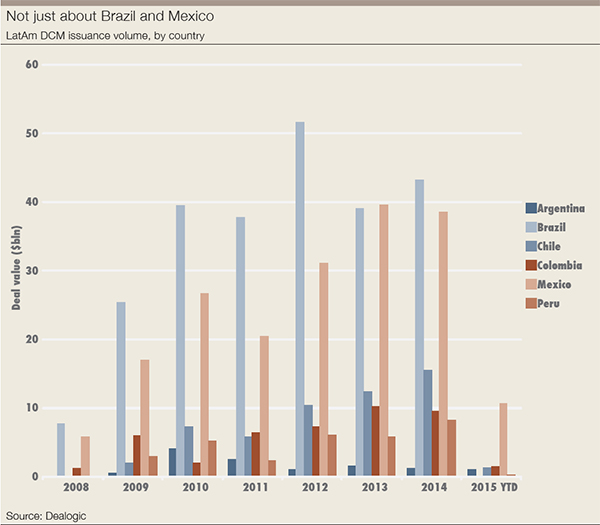
Last year investors feasted on Latin American credits in the international markets. A record volume of $185.2 billion was issued, beating the previous year’s record by 9%. The average deal size also set a new record, up 23% to $453 million. That was all seemingly great news for companies, bankers and investors, but there was a sting in the tail: fourth quarter issuance fell to $30.4 billion – the lowest quarterly volume since the second quarter of 2012.
And it has got worse in 2015. By late February, the first quarter (usually the strongest for issuance) had produced just $15.8 billion worth of volume from 12 deals. By comparison, in the first quarter of 2014, 48 issuers raised a total of $43.6 billion, according to Dealogic data.

|
The main reason for the slowdown is the fallout from the Petrobras saga. The oil company’s inability to publish audited financial results has led to a huge spike in premium for Brazilian credits that, to date, no other company has wanted, or needed, to pay. Other countries have been taking advantage – Mexico’s government opened the markets in January and was followed by quasi-sovereign Pemex. Argentina has already printed two transactions (the same number as in all of 2014), with the issue from the City of Buenos Aires clearly demonstrating the continuing liquidity for Latin American credit. It was four times oversubscribed, despite carrying a rating of Caa2/CCC- and coming to market in an election year.
Energy company YPF’s deal was also interesting, in that it generated large demand but showed the greater importance of establishing a decent benchmark rather than capturing size. Bankers close to the deal reported that YPF could easily have sold more than the $500 million it printed but it preferred to close with a tighter price.
The transparency of international issuance makes it the preferred asset class for judging investor appetite for the region. But it doesn’t tell the whole story. International investors have increasingly been participating in local currency transactions – some through offshore global local currency transactions, some through synthetic structures such as global depositary notes (GDNs), but also as buyers of local currency debt in local markets.
That trend has been developing for a while and is, in some markets, being encouraged to add competition to concentrated local markets’ buysides, with the aim of producing better pricing levels for local corporates and governments.
Mexico is leading the way. Its sovereign deals have been Euroclearable for years but it has just opened up this international investor-friendly feature to corporate issuance in the local market. In February, Pemex became the first corporate (it is classed as such) to issue a Euroclearable tranche, which incorporated other international investor-friendly features such as gross-up withholding taxes (essentially paying the international investors’ taxes).
Again in Mexico, AMX – a true corporate – has pioneered a Global MXN bond which links international and local investors in a completely homogenous structure – denominated in local currencies. Both deals ticked many of the international boxes: scale, liquidity and issued in a fully-convertible currency. These innovations crucially built on the growing international interest in local market deals as investors – starved in yield in the developed markets – looked for EM sovereign returns. International investors now hold more than 40% of local sovereign debt and as they became comfortable with the local currency risk it led many to hunt for yield pick-up, and a quasi-sovereign oil company and one of the world’s largest and strongest Telcos were natural targets for added local currency risk.
Critical question
However, the critical question for the development of Mexico – and other Latin American local debt markets, which have all, albeit to a lesser extent, seen an increase participation of foreign holdings of local sovereign debt, is whether international investors will want to extend into private credit markets. In essence, will these investors start to mix currency risk with credit risk?
“In our dialogue with investors, their response to this question is that they can only deal with one of the variables at a time,” says Carlos Corona, director of global finance, Latin America at Barclays. “So if they are taking currency risk then they can’t also be worried about credit risk, and that means they will not look to extend outside the sovereign risk. But on certain occasions, where appetite is so strong for yield and for risk, they have been willing to put that strategy aside and mix local currency and credit risk.”
Appetite rose in the middle of 2014, says Corona, “when we actually received quite a lot of reverse enquiries from real money accounts – big investors – who wanted local currency credit product.”
Dan Vallimarescu, head of Americas DCM, Santander Global Banking and Markets, says the jury is still out on whether the international investors will mix the two local risks.
“There have been differing initiatives in the past couple of years,” he says, emphasizing that a third risk – liquidity – has also been preventing a large increase in international participation in local markets debt. “For example a Mexican company used the GDN process to get investors in and I think this new Euroclearable format is an improvement on the GDN construct, which quite honestly doesn’t provide the necessary liquidity for international investors as it is complicated to unwind.”
He says that although the new Euroclearable corporate structure is an improvement, it is not yet clear whether pure corporates will be able to use it or not. “Initially that deal worked well in terms of the amount of foreign interest that was generated but it remains to be seen whether pure corporates will be able to avail themselves of this structure,” he says.
Chris Gilfond, co-head of debt and equity capital markets origination for Latin America at Citi, defends the GDN product, saying it gives investors access to local bonds with settlement in DTC and/or Euroclear while also providing the government with ability to manage the flows into the local markets. So far, Mexico is alone in having Euroclearability and, whilst many others countries have looked at it (including reportedly Brazil’s finance minister Joaquim Levy, when he was working at the Brazilian Central Bank), adoption is not simple.
“There is an issue of relinquishing a significant degree of control around flows. So when we speak with some countries, their biggest concern with opening up their markets is the potential upward pressure on the currency and the potential for importing volatility from abroad,” says Gilfond. “Perhaps local markets are not the theme of the day in the market, but what happens when their currency is appreciating and you have created this big pipe into Euroclear? It’s attracting all this investment, so that liquidity is rushing into the local market and driving up the FX and there is no valve – you really don’t have a lot of control once it’s established.”
Gilfond adds: “At one point foreigners owned 70% of parts of the long end of the Mexican Mbono curve, which is OK if your economy is large and open like Mexico’s and has other mechanisms to absorb shocks, but to a smaller economy it could be viewed as external vulnerability. The GDN is more scalable, more controllable and a more practical (safe) way for many Latin American governments to issue local currency instruments to international investors.”
|
Local investors are generally happy to support recent Chris Gilfond, Citi |
However, for investors, the volatility of the FX component of local market deals usually makes this a much more important factor than the credit component.
Take, for example, the global Colombian Peso-denominated deal for Findeter (Colombia’s answer to Fannie Mae). It issued $500 million-equivalent when the exchange rate was $1/COP18.93. At the time of writing this article, the exchange rate has slipped to 24.6, a devaluation of nearly 30%, so although the bonds performed well in local currency terms, for investors who mark-to-market in US dollars, the FX more than wiped out the gains on the credit investment.
Bankers note that a four-point price appreciation in credit (as happened with Findeter) is normally a good result, but not when FX knocks off 30. However, it’s an asset class that has paid off well in the past. Before September 2014, being long local currency was a one-way bet for more than five years, as one banker puts it: “If you closed your eyes and picked any day between January 1, 2009 and September 30, 2014 you would have been making money because of the high carry and the appreciating FX. Now it’s more of a question.”
However, many think the recent devaluation in Latin American currencies has now played out and gives opportunities for good returns in the future. “The sharp devaluation in local currencies has stabilized and I think the local currency investors are starting to reload again as they see the recent moves as fully adjusting if not overshooting the fair value,” says Max Volkov, managing director of Latin America debt capital markets at Bank of America Merrill Lynch.
However, Volkov says experience will lead to this ‘reload’ focusing almost exclusively on the sovereign credits. “Foreigners learned in 2008 that what is most important in any market is liquidity – the ability to get out. Size gives you liquidity and by definition that is the government markets and that’s why you are seeing the switch to bigger deals in Peru and Colombia, to attract the international investors. However, it occasionally works the other way and when the markets are under pressure these are the first securities to be sold.”
|
Further reading |

|
Local buyside issues are also frustrating the development of liquidity in local debt markets. Across the region the risk appetite of local institutional investors varies, but it always focuses on investment grade credit. The rapid growth of these institutional investors also means that they are typically buy-and-hold in nature, because there is a scarcity of paper. “Local investors are generally happy to support recent liability management transactions, but they also need some paper back because they need to stay invested,” says Citi’s Gilfond.
This concentration of the buyside is a potential problem for the development of the local markets and Vallimarescu says it’s a problem that regulators across the region are beginning to address. For example, in 2014, Chile scrapped withholding tax on foreign investors’ profits on local bonds in a bid to increase international participation in the local market. “It’s true that these markets haven’t really expanded in terms of size and depth particularly quickly in the last couple of years but they are nonetheless dynamic and viable financing options for higher quality credits,” he says. “Local authorities are also continually trying to find ways to enhance liquidity and the investor base and that is going to be an ongoing effort. The example of Mexico will be looked at by other countries – specifically the development of Euroclearability – as a means to increase foreign investors’ participation and increase local market liquidity. It’s a work in a progress.”