 |
 |
| Results index |
The recovery of the global real estate market from the devastating toll inflicted by the financial crisis is continuing to gather pace, with investment almost back to 2008 levels and growing confidence fuelling increased risk appetite.
However, real estate 2.0 looks different in many ways. Asia Pacific has surged ahead of North America and Europe to consolidate its position as the largest market, accounting for almost 50% of the $1.18 trillion invested globally in 2013, according to commercial real estate firm Cushman & Wakefield. Asia is responsible for around 30% of cross-border capital flows, fuelled by long-term investment from sovereign and institutional funds looking for steady returns.
Global financial regulation has been informed by the explicit aim of preventing a repeat of the over-extension of credit and mispricing of risk that allowed the real estate bubble to inflate. Regulators in fast growing hotspots in Asia and Europe have taken steps to cool the market which, combined with growing anticipation of interest rates beginning to rise, is helping to rein in expectations for price growth.
“Rising demand for UK housing appears to have been capped by the measures regarding the Mortgage Market Review (introduced in April to curb lending) together with the prospect of the Bank England taking action to cool the market, which it has done,” says Stephen Lewis, chief economist at ADM Investor Services.
“It’s looking more sustainable and the latest RICS survey shows price increases are easing off and fewer buyers are coming forward.”
| I don’t think the period of re-regulation is over. As long as you have that uncertainty it will continue to introduce some sort of questions and concerns in terms of the amount of liquidity you have in the market Matt Webster |
The implications of the new landscape for the financing market have been far reaching, with a rise to prominence of alternative lenders, including hedge funds, asset managers, insurers, pension and sovereign funds.
Regulation, tightening of credit standards and the rise of the overseas buyer means cash is king. In the US, for example, cash accounted for around one-third of residential real estate transactions in April, up from 14% in 2008, according to the National Association of Realtors.
Regulation continues to be of primary concern among market participants.
“I don’t think the period of re-regulation is over,’’ says Matt Webster, HSBC’s global head of real estate finance. “As long as you have that uncertainty it will continue to introduce some sort of questions and concerns in terms of the amount of liquidity you have in the market.”
HSBC rose to second from third global bank in Euromoney’s Real Estate Survey 2014. Goldman Sachs was first, joining winners including CBRE as top global advisor and Colliers International, voted top agency.
“It’s important that when cooperating and sharing concepts on a global basis that regulators take into account the different stages in the cycle different markets are at and how they are inter-related,” says HSBC’s Webster.
“It’s the proverbial stepping on a balloon. If you stamp out capital creation in one market you’re simply going to create it somewhere else.”
But in other areas not much has changed. Competition for prime assets in core markets is rising, forcing investors to look to secondary markets in search of keener pricing and to diversify into unconventional assets. At the same time gaps in the supply of finance for longer term and riskier propositions created by the post-crisis flight-to-safety are narrowing. Both equity and debt financing are becoming more widely available and while loan ratios remain conservative, competition and the search for yield is tempting lenders further up the risk curve.
In addition, the ability of leverage to produce a higher return, particularly in a tame interest rate environment, continues to underpin real estate financing, ensuring a modest revival of the fortunes – to varying degrees – of securitization, bank and mezzanine lending, commercial property funds and Real Estate Investment Trusts (Reits).
“We’re back to the levels of global investment we had in 2008, but the big difference is that the average leverage back then was close to 65%, meaning you had a lot of leverage buyers way ahead of 65% all the way to 85% and 90%; but today that average is close to 30%,” says Wenceslao Bunge, global co-head of Credit Suisse’s real estate group.
The fact there is so much more equity going into the sector means lower volatility, he says, which makes Credit Suisse far more comfortable going back into the lending market.
Biggest beneficiaries
US property-owning Reits have been among the biggest beneficiaries of the improving economy amid still low interest rates, offering investors an attractive yield over treasuries or fixed income. Listed Reits rebounded from under-performing the overall equity market in 2013, to a strong outperformance this year.
National Association of Real Estate Investment Trust figures show listed Reits surged 16.25% in the first half of this year with a yield of 3.5%. That compares to the S&P 500’s total return of 7.1% and a dividend yield of 2%. The industry closed deals worth more than $4.3 billion in 2013 ranging from health care real estate and retirement communities to upscale shopping malls, lodging and industrial.
Reits’ restricted ability to accumulate cash reserves to meet this level of activity meant increased used of mortgage financing to fund deals or refinance, providing a much needed lift to a domestic CMBS market barely a quarter its 2007 size. Data from Dealogic shows 2013 CMBS volumes in the US doubled to $102.5 billion, from $53 billion in 2012, accounting for 93% of global issuance, although issuance has slowed sharply again this year.
| Further reading |
| |
|
Real estate survey 2014: Results index |
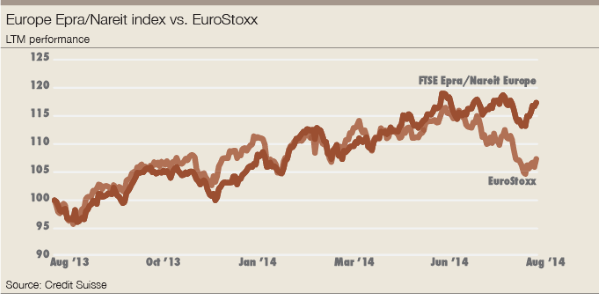
European Reits have also outperformed stocks. Irish Reits and Spanish Socimis have raised more than $3.5 billion to invest in real estate in the past 12 months, and there have been four Spanish real estate investment trust IPOs since January. The Merlin Properties Socimi listing in July raised €1.3 billion, western Europe’s largest real estate IPO, despite falling short on expectations.
Merlin has invested €1 billion of its war chest, acquiring a portfolio of income streams from Tree Inversiones comprising 880 retail branches and five buildings of BBVA – with 25- and 15-year leases respectively. Tree acquired the properties at the height of Spain’s real estate slump in 2009. Merlin has also acquired an office building in Barcelona and a shopping/hotel complex in A Coruña.
The Tree deal has positive liquidity and financing implications for Spanish real estate, with the owners – Ares Management, Europa Capital, Deutsche Bank and Banca March – saying the exit frees them to look for new investment opportunities.
Credit Suisse, which was the sole global coordinator of the Merlin flotation, says the deal demonstrates the market’s appetite for new managers with a proven track-record in those markets that investors feel have bottomed out and where the recovery is on its way.
“There’s a lot of liquidity in the US and there’s a feeling among investors there that there’s more growth in the coming years in Europe than in the US,” says Credit Suisse’s Bunge.
“The US has already recovered and people believe there’s very little upside there so we’ve seen a lot of the very active fund managers look at opportunities in Europe. They started in the UK which recovered very, very fast, they moved to Ireland, which recovered extremely fast and the next frontier was Spain, and to a lesser degree, Portugal,” he says.
“It’s partly that the market has fallen sharply since the crisis but we’ve also seen a significant recovery over the past 12 months that we didn’t think possible.”
| Borrowers may be starting to feel mortgages are becoming too expensive and worry about their ability to repay Stephen Lewis |
Bunge says that strength is reflected in cap rates. Assets such as prime shopping centres that traded north of 7% a year ago today trade below 6%.
“It shows how fast the market is recovering, how much liquidity is there for assets that come to the market,” he says. “People are not only focusing on cap rates but rents, capital values and occupancy which haven’t recovered. They’re still way lower than in 2004 and 2005 and that’s the upside that countries like Spain and Ireland promise.”
Ireland’s Green Reit has raised equity of €685 million since it launched last summer to finance a number of acquisitions, including Dublin’s flagship Central Park project [with Pimco and Kennedy Wilson], where tenants include First Active, Merrill Lynch and Vodafone and a portfolio of office and retail assets from Cosgrove Property for €375 million. Green subsequently announced a funding mandate that could see it finance up to 65% of the portfolio’s value in senior debt.
In the US, the falling yield on 10-year treasuries is impacting the returns from MBS by shortening the life of the bonds, as growing numbers of borrowers prepay their loans, refinancing to take advantage of lower mortgage rates. Prepayment risk is causing large holders of mortgages and MBS – money managers, insurers, commercial banks and hedge funds – to increase their holdings of treasuries to hedge against higher rate loans in the pool being paid off early and having to reinvest the proceeds at lower market rates.
Those treasury purchases are among a number of factors, including hefty dividends paid to the government by Fannie Mae and Freddie Mac, conspiring to suppress benchmark 10-year rates.
Once bitten twice shy
Mortgage credit extension accounts for around a quarter of all lending in the US and includes loans by banks and non-banks – money market/mutual funds, insurers, pension funds – and increasingly securitization of home mortgage loans with MBS.
However, the fallout from the sub-prime mortgage crisis, which has seen private label issuers heavily penalised for selling toxic MBS and left investors once-bitten-twice shy, has allowed Fannie Mae, Freddie Mac and Ginnie Mae to dominate. Sifma data show the three agencies issued $1.64 trillion MBS last year, equivalent to 94% of all mortgages originated in 2013, compared with less than $14 billion of mostly jumbo loan MBS from private issuers. Jumbo MBS comprising loans that exceed the agencies’ $417,000 limit but are of high quality, accounted for just 5% of 2013 jumbo mortgage origination.
This year has seen downside pressure on the residential MBS pipeline as mortgage originations for family homes halved, totalling just $493 billion compared with over $1 trillion in the first half of 2013.
Analysts say 2013 was a spike produced by the release of pent up demand for mortgages and refinancing. With MBS issuance in the first half of 2014 down by more than a quarter on the same period last year, according to Dealogic data, investor dollars are chasing fewer buying opportunities.
ADM’s Lewis says the sharp drop in mortgage originations in Q3, which persisted through the first half of this year, is down to elevated spreads.
“The rise in mortgage rates last year has been progressively passed onto borrowers. Interest rates have since fallen but mortgage rates have not followed and this reflects stronger demand for mortgage credit,” he says. “I think borrowers may be starting to feel mortgages are becoming too expensive and worry about their ability to repay.”
 |
That is feeding through to MBS through fewer loans being available to securitize. The market tightening is reflected in the levelling off of returns on agency MBS, which Bloomberg’s MBS Bond Index shows decreased to just over 1% in the last quarter, still beating the 0.8% returned by investment-grade US corporate bonds. Even so, MBS’ yield-to-maturity is unchanged at 2.57% compared to 2.74% for corporate bonds and 2.03% for treasuries.
MBS issuance in Europe, which peaked at around $800 billion in 2008, continues to flounder, with recovering volume collapsing following the introduction of risk retention rules in 2011. But CMBS has increased its share. Total 2013 volume was $31.8 billion with an RMBS-CMBS split of 80:20, Dealogic data shows. This year to August, the total is $14.2 billion with the share of CMBS falling back to 14%.
The ECB and Bank and England have said any revival of the securitization market depends on transactions being priced in a way that meets the demands of both investors and issuers. Obstacles include temporary factors like the interest rate environment and lingering stigma from the crisis, but also structural impediments such as regulatory treatment of securitization and a lack of asset performance data.
But HSBC’s Webster believes the market will gather momentum, and soon.
“Regulation of US securitization is further down the road than in Europe and the pricing on CMBS deals in particular has been a great alternative to bank financing, but banks may recover market share as their financing and funding costs continue to drop,” he says.
“The CMBS investor base is not there in Europe in the same way and it’s going to take time to develop. The regulatory framework needs developing and there are outstanding questions regarding the price and availability of liquidity to the banking system, and ECB/EBA rules on capital treatment.”
He says a number of lenders are working on bringing deals to market so he expects to see more issuance volume coming out of Europe in the second half.
At the same time, deleveraging in Europe is continuing as banks, non-banks and asset management agencies continue to unwind real estate assets from their balance sheets.
A record €40.9 billion of commercial real estate loan and real-estate owned sales were transacted in the first half, up more than 600% on 2013, with state ‘bad banks’ accounting for almost two-thirds of disposals, according to Cushman & Wakefield.
Three-quarters of these assets were purchased by US private equity, led by Lone Star, Cerberus, and CarVal, with average transaction size almost doubling from 2013 to €621 million.
Cushman & Wakefield estimates the gross exposure of European banks and the EU’s nine bad banks to non-core real estate that needs to be sold or worked out in the next few years to meet Basel capital requirements at €584 billion.
That figure is expected to increase following the ECB/EBA asset quality review and stress tests next month, suggesting opportunities for non-banks and the continuing reshaping of the real estate financing landscape for years to come.



